Compare commits
161 Commits
| Author | SHA1 | Date | |
|---|---|---|---|
 Josh Hunt Josh Hunt
|
b51f687c96 | ||
 github-actions[bot] github-actions[bot]
|
6899b191cb | ||
 github-actions[bot] github-actions[bot]
|
cd9ef5746c | ||
|
github-actions[bot]
|
2393046d43 | ||
|
github-actions[bot]
|
05675bd910 | ||
 Kevin Minehart Kevin Minehart
|
d099770d0b | ||
 Andreas Christou Andreas Christou
|
0c7510b5a9 | ||
 xavi xavi
|
1285f8ca5a | ||
 Isabel Matwawana Isabel Matwawana
|
77bd0082d1 | ||
|
Isabel Matwawana
|
c93e7d7c3f | ||
|
Isabel Matwawana
|
6f778964a7 | ||
|
Isabel Matwawana
|
a1e6fee983 | ||
|
Isabel Matwawana
|
33db458f15 | ||
|
Isabel Matwawana
|
084c4b6ecc | ||
 Mariell Hoversholm Mariell Hoversholm
|
ef39d1ec35 | ||
|
Isabel Matwawana
|
ac5703b7fc | ||
|
Isabel Matwawana
|
52c2214a01 | ||
|
Isabel Matwawana
|
be33ee2f79 | ||
|
Isabel Matwawana
|
290d59ef66 | ||
|
Isabel Matwawana
|
db1dd312e0 | ||
 Misi Misi
|
182fd8388f | ||
|
Misi
|
4d8e491fef | ||
 Denis Vodopianov Denis Vodopianov
|
6e612a368c | ||
|
Isabel Matwawana
|
8856dfda48 | ||
|
github-actions[bot]
|
6649b38240 | ||
|
Isabel Matwawana
|
011256f66d | ||
|
github-actions[bot]
|
f6036260aa | ||
|
Denis Vodopianov
|
046295c54e | ||
|
Denis Vodopianov
|
8ab24bb196 | ||
 Matias Chomicki Matias Chomicki
|
bc41636987 | ||
 Jacob Valdez Jacob Valdez
|
8ff8f658f6 | ||
|
Denis Vodopianov
|
0eade5207c | ||
|
Denis Vodopianov
|
324ee3bc75 | ||
 Matthew Jacobson Matthew Jacobson
|
e824a602e0 | ||
|
Isabel Matwawana
|
e8e617cd85 | ||
 Ieva Ieva
|
3d185ab56c | ||
 Robby Milo Robby Milo
|
2b9a49a63e | ||
 Jack Baldry Jack Baldry
|
019184b710 | ||
 Matheus Macabu Matheus Macabu
|
43fe75f8a7 | ||
|
Isabel Matwawana
|
4986595f6e | ||
|
Matheus Macabu
|
d1354c6c6f | ||
 Jev Forsberg Jev Forsberg
|
a21a78e2e5 | ||
|
Matheus Macabu
|
00b587d44b | ||
 Larissa Wandzura Larissa Wandzura
|
9c4f29409e | ||
 Witek Bedyk Witek Bedyk
|
18103b650f | ||
 Kevin Minehart Kevin Minehart
|
5f52372e57 | ||
|
xavi
|
05e182cd49 | ||
|
Jev Forsberg
|
24b72cc7b3 | ||
|
Matthew Jacobson
|
5e81bb456e | ||
|
Andreas Christou
|
6fb18ecf33 | ||
|
Andreas Christou
|
3065be4a7e | ||
|
Andreas Christou
|
8c525e68da | ||
|
github-actions[bot]
|
696f41a7c2 | ||
|
Kevin Minehart
|
c8f8c81e1c | ||
|
github-actions[bot]
|
13945ba51b | ||
|
Kevin Minehart
|
8229a4c073 | ||
|
Matheus Macabu
|
bf3be6309a | ||
|
Kevin Minehart
|
5c316a5113 | ||
|
Kevin Minehart
|
0c2af5a880 | ||
 Todd Treece Todd Treece
|
a3a4c2565a | ||
|
Misi
|
2451837fb8 | ||
 Dominik Prokop Dominik Prokop
|
27251b44fc | ||
 Oscar Kilhed Oscar Kilhed
|
38ae17fbc3 | ||
 Karl Persson Karl Persson
|
bc6beda11e | ||
|
Misi
|
dff8f508d5 | ||
|
Misi
|
08f66dd50c | ||
|
Kevin Minehart
|
e9f564277f | ||
|
Josh Hunt
|
ef65865de0 | ||
|
Jacob Valdez
|
33cf9d6cd4 | ||
|
Jev Forsberg
|
10b95276ae | ||
|
Jacob Valdez
|
54db7b0992 | ||
 grafana-delivery-bot[bot] grafana-delivery-bot[bot]
|
30e5410f4e | ||
|
Jev Forsberg
|
96c8b4bcdf | ||
|
grafana-delivery-bot[bot]
|
e1cde0f2d9 | ||
 Dan Cech Dan Cech
|
ced52a53ad | ||
 Yuri Tseretyan Yuri Tseretyan
|
47c6551b50 | ||
|
grafana-delivery-bot[bot]
|
c74bb4952e | ||
|
grafana-delivery-bot[bot]
|
6f95b96fe3 | ||
|
grafana-delivery-bot[bot]
|
d9bfaa0efe | ||
 Sergej-Vlasov Sergej-Vlasov
|
d41e17725c | ||
|
github-actions[bot]
|
c7917bf9c8 | ||
|
grafana-delivery-bot[bot]
|
3e2b2f35af | ||
|
grafana-delivery-bot[bot]
|
e215d16299 | ||
|
grafana-delivery-bot[bot]
|
ccb40e3bba | ||
|
Jack Baldry
|
350d9c71ce | ||
|
grafana-delivery-bot[bot]
|
a7ea2a3b73 | ||
|
grafana-delivery-bot[bot]
|
690a223f6b | ||
|
grafana-delivery-bot[bot]
|
8dd4637706 | ||
|
grafana-delivery-bot[bot]
|
0fc69d16e9 | ||
|
grafana-delivery-bot[bot]
|
f433bc770f | ||
|
grafana-delivery-bot[bot]
|
d4331c9d0b | ||
|
grafana-delivery-bot[bot]
|
074a1cf348 | ||
|
grafana-delivery-bot[bot]
|
9aa8526e7d | ||
|
grafana-delivery-bot[bot]
|
122642a6d7 | ||
|
Isabel Matwawana
|
805ab7bd8a | ||
|
Mariell Hoversholm
|
86bb6dd4b1 | ||
|
grafana-delivery-bot[bot]
|
7b5235f06d | ||
|
grafana-delivery-bot[bot]
|
f83e0a8a39 | ||
|
Sergej-Vlasov
|
0c7f575149 | ||
|
grafana-delivery-bot[bot]
|
696d22a3fe | ||
|
grafana-delivery-bot[bot]
|
fc1d9c1719 | ||
|
Larissa Wandzura
|
de310cb88c | ||
|
grafana-delivery-bot[bot]
|
227c8392e0 | ||
|
grafana-delivery-bot[bot]
|
dc2c257c1a | ||
|
grafana-delivery-bot[bot]
|
97517f41cf | ||
|
grafana-delivery-bot[bot]
|
a13443ad11 | ||
|
grafana-delivery-bot[bot]
|
2d06a936c3 | ||
|
grafana-delivery-bot[bot]
|
860a25f7fd | ||
 Ivan Ortega Alba Ivan Ortega Alba
|
ede278c767 | ||
|
grafana-delivery-bot[bot]
|
dab5a49df0 | ||
|
Oscar Kilhed
|
49ea20d027 | ||
|
grafana-delivery-bot[bot]
|
ed927a143c | ||
|
grafana-delivery-bot[bot]
|
4e072ffe50 | ||
 Kim Nylander Kim Nylander
|
07841886b6 | ||
|
grafana-delivery-bot[bot]
|
1547a09645 | ||
|
grafana-delivery-bot[bot]
|
ea930b2a51 | ||
|
grafana-delivery-bot[bot]
|
2c408c8139 | ||
|
grafana-delivery-bot[bot]
|
4a6f5ebe23 | ||
|
grafana-delivery-bot[bot]
|
86c21cee85 | ||
|
grafana-delivery-bot[bot]
|
0573e4d9a9 | ||
|
grafana-delivery-bot[bot]
|
6a08b1cdc2 | ||
|
grafana-delivery-bot[bot]
|
b12cab40d1 | ||
|
grafana-delivery-bot[bot]
|
9b1414e2ef | ||
|
grafana-delivery-bot[bot]
|
96060e359f | ||
|
grafana-delivery-bot[bot]
|
cd060b0791 | ||
 Erik Sundell Erik Sundell
|
f2c2883a0f | ||
 Moustafa Baiou Moustafa Baiou
|
b7fff35a8a | ||
|
grafana-delivery-bot[bot]
|
122c417f8c | ||
|
Isabel Matwawana
|
fb86150321 | ||
|
grafana-delivery-bot[bot]
|
e0dd77c05a | ||
|
Isabel Matwawana
|
a69e5fb0a2 | ||
|
grafana-delivery-bot[bot]
|
e1ba2dd355 | ||
|
grafana-delivery-bot[bot]
|
4c288f39ee | ||
|
grafana-delivery-bot[bot]
|
d9045acddb | ||
 Adam Yeats Adam Yeats
|
c705a3eb36 | ||
|
grafana-delivery-bot[bot]
|
03e84aca2b | ||
|
grafana-delivery-bot[bot]
|
20f9416142 | ||
|
grafana-delivery-bot[bot]
|
7e1f67f9d7 | ||
|
grafana-delivery-bot[bot]
|
66a7e6a60a | ||
|
grafana-delivery-bot[bot]
|
620534891d | ||
 Gilles De Mey Gilles De Mey
|
de338282c1 | ||
|
Mariell Hoversholm
|
72acd7f000 | ||
|
Sergej-Vlasov
|
0e6b320f4d | ||
|
grafana-delivery-bot[bot]
|
bed84aefdf | ||
|
grafana-delivery-bot[bot]
|
cb0f9b4093 | ||
|
grafana-delivery-bot[bot]
|
9bfc35ec25 | ||
|
grafana-delivery-bot[bot]
|
e076682a17 | ||
|
grafana-delivery-bot[bot]
|
01a0baf5c1 | ||
|
Isabel Matwawana
|
8a0b736610 | ||
|
grafana-delivery-bot[bot]
|
006d2b2b72 | ||
|
grafana-delivery-bot[bot]
|
df43a3fff4 | ||
 Pepe Cano Pepe Cano
|
93c507cc8f | ||
|
grafana-delivery-bot[bot]
|
626c15c1a5 | ||
|
grafana-delivery-bot[bot]
|
ac481509c7 | ||
|
grafana-delivery-bot[bot]
|
e4a7eb6b69 | ||
|
grafana-delivery-bot[bot]
|
c9859478ee | ||
|
grafana-delivery-bot[bot]
|
0b732db623 | ||
|
grafana-delivery-bot[bot]
|
88aa744512 | ||
|
github-actions[bot]
|
443dcc026d | ||
 jev forsberg jev forsberg
|
b58701869e | ||
 idastambuk idastambuk
|
b12308499b |
@@ -5679,9 +5679,6 @@ exports[`better eslint`] = {
|
||||
"public/app/plugins/datasource/cloudwatch/components/ConfigEditor/XrayLinkConfig.tsx:5381": [
|
||||
[0, 0, 0, "Styles should be written using objects.", "0"]
|
||||
],
|
||||
"public/app/plugins/datasource/cloudwatch/components/QueryEditor/LogsQueryEditor/LogsQueryEditor.tsx:5381": [
|
||||
[0, 0, 0, "Styles should be written using objects.", "0"]
|
||||
],
|
||||
"public/app/plugins/datasource/cloudwatch/components/QueryEditor/MetricsQueryEditor/DynamicLabelsField.tsx:5381": [
|
||||
[0, 0, 0, "Styles should be written using objects.", "0"]
|
||||
],
|
||||
@@ -7392,14 +7389,6 @@ exports[`no gf-form usage`] = {
|
||||
"public/app/plugins/datasource/cloudwatch/components/ConfigEditor/XrayLinkConfig.tsx:5381": [
|
||||
[0, 0, 0, "gf-form usage has been deprecated. Use a component from @grafana/ui or custom CSS instead.", "5381"]
|
||||
],
|
||||
"public/app/plugins/datasource/cloudwatch/components/QueryEditor/LogsQueryEditor/LogsQueryEditor.tsx:5381": [
|
||||
[0, 0, 0, "gf-form usage has been deprecated. Use a component from @grafana/ui or custom CSS instead.", "5381"]
|
||||
],
|
||||
"public/app/plugins/datasource/cloudwatch/components/QueryEditor/LogsQueryEditor/LogsQueryField.tsx:5381": [
|
||||
[0, 0, 0, "gf-form usage has been deprecated. Use a component from @grafana/ui or custom CSS instead.", "5381"],
|
||||
[0, 0, 0, "gf-form usage has been deprecated. Use a component from @grafana/ui or custom CSS instead.", "5381"],
|
||||
[0, 0, 0, "gf-form usage has been deprecated. Use a component from @grafana/ui or custom CSS instead.", "5381"]
|
||||
],
|
||||
"public/app/plugins/datasource/cloudwatch/components/shared/LogGroups/LegacyLogGroupNamesSelection.tsx:5381": [
|
||||
[0, 0, 0, "gf-form usage has been deprecated. Use a component from @grafana/ui or custom CSS instead.", "5381"],
|
||||
[0, 0, 0, "gf-form usage has been deprecated. Use a component from @grafana/ui or custom CSS instead.", "5381"]
|
||||
|
||||
+3
-3
@@ -35,11 +35,11 @@ $(DRONE): $(BINGO_DIR)/drone.mod
|
||||
@echo "(re)installing $(GOBIN)/drone-v1.5.0"
|
||||
@cd $(BINGO_DIR) && GOWORK=off CGO_ENABLED=0 $(GO) build -mod=mod -modfile=drone.mod -o=$(GOBIN)/drone-v1.5.0 "github.com/drone/drone-cli/drone"
|
||||
|
||||
GOLANGCI_LINT := $(GOBIN)/golangci-lint-v1.62.0
|
||||
GOLANGCI_LINT := $(GOBIN)/golangci-lint-v1.64.2
|
||||
$(GOLANGCI_LINT): $(BINGO_DIR)/golangci-lint.mod
|
||||
@# Install binary/ries using Go 1.14+ build command. This is using bwplotka/bingo-controlled, separate go module with pinned dependencies.
|
||||
@echo "(re)installing $(GOBIN)/golangci-lint-v1.62.0"
|
||||
@cd $(BINGO_DIR) && GOWORK=off $(GO) build -mod=mod -modfile=golangci-lint.mod -o=$(GOBIN)/golangci-lint-v1.62.0 "github.com/golangci/golangci-lint/cmd/golangci-lint"
|
||||
@echo "(re)installing $(GOBIN)/golangci-lint-v1.64.2"
|
||||
@cd $(BINGO_DIR) && GOWORK=off $(GO) build -mod=mod -modfile=golangci-lint.mod -o=$(GOBIN)/golangci-lint-v1.64.2 "github.com/golangci/golangci-lint/cmd/golangci-lint"
|
||||
|
||||
JB := $(GOBIN)/jb-v0.5.1
|
||||
$(JB): $(BINGO_DIR)/jb.mod
|
||||
|
||||
@@ -1,5 +1,5 @@
|
||||
module _ // Auto generated by https://github.com/bwplotka/bingo. DO NOT EDIT
|
||||
|
||||
go 1.23
|
||||
go 1.24.2
|
||||
|
||||
require github.com/golangci/golangci-lint v1.62.0 // cmd/golangci-lint
|
||||
require github.com/golangci/golangci-lint v1.64.2 // cmd/golangci-lint
|
||||
|
||||
@@ -2,6 +2,8 @@
|
||||
4d63.com/gocheckcompilerdirectives v1.2.1/go.mod h1:yjDJSxmDTtIHHCqX0ufRYZDL6vQtMG7tJdKVeWwsqvs=
|
||||
4d63.com/gochecknoglobals v0.2.1 h1:1eiorGsgHOFOuoOiJDy2psSrQbRdIHrlge0IJIkUgDc=
|
||||
4d63.com/gochecknoglobals v0.2.1/go.mod h1:KRE8wtJB3CXCsb1xy421JfTHIIbmT3U5ruxw2Qu8fSU=
|
||||
4d63.com/gochecknoglobals v0.2.2 h1:H1vdnwnMaZdQW/N+NrkT1SZMTBmcwHe9Vq8lJcYYTtU=
|
||||
4d63.com/gochecknoglobals v0.2.2/go.mod h1:lLxwTQjL5eIesRbvnzIP3jZtG140FnTdz+AlMa+ogt0=
|
||||
cloud.google.com/go v0.26.0/go.mod h1:aQUYkXzVsufM+DwF1aE+0xfcU+56JwCaLick0ClmMTw=
|
||||
cloud.google.com/go v0.34.0/go.mod h1:aQUYkXzVsufM+DwF1aE+0xfcU+56JwCaLick0ClmMTw=
|
||||
cloud.google.com/go v0.38.0/go.mod h1:990N+gfupTy94rShfmMCWGDn0LpTmnzTp2qbd1dvSRU=
|
||||
@@ -39,6 +41,8 @@ github.com/4meepo/tagalign v1.3.3 h1:ZsOxcwGD/jP4U/aw7qeWu58i7dwYemfy5Y+IF1ACoNw
|
||||
github.com/4meepo/tagalign v1.3.3/go.mod h1:Q9c1rYMZJc9dPRkbQPpcBNCLEmY2njbAsXhQOZFE2dE=
|
||||
github.com/4meepo/tagalign v1.3.4 h1:P51VcvBnf04YkHzjfclN6BbsopfJR5rxs1n+5zHt+w8=
|
||||
github.com/4meepo/tagalign v1.3.4/go.mod h1:M+pnkHH2vG8+qhE5bVc/zeP7HS/j910Fwa9TUSyZVI0=
|
||||
github.com/4meepo/tagalign v1.4.1 h1:GYTu2FaPGOGb/xJalcqHeD4il5BiCywyEYZOA55P6J4=
|
||||
github.com/4meepo/tagalign v1.4.1/go.mod h1:2H9Yu6sZ67hmuraFgfZkNcg5Py9Ch/Om9l2K/2W1qS4=
|
||||
github.com/Abirdcfly/dupword v0.0.14 h1:3U4ulkc8EUo+CaT105/GJ1BQwtgyj6+VaBVbAX11Ba8=
|
||||
github.com/Abirdcfly/dupword v0.0.14/go.mod h1:VKDAbxdY8YbKUByLGg8EETzYSuC4crm9WwI6Y3S0cLI=
|
||||
github.com/Abirdcfly/dupword v0.1.1 h1:Bsxe0fIw6OwBtXMIncaTxCLHYO5BB+3mcsR5E8VXloY=
|
||||
@@ -57,6 +61,8 @@ github.com/Antonboom/nilnil v0.1.9 h1:eKFMejSxPSA9eLSensFmjW2XTgTwJMjZ8hUHtV4s/S
|
||||
github.com/Antonboom/nilnil v0.1.9/go.mod h1:iGe2rYwCq5/Me1khrysB4nwI7swQvjclR8/YRPl5ihQ=
|
||||
github.com/Antonboom/nilnil v1.0.0 h1:n+v+B12dsE5tbAqRODXmEKfZv9j2KcTBrp+LkoM4HZk=
|
||||
github.com/Antonboom/nilnil v1.0.0/go.mod h1:fDJ1FSFoLN6yoG65ANb1WihItf6qt9PJVTn/s2IrcII=
|
||||
github.com/Antonboom/nilnil v1.0.1 h1:C3Tkm0KUxgfO4Duk3PM+ztPncTFlOf0b2qadmS0s4xs=
|
||||
github.com/Antonboom/nilnil v1.0.1/go.mod h1:CH7pW2JsRNFgEh8B2UaPZTEPhCMuFowP/e8Udp9Nnb0=
|
||||
github.com/Antonboom/testifylint v1.2.0 h1:015bxD8zc5iY8QwTp4+RG9I4kIbqwvGX9TrBbb7jGdM=
|
||||
github.com/Antonboom/testifylint v1.2.0/go.mod h1:rkmEqjqVnHDRNsinyN6fPSLnoajzFwsCcguJgwADBkw=
|
||||
github.com/Antonboom/testifylint v1.3.0 h1:UiqrddKs1W3YK8R0TUuWwrVKlVAnS07DTUVWWs9c+y4=
|
||||
@@ -67,6 +73,8 @@ github.com/Antonboom/testifylint v1.4.3 h1:ohMt6AHuHgttaQ1xb6SSnxCeK4/rnK7KKzbvs
|
||||
github.com/Antonboom/testifylint v1.4.3/go.mod h1:+8Q9+AOLsz5ZiQiiYujJKs9mNz398+M6UgslP4qgJLA=
|
||||
github.com/Antonboom/testifylint v1.5.0 h1:dlUIsDMtCrZWUnvkaCz3quJCoIjaGi41GzjPBGkkJ8A=
|
||||
github.com/Antonboom/testifylint v1.5.0/go.mod h1:wqaJbu0Blb5Wag2wv7Z5xt+CIV+eVLxtGZrlK13z3AE=
|
||||
github.com/Antonboom/testifylint v1.5.2 h1:4s3Xhuv5AvdIgbd8wOOEeo0uZG7PbDKQyKY5lGoQazk=
|
||||
github.com/Antonboom/testifylint v1.5.2/go.mod h1:vxy8VJ0bc6NavlYqjZfmp6EfqXMtBgQ4+mhCojwC1P8=
|
||||
github.com/BurntSushi/toml v0.3.1/go.mod h1:xHWCNGjB5oqiDr8zfno3MHue2Ht5sIBksp03qcyfWMU=
|
||||
github.com/BurntSushi/toml v1.3.2 h1:o7IhLm0Msx3BaB+n3Ag7L8EVlByGnpq14C4YWiu/gL8=
|
||||
github.com/BurntSushi/toml v1.3.2/go.mod h1:CxXYINrC8qIiEnFrOxCa7Jy5BFHlXnUU2pbicEuybxQ=
|
||||
@@ -81,6 +89,8 @@ github.com/Crocmagnon/fatcontext v0.4.0 h1:4ykozu23YHA0JB6+thiuEv7iT6xq995qS1vcu
|
||||
github.com/Crocmagnon/fatcontext v0.4.0/go.mod h1:ZtWrXkgyfsYPzS6K3O88va6t2GEglG93vnII/F94WC0=
|
||||
github.com/Crocmagnon/fatcontext v0.5.2 h1:vhSEg8Gqng8awhPju2w7MKHqMlg4/NI+gSDHtR3xgwA=
|
||||
github.com/Crocmagnon/fatcontext v0.5.2/go.mod h1:87XhRMaInHP44Q7Tlc7jkgKKB7kZAOPiDkFMdKCC+74=
|
||||
github.com/Crocmagnon/fatcontext v0.7.1 h1:SC/VIbRRZQeQWj/TcQBS6JmrXcfA+BU4OGSVUt54PjM=
|
||||
github.com/Crocmagnon/fatcontext v0.7.1/go.mod h1:1wMvv3NXEBJucFGfwOJBxSVWcoIO6emV215SMkW9MFU=
|
||||
github.com/Djarvur/go-err113 v0.0.0-20210108212216-aea10b59be24 h1:sHglBQTwgx+rWPdisA5ynNEsoARbiCBOyGcJM4/OzsM=
|
||||
github.com/Djarvur/go-err113 v0.0.0-20210108212216-aea10b59be24/go.mod h1:4UJr5HIiMZrwgkSPdsjy2uOQExX/WEILpIrO9UPGuXs=
|
||||
github.com/GaijinEntertainment/go-exhaustruct/v3 v3.2.0 h1:sATXp1x6/axKxz2Gjxv8MALP0bXaNRfQinEwyfMcx8c=
|
||||
@@ -99,6 +109,8 @@ github.com/alecthomas/go-check-sumtype v0.1.4 h1:WCvlB3l5Vq5dZQTFmodqL2g68uHiSww
|
||||
github.com/alecthomas/go-check-sumtype v0.1.4/go.mod h1:WyYPfhfkdhyrdaligV6svFopZV8Lqdzn5pyVBaV6jhQ=
|
||||
github.com/alecthomas/go-check-sumtype v0.2.0 h1:Bo+e4DFf3rs7ME9w/0SU/g6nmzJaphduP8Cjiz0gbwY=
|
||||
github.com/alecthomas/go-check-sumtype v0.2.0/go.mod h1:WyYPfhfkdhyrdaligV6svFopZV8Lqdzn5pyVBaV6jhQ=
|
||||
github.com/alecthomas/go-check-sumtype v0.3.1 h1:u9aUvbGINJxLVXiFvHUlPEaD7VDULsrxJb4Aq31NLkU=
|
||||
github.com/alecthomas/go-check-sumtype v0.3.1/go.mod h1:A8TSiN3UPRw3laIgWEUOHHLPa6/r9MtoigdlP5h3K/E=
|
||||
github.com/alecthomas/template v0.0.0-20160405071501-a0175ee3bccc/go.mod h1:LOuyumcjzFXgccqObfd/Ljyb9UuFJ6TxHnclSeseNhc=
|
||||
github.com/alecthomas/template v0.0.0-20190718012654-fb15b899a751/go.mod h1:LOuyumcjzFXgccqObfd/Ljyb9UuFJ6TxHnclSeseNhc=
|
||||
github.com/alecthomas/units v0.0.0-20151022065526-2efee857e7cf/go.mod h1:ybxpYRFXyAe+OPACYpWeL0wqObRcbAqCMya13uyzqw0=
|
||||
@@ -112,10 +124,14 @@ github.com/alexkohler/prealloc v1.0.0 h1:Hbq0/3fJPQhNkN0dR95AVrr6R7tou91y0uHG5pO
|
||||
github.com/alexkohler/prealloc v1.0.0/go.mod h1:VetnK3dIgFBBKmg0YnD9F9x6Icjd+9cvfHR56wJVlKE=
|
||||
github.com/alingse/asasalint v0.0.11 h1:SFwnQXJ49Kx/1GghOFz1XGqHYKp21Kq1nHad/0WQRnw=
|
||||
github.com/alingse/asasalint v0.0.11/go.mod h1:nCaoMhw7a9kSJObvQyVzNTPBDbNpdocqrSP7t/cW5+I=
|
||||
github.com/alingse/nilnesserr v0.1.2 h1:Yf8Iwm3z2hUUrP4muWfW83DF4nE3r1xZ26fGWUKCZlo=
|
||||
github.com/alingse/nilnesserr v0.1.2/go.mod h1:1xJPrXonEtX7wyTq8Dytns5P2hNzoWymVUIaKm4HNFg=
|
||||
github.com/ashanbrown/forbidigo v1.6.0 h1:D3aewfM37Yb3pxHujIPSpTf6oQk9sc9WZi8gerOIVIY=
|
||||
github.com/ashanbrown/forbidigo v1.6.0/go.mod h1:Y8j9jy9ZYAEHXdu723cUlraTqbzjKF1MUyfOKL+AjcU=
|
||||
github.com/ashanbrown/makezero v1.1.1 h1:iCQ87C0V0vSyO+M9E/FZYbu65auqH0lnsOkf5FcB28s=
|
||||
github.com/ashanbrown/makezero v1.1.1/go.mod h1:i1bJLCRSCHOcOa9Y6MyF2FTfMZMFdHvxKHxgO5Z1axI=
|
||||
github.com/ashanbrown/makezero v1.2.0 h1:/2Lp1bypdmK9wDIq7uWBlDF1iMUpIIS4A+pF6C9IEUU=
|
||||
github.com/ashanbrown/makezero v1.2.0/go.mod h1:dxlPhHbDMC6N6xICzFBSK+4njQDdK8euNO0qjQMtGY4=
|
||||
github.com/beorn7/perks v0.0.0-20180321164747-3a771d992973/go.mod h1:Dwedo/Wpr24TaqPxmxbtue+5NUziq4I4S80YR8gNf3Q=
|
||||
github.com/beorn7/perks v1.0.0/go.mod h1:KWe93zE9D1o94FZ5RNwFwVgaQK1VOXiVxmqh+CedLV8=
|
||||
github.com/beorn7/perks v1.0.1 h1:VlbKKnNfV8bJzeqoa4cOKqO6bYr3WgKZxO8Z16+hsOM=
|
||||
@@ -130,6 +146,8 @@ github.com/bombsimon/wsl/v4 v4.2.1 h1:Cxg6u+XDWff75SIFFmNsqnIOgob+Q9hG6y/ioKbRFi
|
||||
github.com/bombsimon/wsl/v4 v4.2.1/go.mod h1:Xu/kDxGZTofQcDGCtQe9KCzhHphIe0fDuyWTxER9Feo=
|
||||
github.com/bombsimon/wsl/v4 v4.4.1 h1:jfUaCkN+aUpobrMO24zwyAMwMAV5eSziCkOKEauOLdw=
|
||||
github.com/bombsimon/wsl/v4 v4.4.1/go.mod h1:Xu/kDxGZTofQcDGCtQe9KCzhHphIe0fDuyWTxER9Feo=
|
||||
github.com/bombsimon/wsl/v4 v4.5.0 h1:iZRsEvDdyhd2La0FVi5k6tYehpOR/R7qIUjmKk7N74A=
|
||||
github.com/bombsimon/wsl/v4 v4.5.0/go.mod h1:NOQ3aLF4nD7N5YPXMruR6ZXDOAqLoM0GEpLwTdvmOSc=
|
||||
github.com/breml/bidichk v0.2.7 h1:dAkKQPLl/Qrk7hnP6P+E0xOodrq8Us7+U0o4UBOAlQY=
|
||||
github.com/breml/bidichk v0.2.7/go.mod h1:YodjipAGI9fGcYM7II6wFvGhdMYsC5pHDlGzqvEW3tQ=
|
||||
github.com/breml/bidichk v0.3.2 h1:xV4flJ9V5xWTqxL+/PMFF6dtJPvZLPsyixAoPe8BGJs=
|
||||
@@ -140,18 +158,26 @@ github.com/breml/errchkjson v0.4.0 h1:gftf6uWZMtIa/Is3XJgibewBm2ksAQSY/kABDNFTAd
|
||||
github.com/breml/errchkjson v0.4.0/go.mod h1:AuBOSTHyLSaaAFlWsRSuRBIroCh3eh7ZHh5YeelDIk8=
|
||||
github.com/butuzov/ireturn v0.3.0 h1:hTjMqWw3y5JC3kpnC5vXmFJAWI/m31jaCYQqzkS6PL0=
|
||||
github.com/butuzov/ireturn v0.3.0/go.mod h1:A09nIiwiqzN/IoVo9ogpa0Hzi9fex1kd9PSD6edP5ZA=
|
||||
github.com/butuzov/ireturn v0.3.1 h1:mFgbEI6m+9W8oP/oDdfA34dLisRFCj2G6o/yiI1yZrY=
|
||||
github.com/butuzov/ireturn v0.3.1/go.mod h1:ZfRp+E7eJLC0NQmk1Nrm1LOrn/gQlOykv+cVPdiXH5M=
|
||||
github.com/butuzov/mirror v1.1.0 h1:ZqX54gBVMXu78QLoiqdwpl2mgmoOJTk7s4p4o+0avZI=
|
||||
github.com/butuzov/mirror v1.1.0/go.mod h1:8Q0BdQU6rC6WILDiBM60DBfvV78OLJmMmixe7GF45AE=
|
||||
github.com/butuzov/mirror v1.2.0 h1:9YVK1qIjNspaqWutSv8gsge2e/Xpq1eqEkslEUHy5cs=
|
||||
github.com/butuzov/mirror v1.2.0/go.mod h1:DqZZDtzm42wIAIyHXeN8W/qb1EPlb9Qn/if9icBOpdQ=
|
||||
github.com/butuzov/mirror v1.3.0 h1:HdWCXzmwlQHdVhwvsfBb2Au0r3HyINry3bDWLYXiKoc=
|
||||
github.com/butuzov/mirror v1.3.0/go.mod h1:AEij0Z8YMALaq4yQj9CPPVYOyJQyiexpQEQgihajRfI=
|
||||
github.com/catenacyber/perfsprint v0.7.1 h1:PGW5G/Kxn+YrN04cRAZKC+ZuvlVwolYMrIyyTJ/rMmc=
|
||||
github.com/catenacyber/perfsprint v0.7.1/go.mod h1:/wclWYompEyjUD2FuIIDVKNkqz7IgBIWXIH3V0Zol50=
|
||||
github.com/catenacyber/perfsprint v0.8.1 h1:bGOHuzHe0IkoGeY831RW4aSlt1lPRd3WRAScSWOaV7E=
|
||||
github.com/catenacyber/perfsprint v0.8.1/go.mod h1:/wclWYompEyjUD2FuIIDVKNkqz7IgBIWXIH3V0Zol50=
|
||||
github.com/ccojocar/zxcvbn-go v1.0.2 h1:na/czXU8RrhXO4EZme6eQJLR4PzcGsahsBOAwU6I3Vg=
|
||||
github.com/ccojocar/zxcvbn-go v1.0.2/go.mod h1:g1qkXtUSvHP8lhHp5GrSmTz6uWALGRMQdw6Qnz/hi60=
|
||||
github.com/census-instrumentation/opencensus-proto v0.2.1/go.mod h1:f6KPmirojxKA12rnyqOA5BBL4O983OfeGPqjHWSTneU=
|
||||
github.com/cespare/xxhash/v2 v2.1.1/go.mod h1:VGX0DQ3Q6kWi7AoAeZDth3/j3BFtOZR5XLFGgcrjCOs=
|
||||
github.com/cespare/xxhash/v2 v2.1.2 h1:YRXhKfTDauu4ajMg1TPgFO5jnlC2HCbmLXMcTG5cbYE=
|
||||
github.com/cespare/xxhash/v2 v2.1.2/go.mod h1:VGX0DQ3Q6kWi7AoAeZDth3/j3BFtOZR5XLFGgcrjCOs=
|
||||
github.com/cespare/xxhash/v2 v2.3.0 h1:UL815xU9SqsFlibzuggzjXhog7bL6oX9BbNZnL2UFvs=
|
||||
github.com/cespare/xxhash/v2 v2.3.0/go.mod h1:VGX0DQ3Q6kWi7AoAeZDth3/j3BFtOZR5XLFGgcrjCOs=
|
||||
github.com/charithe/durationcheck v0.0.10 h1:wgw73BiocdBDQPik+zcEoBG/ob8uyBHf2iyoHGPf5w4=
|
||||
github.com/charithe/durationcheck v0.0.10/go.mod h1:bCWXb7gYRysD1CU3C+u4ceO49LoGOY1C1L6uouGNreQ=
|
||||
github.com/chavacava/garif v0.1.0 h1:2JHa3hbYf5D9dsgseMKAmc/MZ109otzgNFk5s87H9Pc=
|
||||
@@ -167,12 +193,16 @@ github.com/ckaznocha/intrange v0.2.0 h1:FykcZuJ8BD7oX93YbO1UY9oZtkRbp+1/kJcDjkef
|
||||
github.com/ckaznocha/intrange v0.2.0/go.mod h1:r5I7nUlAAG56xmkOpw4XVr16BXhwYTUdcuRFeevn1oE=
|
||||
github.com/ckaznocha/intrange v0.2.1 h1:M07spnNEQoALOJhwrImSrJLaxwuiQK+hA2DeajBlwYk=
|
||||
github.com/ckaznocha/intrange v0.2.1/go.mod h1:7NEhVyf8fzZO5Ds7CRaqPEm52Ut83hsTiL5zbER/HYk=
|
||||
github.com/ckaznocha/intrange v0.3.0 h1:VqnxtK32pxgkhJgYQEeOArVidIPg+ahLP7WBOXZd5ZY=
|
||||
github.com/ckaznocha/intrange v0.3.0/go.mod h1:+I/o2d2A1FBHgGELbGxzIcyd3/9l9DuwjM8FsbSS3Lo=
|
||||
github.com/client9/misspell v0.3.4/go.mod h1:qj6jICC3Q7zFZvVWo7KLAzC3yx5G7kyvSDkc90ppPyw=
|
||||
github.com/cncf/udpa/go v0.0.0-20191209042840-269d4d468f6f/go.mod h1:M8M6+tZqaGXZJjfX53e64911xZQV5JYwmTeXPW+k8Sc=
|
||||
github.com/cpuguy83/go-md2man/v2 v2.0.2/go.mod h1:tgQtvFlXSQOSOSIRvRPT7W67SCa46tRHOmNcaadrF8o=
|
||||
github.com/cpuguy83/go-md2man/v2 v2.0.4/go.mod h1:tgQtvFlXSQOSOSIRvRPT7W67SCa46tRHOmNcaadrF8o=
|
||||
github.com/curioswitch/go-reassign v0.2.0 h1:G9UZyOcpk/d7Gd6mqYgd8XYWFMw/znxwGDUstnC9DIo=
|
||||
github.com/curioswitch/go-reassign v0.2.0/go.mod h1:x6OpXuWvgfQaMGks2BZybTngWjT84hqJfKoO8Tt/Roc=
|
||||
github.com/curioswitch/go-reassign v0.3.0 h1:dh3kpQHuADL3cobV/sSGETA8DOv457dwl+fbBAhrQPs=
|
||||
github.com/curioswitch/go-reassign v0.3.0/go.mod h1:nApPCCTtqLJN/s8HfItCcKV0jIPwluBOvZP+dsJGA88=
|
||||
github.com/daixiang0/gci v0.12.3 h1:yOZI7VAxAGPQmkb1eqt5g/11SUlwoat1fSblGLmdiQc=
|
||||
github.com/daixiang0/gci v0.12.3/go.mod h1:xtHP9N7AHdNvtRNfcx9gwTDfw7FRJx4bZUsiEfiNNAI=
|
||||
github.com/daixiang0/gci v0.13.4 h1:61UGkmpoAcxHM2hhNkZEf5SzwQtWJXTSws7jaPyqwlw=
|
||||
@@ -212,6 +242,8 @@ github.com/ghostiam/protogetter v0.3.6 h1:R7qEWaSgFCsy20yYHNIJsU9ZOb8TziSRRxuAOT
|
||||
github.com/ghostiam/protogetter v0.3.6/go.mod h1:7lpeDnEJ1ZjL/YtyoN99ljO4z0pd3H0d18/t2dPBxHw=
|
||||
github.com/ghostiam/protogetter v0.3.8 h1:LYcXbYvybUyTIxN2Mj9h6rHrDZBDwZloPoKctWrFyJY=
|
||||
github.com/ghostiam/protogetter v0.3.8/go.mod h1:WZ0nw9pfzsgxuRsPOFQomgDVSWtDLJRfQJEhsGbmQMA=
|
||||
github.com/ghostiam/protogetter v0.3.9 h1:j+zlLLWzqLay22Cz/aYwTHKQ88GE2DQ6GkWSYFOI4lQ=
|
||||
github.com/ghostiam/protogetter v0.3.9/go.mod h1:WZ0nw9pfzsgxuRsPOFQomgDVSWtDLJRfQJEhsGbmQMA=
|
||||
github.com/go-critic/go-critic v0.11.2 h1:81xH/2muBphEgPtcwH1p6QD+KzXl2tMSi3hXjBSxDnM=
|
||||
github.com/go-critic/go-critic v0.11.2/go.mod h1:OePaicfjsf+KPy33yq4gzv6CO7TEQ9Rom6ns1KsJnl8=
|
||||
github.com/go-critic/go-critic v0.11.4 h1:O7kGOCx0NDIni4czrkRIXTnit0mkyKOCePh3My6OyEU=
|
||||
@@ -255,6 +287,8 @@ github.com/go-viper/mapstructure/v2 v2.2.1 h1:ZAaOCxANMuZx5RCeg0mBdEZk7DZasvvZIx
|
||||
github.com/go-viper/mapstructure/v2 v2.2.1/go.mod h1:oJDH3BJKyqBA2TXFhDsKDGDTlndYOZ6rGS0BRZIxGhM=
|
||||
github.com/go-xmlfmt/xmlfmt v1.1.2 h1:Nea7b4icn8s57fTx1M5AI4qQT5HEM3rVUO8MuE6g80U=
|
||||
github.com/go-xmlfmt/xmlfmt v1.1.2/go.mod h1:aUCEOzzezBEjDBbFBoSiya/gduyIiWYRP6CnSFIV8AM=
|
||||
github.com/go-xmlfmt/xmlfmt v1.1.3 h1:t8Ey3Uy7jDSEisW2K3somuMKIpzktkWptA0iFCnRUWY=
|
||||
github.com/go-xmlfmt/xmlfmt v1.1.3/go.mod h1:aUCEOzzezBEjDBbFBoSiya/gduyIiWYRP6CnSFIV8AM=
|
||||
github.com/gobwas/glob v0.2.3 h1:A4xDbljILXROh+kObIiy5kIaPYD8e96x1tgBhUI5J+Y=
|
||||
github.com/gobwas/glob v0.2.3/go.mod h1:d3Ez4x06l9bZtSvzIay5+Yzi0fmZzPgnTbPcKjJAkT8=
|
||||
github.com/gofrs/flock v0.8.1 h1:+gYjHKf32LDeiEEFhQaotPbLuUXjY5ZqxKgXy7n59aw=
|
||||
@@ -299,6 +333,8 @@ github.com/golangci/gofmt v0.0.0-20231018234816-f50ced29576e h1:ULcKCDV1LOZPFxGZ
|
||||
github.com/golangci/gofmt v0.0.0-20231018234816-f50ced29576e/go.mod h1:Pm5KhLPA8gSnQwrQ6ukebRcapGb/BG9iUkdaiCcGHJM=
|
||||
github.com/golangci/gofmt v0.0.0-20240816233607-d8596aa466a9 h1:/1322Qns6BtQxUZDTAT4SdcoxknUki7IAoK4SAXr8ME=
|
||||
github.com/golangci/gofmt v0.0.0-20240816233607-d8596aa466a9/go.mod h1:Oesb/0uFAyWoaw1U1qS5zyjCg5NP9C9iwjnI4tIsXEE=
|
||||
github.com/golangci/gofmt v0.0.0-20250106114630-d62b90e6713d h1:viFft9sS/dxoYY0aiOTsLKO2aZQAPT4nlQCsimGcSGE=
|
||||
github.com/golangci/gofmt v0.0.0-20250106114630-d62b90e6713d/go.mod h1:ivJ9QDg0XucIkmwhzCDsqcnxxlDStoTl89jDMIoNxKY=
|
||||
github.com/golangci/golangci-lint v1.57.1 h1:cqhpzkzjDwdN12rfMf1SUyyKyp88a1SltNqEYGS0nJw=
|
||||
github.com/golangci/golangci-lint v1.57.1/go.mod h1:zLcHhz3NHc88T5zV2j75lyc0zH3LdOPOybblYa4p0oI=
|
||||
github.com/golangci/golangci-lint v1.59.0 h1:st69YDnAH/v2QXDcgUaZ0seQajHScPALBVkyitYLXEk=
|
||||
@@ -311,6 +347,8 @@ github.com/golangci/golangci-lint v1.61.0 h1:VvbOLaRVWmyxCnUIMTbf1kDsaJbTzH20FAM
|
||||
github.com/golangci/golangci-lint v1.61.0/go.mod h1:e4lztIrJJgLPhWvFPDkhiMwEFRrWlmFbrZea3FsJyN8=
|
||||
github.com/golangci/golangci-lint v1.62.0 h1:/G0g+bi1BhmGJqLdNQkKBWjcim8HjOPc4tsKuHDOhcI=
|
||||
github.com/golangci/golangci-lint v1.62.0/go.mod h1:jtoOhQcKTz8B6dGNFyfQV3WZkQk+YvBDewDtNpiAJts=
|
||||
github.com/golangci/golangci-lint v1.64.2 h1:+os/Y7xzFKmVfYRzYayEpVItp/8eTR4VDODaCgcGOHA=
|
||||
github.com/golangci/golangci-lint v1.64.2/go.mod h1:NTiG5Pmn7rkG6TuTPLcyT18Qbfijzcwir4NRiOoVcpw=
|
||||
github.com/golangci/misspell v0.4.1 h1:+y73iSicVy2PqyX7kmUefHusENlrP9YwuHZHPLGQj/g=
|
||||
github.com/golangci/misspell v0.4.1/go.mod h1:9mAN1quEo3DlpbaIKKyEvRxK1pwqR9s/Sea1bJCtlNI=
|
||||
github.com/golangci/misspell v0.5.1 h1:/SjR1clj5uDjNLwYzCahHwIOPmQgoH04AyQIiWGbhCM=
|
||||
@@ -325,6 +363,8 @@ github.com/golangci/revgrep v0.5.2 h1:EndcWoRhcnfj2NHQ+28hyuXpLMF+dQmCN+YaeeIl4F
|
||||
github.com/golangci/revgrep v0.5.2/go.mod h1:bjAMA+Sh/QUfTDcHzxfyHxr4xKvllVr/0sCv2e7jJHA=
|
||||
github.com/golangci/revgrep v0.5.3 h1:3tL7c1XBMtWHHqVpS5ChmiAAoe4PF/d5+ULzV9sLAzs=
|
||||
github.com/golangci/revgrep v0.5.3/go.mod h1:U4R/s9dlXZsg8uJmaR1GrloUr14D7qDl8gi2iPXJH8k=
|
||||
github.com/golangci/revgrep v0.8.0 h1:EZBctwbVd0aMeRnNUsFogoyayvKHyxlV3CdUA46FX2s=
|
||||
github.com/golangci/revgrep v0.8.0/go.mod h1:U4R/s9dlXZsg8uJmaR1GrloUr14D7qDl8gi2iPXJH8k=
|
||||
github.com/golangci/unconvert v0.0.0-20240309020433-c5143eacb3ed h1:IURFTjxeTfNFP0hTEi1YKjB/ub8zkpaOqFFMApi2EAs=
|
||||
github.com/golangci/unconvert v0.0.0-20240309020433-c5143eacb3ed/go.mod h1:XLXN8bNw4CGRPaqgl3bv/lhz7bsGPh4/xSaMTbo2vkQ=
|
||||
github.com/google/btree v0.0.0-20180813153112-4030bb1f1f0c/go.mod h1:lNA+9X1NB3Zf8V7Ke586lFgjr2dZNuvo3lPJSGZ5JPQ=
|
||||
@@ -368,6 +408,8 @@ github.com/gostaticanalysis/forcetypeassert v0.1.0/go.mod h1:qZEedyP/sY1lTGV1uJ3
|
||||
github.com/gostaticanalysis/nilerr v0.1.1 h1:ThE+hJP0fEp4zWLkWHWcRyI2Od0p7DlgYG3Uqrmrcpk=
|
||||
github.com/gostaticanalysis/nilerr v0.1.1/go.mod h1:wZYb6YI5YAxxq0i1+VJbY0s2YONW0HU0GPE3+5PWN4A=
|
||||
github.com/gostaticanalysis/testutil v0.3.1-0.20210208050101-bfb5c8eec0e4/go.mod h1:D+FIZ+7OahH3ePw/izIEeH5I06eKs1IKI4Xr64/Am3M=
|
||||
github.com/hashicorp/go-immutable-radix/v2 v2.1.0 h1:CUW5RYIcysz+D3B+l1mDeXrQ7fUvGGCwJfdASSzbrfo=
|
||||
github.com/hashicorp/go-immutable-radix/v2 v2.1.0/go.mod h1:hgdqLXA4f6NIjRVisM1TJ9aOJVNRqKZj+xDGF6m7PBw=
|
||||
github.com/hashicorp/go-version v1.2.1/go.mod h1:fltr4n8CU8Ke44wwGCBoEymUuxUHl09ZGVZPK5anwXA=
|
||||
github.com/hashicorp/go-version v1.6.0 h1:feTTfFNnjP967rlCxM/I9g701jU+RN74YKx2mOkIeek=
|
||||
github.com/hashicorp/go-version v1.6.0/go.mod h1:fltr4n8CU8Ke44wwGCBoEymUuxUHl09ZGVZPK5anwXA=
|
||||
@@ -375,6 +417,8 @@ github.com/hashicorp/go-version v1.7.0 h1:5tqGy27NaOTB8yJKUZELlFAS/LTKJkrmONwQKe
|
||||
github.com/hashicorp/go-version v1.7.0/go.mod h1:fltr4n8CU8Ke44wwGCBoEymUuxUHl09ZGVZPK5anwXA=
|
||||
github.com/hashicorp/golang-lru v0.5.0/go.mod h1:/m3WP610KZHVQ1SGc6re/UDhFvYD7pJ4Ao+sR/qLZy8=
|
||||
github.com/hashicorp/golang-lru v0.5.1/go.mod h1:/m3WP610KZHVQ1SGc6re/UDhFvYD7pJ4Ao+sR/qLZy8=
|
||||
github.com/hashicorp/golang-lru/v2 v2.0.7 h1:a+bsQ5rvGLjzHuww6tVxozPZFVghXaHOwFs4luLUK2k=
|
||||
github.com/hashicorp/golang-lru/v2 v2.0.7/go.mod h1:QeFd9opnmA6QUJc5vARoKUSoFhyfM2/ZepoAG6RGpeM=
|
||||
github.com/hashicorp/hcl v1.0.0 h1:0Anlzjpi4vEasTeNFn2mLJgTSwt0+6sfsiTG8qcWGx4=
|
||||
github.com/hashicorp/hcl v1.0.0/go.mod h1:E5yfLk+7swimpb2L/Alb/PJmXilQ/rhwaUYs4T20WEQ=
|
||||
github.com/hexops/gotextdiff v1.0.3 h1:gitA9+qJrrTCsiCl7+kh75nPqQt1cx4ZkudSTLoUqJM=
|
||||
@@ -396,6 +440,8 @@ github.com/jjti/go-spancheck v0.6.1 h1:ZK/wE5Kyi1VX3PJpUO2oEgeoI4FWOUm7Shb2Gbv5o
|
||||
github.com/jjti/go-spancheck v0.6.1/go.mod h1:vF1QkOO159prdo6mHRxak2CpzDpHAfKiPUDP/NeRnX8=
|
||||
github.com/jjti/go-spancheck v0.6.2 h1:iYtoxqPMzHUPp7St+5yA8+cONdyXD3ug6KK15n7Pklk=
|
||||
github.com/jjti/go-spancheck v0.6.2/go.mod h1:+X7lvIrR5ZdUTkxFYqzJ0abr8Sb5LOo80uOhWNqIrYA=
|
||||
github.com/jjti/go-spancheck v0.6.4 h1:Tl7gQpYf4/TMU7AT84MN83/6PutY21Nb9fuQjFTpRRc=
|
||||
github.com/jjti/go-spancheck v0.6.4/go.mod h1:yAEYdKJ2lRkDA8g7X+oKUHXOWVAXSBJRv04OhF+QUjk=
|
||||
github.com/jpillora/backoff v1.0.0/go.mod h1:J/6gKK9jxlEcS3zixgDgUAsiuZ7yrSoa/FX5e0EB2j4=
|
||||
github.com/json-iterator/go v1.1.6/go.mod h1:+SdeFBvtyEkXs7REEP0seUULqWtbJapLOCVDaaPEHmU=
|
||||
github.com/json-iterator/go v1.1.10/go.mod h1:KdQUCv79m/52Kvf8AW2vK1V8akMuk1QjK/uOdHXbAo4=
|
||||
@@ -407,10 +453,14 @@ github.com/julienschmidt/httprouter v1.2.0/go.mod h1:SYymIcj16QtmaHHD7aYtjjsJG7V
|
||||
github.com/julienschmidt/httprouter v1.3.0/go.mod h1:JR6WtHb+2LUe8TCKY3cZOxFyyO8IZAc4RVcycCCAKdM=
|
||||
github.com/julz/importas v0.1.0 h1:F78HnrsjY3cR7j0etXy5+TU1Zuy7Xt08X/1aJnH5xXY=
|
||||
github.com/julz/importas v0.1.0/go.mod h1:oSFU2R4XK/P7kNBrnL/FEQlDGN1/6WoxXEjSSXO0DV0=
|
||||
github.com/julz/importas v0.2.0 h1:y+MJN/UdL63QbFJHws9BVC5RpA2iq0kpjrFajTGivjQ=
|
||||
github.com/julz/importas v0.2.0/go.mod h1:pThlt589EnCYtMnmhmRYY/qn9lCf/frPOK+WMx3xiJY=
|
||||
github.com/karamaru-alpha/copyloopvar v1.0.8 h1:gieLARwuByhEMxRwM3GRS/juJqFbLraftXIKDDNJ50Q=
|
||||
github.com/karamaru-alpha/copyloopvar v1.0.8/go.mod h1:u7CIfztblY0jZLOQZgH3oYsJzpC2A7S6u/lfgSXHy0k=
|
||||
github.com/karamaru-alpha/copyloopvar v1.1.0 h1:x7gNyKcC2vRBO1H2Mks5u1VxQtYvFiym7fCjIP8RPos=
|
||||
github.com/karamaru-alpha/copyloopvar v1.1.0/go.mod h1:u7CIfztblY0jZLOQZgH3oYsJzpC2A7S6u/lfgSXHy0k=
|
||||
github.com/karamaru-alpha/copyloopvar v1.2.1 h1:wmZaZYIjnJ0b5UoKDjUHrikcV0zuPyyxI4SVplLd2CI=
|
||||
github.com/karamaru-alpha/copyloopvar v1.2.1/go.mod h1:nFmMlFNlClC2BPvNaHMdkirmTJxVCY0lhxBtlfOypMM=
|
||||
github.com/kisielk/errcheck v1.7.0 h1:+SbscKmWJ5mOK/bO1zS60F5I9WwZDWOfRsC4RwfwRV0=
|
||||
github.com/kisielk/errcheck v1.7.0/go.mod h1:1kLL+jV4e+CFfueBmI1dSK2ADDyQnlrnrY/FqKluHJQ=
|
||||
github.com/kisielk/errcheck v1.8.0 h1:ZX/URYa7ilESY19ik/vBmCn6zdGQLxACwjAcWbHlYlg=
|
||||
@@ -436,12 +486,22 @@ github.com/lasiar/canonicalheader v1.1.1 h1:wC+dY9ZfiqiPwAexUApFush/csSPXeIi4Qqy
|
||||
github.com/lasiar/canonicalheader v1.1.1/go.mod h1:cXkb3Dlk6XXy+8MVQnF23CYKWlyA7kfQhSw2CcZtZb0=
|
||||
github.com/lasiar/canonicalheader v1.1.2 h1:vZ5uqwvDbyJCnMhmFYimgMZnJMjwljN5VGY0VKbMXb4=
|
||||
github.com/lasiar/canonicalheader v1.1.2/go.mod h1:qJCeLFS0G/QlLQ506T+Fk/fWMa2VmBUiEI2cuMK4djI=
|
||||
github.com/ldez/exptostd v0.4.1 h1:DIollgQ3LWZMp3HJbSXsdE2giJxMfjyHj3eX4oiD6JU=
|
||||
github.com/ldez/exptostd v0.4.1/go.mod h1:iZBRYaUmcW5jwCR3KROEZ1KivQQp6PHXbDPk9hqJKCQ=
|
||||
github.com/ldez/gomoddirectives v0.2.3 h1:y7MBaisZVDYmKvt9/l1mjNCiSA1BVn34U0ObUcJwlhA=
|
||||
github.com/ldez/gomoddirectives v0.2.3/go.mod h1:cpgBogWITnCfRq2qGoDkKMEVSaarhdBr6g8G04uz6d0=
|
||||
github.com/ldez/gomoddirectives v0.2.4 h1:j3YjBIjEBbqZ0NKtBNzr8rtMHTOrLPeiwTkfUJZ3alg=
|
||||
github.com/ldez/gomoddirectives v0.2.4/go.mod h1:oWu9i62VcQDYp9EQ0ONTfqLNh+mDLWWDO+SO0qSQw5g=
|
||||
github.com/ldez/gomoddirectives v0.6.1 h1:Z+PxGAY+217f/bSGjNZr/b2KTXcyYLgiWI6geMBN2Qc=
|
||||
github.com/ldez/gomoddirectives v0.6.1/go.mod h1:cVBiu3AHR9V31em9u2kwfMKD43ayN5/XDgr+cdaFaKs=
|
||||
github.com/ldez/grignotin v0.9.0 h1:MgOEmjZIVNn6p5wPaGp/0OKWyvq42KnzAt/DAb8O4Ow=
|
||||
github.com/ldez/grignotin v0.9.0/go.mod h1:uaVTr0SoZ1KBii33c47O1M8Jp3OP3YDwhZCmzT9GHEk=
|
||||
github.com/ldez/tagliatelle v0.5.0 h1:epgfuYt9v0CG3fms0pEgIMNPuFf/LpPIfjk4kyqSioo=
|
||||
github.com/ldez/tagliatelle v0.5.0/go.mod h1:rj1HmWiL1MiKQuOONhd09iySTEkUuE/8+5jtPYz9xa4=
|
||||
github.com/ldez/tagliatelle v0.7.1 h1:bTgKjjc2sQcsgPiT902+aadvMjCeMHrY7ly2XKFORIk=
|
||||
github.com/ldez/tagliatelle v0.7.1/go.mod h1:3zjxUpsNB2aEZScWiZTHrAXOl1x25t3cRmzfK1mlo2I=
|
||||
github.com/ldez/usetesting v0.4.2 h1:J2WwbrFGk3wx4cZwSMiCQQ00kjGR0+tuuyW0Lqm4lwA=
|
||||
github.com/ldez/usetesting v0.4.2/go.mod h1:eEs46T3PpQ+9RgN9VjpY6qWdiw2/QmfiDeWmdZdrjIQ=
|
||||
github.com/leonklingele/grouper v1.1.1 h1:suWXRU57D4/Enn6pXR0QVqqWWrnJ9Osrz+5rjt8ivzU=
|
||||
github.com/leonklingele/grouper v1.1.1/go.mod h1:uk3I3uDfi9B6PeUjsCKi6ndcf63Uy7snXgR4yDYQVDY=
|
||||
github.com/leonklingele/grouper v1.1.2 h1:o1ARBDLOmmasUaNDesWqWCIFH3u7hoFlM84YrjT3mIY=
|
||||
@@ -458,9 +518,13 @@ github.com/maratori/testpackage v1.1.1 h1:S58XVV5AD7HADMmD0fNnziNHqKvSdDuEKdPD1r
|
||||
github.com/maratori/testpackage v1.1.1/go.mod h1:s4gRK/ym6AMrqpOa/kEbQTV4Q4jb7WeLZzVhVVVOQMc=
|
||||
github.com/matoous/godox v0.0.0-20230222163458-006bad1f9d26 h1:gWg6ZQ4JhDfJPqlo2srm/LN17lpybq15AryXIRcWYLE=
|
||||
github.com/matoous/godox v0.0.0-20230222163458-006bad1f9d26/go.mod h1:1BELzlh859Sh1c6+90blK8lbYy0kwQf1bYlBhBysy1s=
|
||||
github.com/matoous/godox v1.1.0 h1:W5mqwbyWrwZv6OQ5Z1a/DHGMOvXYCBP3+Ht7KMoJhq4=
|
||||
github.com/matoous/godox v1.1.0/go.mod h1:jgE/3fUXiTurkdHOLT5WEkThTSuE7yxHv5iWPa80afs=
|
||||
github.com/matryer/is v1.4.0/go.mod h1:8I/i5uYgLzgsgEloJE1U6xx5HkBQpAZvepWuujKwMRU=
|
||||
github.com/mattn/go-colorable v0.1.13 h1:fFA4WZxdEF4tXPZVKMLwD8oUnCTTo08duU7wxecdEvA=
|
||||
github.com/mattn/go-colorable v0.1.13/go.mod h1:7S9/ev0klgBDR4GtXTXX8a3vIGJpMovkB8vQcUbaXHg=
|
||||
github.com/mattn/go-colorable v0.1.14 h1:9A9LHSqF/7dyVVX6g0U9cwm9pG3kP9gSzcuIPHPsaIE=
|
||||
github.com/mattn/go-colorable v0.1.14/go.mod h1:6LmQG8QLFO4G5z1gPvYEzlUgJ2wF+stgPZH1UqBm1s8=
|
||||
github.com/mattn/go-isatty v0.0.16/go.mod h1:kYGgaQfpe5nmfYZH+SKPsOc2e4SrIfOl2e/yFXSvRLM=
|
||||
github.com/mattn/go-isatty v0.0.20 h1:xfD0iDuEKnDkl03q4limB+vH+GxLEtL/jb4xVJSWWEY=
|
||||
github.com/mattn/go-isatty v0.0.20/go.mod h1:W+V8PltTTMOvKvAeJH7IuucS94S2C6jfK/D7dTCTo3Y=
|
||||
@@ -476,6 +540,8 @@ github.com/mgechev/revive v1.3.9 h1:18Y3R4a2USSBF+QZKFQwVkBROUda7uoBlkEuBD+YD1A=
|
||||
github.com/mgechev/revive v1.3.9/go.mod h1:+uxEIr5UH0TjXWHTno3xh4u7eg6jDpXKzQccA9UGhHU=
|
||||
github.com/mgechev/revive v1.5.0 h1:oaSmjA7rP8+HyoRuCgC531VHwnLH1AlJdjj+1AnQceQ=
|
||||
github.com/mgechev/revive v1.5.0/go.mod h1:L6T3H8EoerRO86c7WuGpvohIUmiploGiyoYbtIWFmV8=
|
||||
github.com/mgechev/revive v1.6.0 h1:NsdaDzYcWZd3ikrWbdbFsvk+DvEAmP6A21LAdZEomZg=
|
||||
github.com/mgechev/revive v1.6.0/go.mod h1:YpafN9JKjfKxG/UDGUHU1kPJKalHx7fHIgclT04SjBs=
|
||||
github.com/mitchellh/go-homedir v1.1.0 h1:lukF9ziXFxDFPkA1vsr5zpc1XuPDn/wFntq5mG+4E0Y=
|
||||
github.com/mitchellh/go-homedir v1.1.0/go.mod h1:SfyaCUpYCn1Vlf4IUYiD9fPX4A5wJrkLzIz1N1q0pr0=
|
||||
github.com/mitchellh/mapstructure v1.5.0 h1:jeMsZIYE/09sWLaz43PL7Gy6RuMjD2eJVyuac5Z2hdY=
|
||||
@@ -503,6 +569,8 @@ github.com/nunnatsa/ginkgolinter v0.16.2 h1:8iLqHIZvN4fTLDC0Ke9tbSZVcyVHoBs0HIbn
|
||||
github.com/nunnatsa/ginkgolinter v0.16.2/go.mod h1:4tWRinDN1FeJgU+iJANW/kz7xKN5nYRAOfJDQUS9dOQ=
|
||||
github.com/nunnatsa/ginkgolinter v0.18.0 h1:ZXO1wKhPg3A6LpbN5dMuqwhfOjN5c3ous8YdKOuqk9k=
|
||||
github.com/nunnatsa/ginkgolinter v0.18.0/go.mod h1:vPrWafSULmjMGCMsfGA908if95VnHQNAahvSBOjTuWs=
|
||||
github.com/nunnatsa/ginkgolinter v0.18.4 h1:zmX4KUR+6fk/vhUFt8DOP6KwznekhkmVSzzVJve2vyM=
|
||||
github.com/nunnatsa/ginkgolinter v0.18.4/go.mod h1:AMEane4QQ6JwFz5GgjI5xLUM9S/CylO+UyM97fN2iBI=
|
||||
github.com/olekukonko/tablewriter v0.0.5 h1:P2Ga83D34wi1o9J6Wh1mRuqd4mF/x/lgBS7N7AbDhec=
|
||||
github.com/olekukonko/tablewriter v0.0.5/go.mod h1:hPp6KlRPjbx+hW8ykQs1w3UBbZlj6HuIJcUGPhkA7kY=
|
||||
github.com/otiai10/copy v1.2.0/go.mod h1:rrF5dJ5F0t/EWSYODDu4j9/vEeYHMkc8jt0zJChqQWw=
|
||||
@@ -531,6 +599,8 @@ github.com/polyfloyd/go-errorlint v1.5.2 h1:SJhVik3Umsjh7mte1vE0fVZ5T1gznasQG3PV
|
||||
github.com/polyfloyd/go-errorlint v1.5.2/go.mod h1:sH1QC1pxxi0fFecsVIzBmxtrgd9IF/SkJpA6wqyKAJs=
|
||||
github.com/polyfloyd/go-errorlint v1.6.0 h1:tftWV9DE7txiFzPpztTAwyoRLKNj9gpVm2cg8/OwcYY=
|
||||
github.com/polyfloyd/go-errorlint v1.6.0/go.mod h1:HR7u8wuP1kb1NeN1zqTd1ZMlqUKPPHF+Id4vIPvDqVw=
|
||||
github.com/polyfloyd/go-errorlint v1.7.1 h1:RyLVXIbosq1gBdk/pChWA8zWYLsq9UEw7a1L5TVMCnA=
|
||||
github.com/polyfloyd/go-errorlint v1.7.1/go.mod h1:aXjNb1x2TNhoLsk26iv1yl7a+zTnXPhwEMtEXukiLR8=
|
||||
github.com/prometheus/client_golang v0.9.1/go.mod h1:7SWBe2y4D6OKWSNQJUaRYU/AaXPKyh/dDVn+NZz0KFw=
|
||||
github.com/prometheus/client_golang v1.0.0/go.mod h1:db9x61etRT2tGnBNRi70OPL5FsnadC4Ky3P0J6CfImo=
|
||||
github.com/prometheus/client_golang v1.7.1/go.mod h1:PY5Wy2awLA44sXw4AOSfFBetzPP4j5+D6mVACh+pe2M=
|
||||
@@ -567,6 +637,8 @@ github.com/quasilyte/stdinfo v0.0.0-20220114132959-f7386bf02567 h1:M8mH9eK4OUR4l
|
||||
github.com/quasilyte/stdinfo v0.0.0-20220114132959-f7386bf02567/go.mod h1:DWNGW8A4Y+GyBgPuaQJuWiy0XYftx4Xm/y5Jqk9I6VQ=
|
||||
github.com/raeperd/recvcheck v0.1.2 h1:SjdquRsRXJc26eSonWIo8b7IMtKD3OAT2Lb5G3ZX1+4=
|
||||
github.com/raeperd/recvcheck v0.1.2/go.mod h1:n04eYkwIR0JbgD73wT8wL4JjPC3wm0nFtzBnWNocnYU=
|
||||
github.com/raeperd/recvcheck v0.2.0 h1:GnU+NsbiCqdC2XX5+vMZzP+jAJC5fht7rcVTAhX74UI=
|
||||
github.com/raeperd/recvcheck v0.2.0/go.mod h1:n04eYkwIR0JbgD73wT8wL4JjPC3wm0nFtzBnWNocnYU=
|
||||
github.com/rivo/uniseg v0.2.0/go.mod h1:J6wj4VEh+S6ZtnVlnTBMWIodfgj8LQOQFoIToxlJtxc=
|
||||
github.com/rivo/uniseg v0.4.7 h1:WUdvkW8uEhrYfLC4ZzdpI2ztxP1I582+49Oc5Mq64VQ=
|
||||
github.com/rivo/uniseg v0.4.7/go.mod h1:FN3SvrM+Zdj16jyLfmOkMNblXMcoc8DfTHruCPUcx88=
|
||||
@@ -586,8 +658,12 @@ github.com/ryanrolds/sqlclosecheck v0.5.1 h1:dibWW826u0P8jNLsLN+En7+RqWWTYrjCB9f
|
||||
github.com/ryanrolds/sqlclosecheck v0.5.1/go.mod h1:2g3dUjoS6AL4huFdv6wn55WpLIDjY7ZgUR4J8HOO/XQ=
|
||||
github.com/sanposhiho/wastedassign/v2 v2.0.7 h1:J+6nrY4VW+gC9xFzUc+XjPD3g3wF3je/NsJFwFK7Uxc=
|
||||
github.com/sanposhiho/wastedassign/v2 v2.0.7/go.mod h1:KyZ0MWTwxxBmfwn33zh3k1dmsbF2ud9pAAGfoLfjhtI=
|
||||
github.com/sanposhiho/wastedassign/v2 v2.1.0 h1:crurBF7fJKIORrV85u9UUpePDYGWnwvv3+A96WvwXT0=
|
||||
github.com/sanposhiho/wastedassign/v2 v2.1.0/go.mod h1:+oSmSC+9bQ+VUAxA66nBb0Z7N8CK7mscKTDYC6aIek4=
|
||||
github.com/santhosh-tekuri/jsonschema/v5 v5.3.1 h1:lZUw3E0/J3roVtGQ+SCrUrg3ON6NgVqpn3+iol9aGu4=
|
||||
github.com/santhosh-tekuri/jsonschema/v5 v5.3.1/go.mod h1:uToXkOrWAZ6/Oc07xWQrPOhJotwFIyu2bBVN41fcDUY=
|
||||
github.com/santhosh-tekuri/jsonschema/v6 v6.0.1 h1:PKK9DyHxif4LZo+uQSgXNqs0jj5+xZwwfKHgph2lxBw=
|
||||
github.com/santhosh-tekuri/jsonschema/v6 v6.0.1/go.mod h1:JXeL+ps8p7/KNMjDQk3TCwPpBy0wYklyWTfbkIzdIFU=
|
||||
github.com/sashamelentyev/interfacebloat v1.1.0 h1:xdRdJp0irL086OyW1H/RTZTr1h/tMEOsumirXcOJqAw=
|
||||
github.com/sashamelentyev/interfacebloat v1.1.0/go.mod h1:+Y9yU5YdTkrNvoX0xHc84dxiN1iBi9+G8zZIhPVoNjQ=
|
||||
github.com/sashamelentyev/usestdlibvars v1.25.0 h1:IK8SI2QyFzy/2OD2PYnhy84dpfNo9qADrRt6LH8vSzU=
|
||||
@@ -596,6 +672,8 @@ github.com/sashamelentyev/usestdlibvars v1.26.0 h1:LONR2hNVKxRmzIrZR0PhSF3mhCAzv
|
||||
github.com/sashamelentyev/usestdlibvars v1.26.0/go.mod h1:9nl0jgOfHKWNFS43Ojw0i7aRoS4j6EBye3YBhmAIRF8=
|
||||
github.com/sashamelentyev/usestdlibvars v1.27.0 h1:t/3jZpSXtRPRf2xr0m63i32ZrusyurIGT9E5wAvXQnI=
|
||||
github.com/sashamelentyev/usestdlibvars v1.27.0/go.mod h1:9nl0jgOfHKWNFS43Ojw0i7aRoS4j6EBye3YBhmAIRF8=
|
||||
github.com/sashamelentyev/usestdlibvars v1.28.0 h1:jZnudE2zKCtYlGzLVreNp5pmCdOxXUzwsMDBkR21cyQ=
|
||||
github.com/sashamelentyev/usestdlibvars v1.28.0/go.mod h1:9nl0jgOfHKWNFS43Ojw0i7aRoS4j6EBye3YBhmAIRF8=
|
||||
github.com/securego/gosec/v2 v2.19.0 h1:gl5xMkOI0/E6Hxx0XCY2XujA3V7SNSefA8sC+3f1gnk=
|
||||
github.com/securego/gosec/v2 v2.19.0/go.mod h1:hOkDcHz9J/XIgIlPDXalxjeVYsHxoWUc5zJSHxcB8YM=
|
||||
github.com/securego/gosec/v2 v2.20.1-0.20240525090044-5f0084eb01a9 h1:rnO6Zp1YMQwv8AyxzuwsVohljJgp4L0ZqiCgtACsPsc=
|
||||
@@ -604,6 +682,8 @@ github.com/securego/gosec/v2 v2.21.2 h1:deZp5zmYf3TWwU7A7cR2+SolbTpZ3HQiwFqnzQyE
|
||||
github.com/securego/gosec/v2 v2.21.2/go.mod h1:au33kg78rNseF5PwPnTWhuYBFf534bvJRvOrgZ/bFzU=
|
||||
github.com/securego/gosec/v2 v2.21.4 h1:Le8MSj0PDmOnHJgUATjD96PaXRvCpKC+DGJvwyy0Mlk=
|
||||
github.com/securego/gosec/v2 v2.21.4/go.mod h1:Jtb/MwRQfRxCXyCm1rfM1BEiiiTfUOdyzzAhlr6lUTA=
|
||||
github.com/securego/gosec/v2 v2.22.0 h1:bV/Ii5YSQtbobXuIFBXrfr91l5N4qslEdFHE9E0I/10=
|
||||
github.com/securego/gosec/v2 v2.22.0/go.mod h1:sR5n3LzZ/52rn4xxRBJk38iPe/hjiA0CkVcyiAHNCrM=
|
||||
github.com/shazow/go-diff v0.0.0-20160112020656-b6b7b6733b8c h1:W65qqJCIOVP4jpqPQ0YvHYKwcMEMVWIzWC5iNQQfBTU=
|
||||
github.com/shazow/go-diff v0.0.0-20160112020656-b6b7b6733b8c/go.mod h1:/PevMnwAxekIXwN8qQyfc5gl2NlkB3CQlkizAbOkeBs=
|
||||
github.com/shurcooL/go v0.0.0-20180423040247-9e1955d9fb6e/go.mod h1:TDJrrUr11Vxrven61rcy3hJMUqaf/CLWYhHNPmT14Lk=
|
||||
@@ -629,6 +709,8 @@ github.com/sourcegraph/go-diff v0.7.0 h1:9uLlrd5T46OXs5qpp8L/MTltk0zikUGi0sNNyCp
|
||||
github.com/sourcegraph/go-diff v0.7.0/go.mod h1:iBszgVvyxdc8SFZ7gm69go2KDdt3ag071iBaWPF6cjs=
|
||||
github.com/spf13/afero v1.11.0 h1:WJQKhtpdm3v2IzqG8VMqrr6Rf3UYpEF239Jy9wNepM8=
|
||||
github.com/spf13/afero v1.11.0/go.mod h1:GH9Y3pIexgf1MTIWtNGyogA5MwRIDXGUr+hbWNoBjkY=
|
||||
github.com/spf13/afero v1.12.0 h1:UcOPyRBYczmFn6yvphxkn9ZEOY65cpwGKb5mL36mrqs=
|
||||
github.com/spf13/afero v1.12.0/go.mod h1:ZTlWwG4/ahT8W7T0WQ5uYmjI9duaLQGy3Q2OAl4sk/4=
|
||||
github.com/spf13/cast v1.5.0 h1:rj3WzYc11XZaIZMPKmwP96zkFEnnAmV8s6XbB2aY32w=
|
||||
github.com/spf13/cast v1.5.0/go.mod h1:SpXXQ5YoyJw6s3/6cMTQuxvgRl3PCJiyaX9p6b155UU=
|
||||
github.com/spf13/cobra v1.7.0 h1:hyqWnYt1ZQShIddO5kBpj3vu05/++x6tJ6dg8EC572I=
|
||||
@@ -639,12 +721,16 @@ github.com/spf13/jwalterweatherman v1.1.0 h1:ue6voC5bR5F8YxI5S67j9i582FU4Qvo2bmq
|
||||
github.com/spf13/jwalterweatherman v1.1.0/go.mod h1:aNWZUN0dPAAO/Ljvb5BEdw96iTZ0EXowPYD95IqWIGo=
|
||||
github.com/spf13/pflag v1.0.5 h1:iy+VFUOCP1a+8yFto/drg2CJ5u0yRoB7fZw3DKv/JXA=
|
||||
github.com/spf13/pflag v1.0.5/go.mod h1:McXfInJRrz4CZXVZOBLb0bTZqETkiAhM9Iw0y3An2Bg=
|
||||
github.com/spf13/pflag v1.0.6 h1:jFzHGLGAlb3ruxLB8MhbI6A8+AQX/2eW4qeyNZXNp2o=
|
||||
github.com/spf13/pflag v1.0.6/go.mod h1:McXfInJRrz4CZXVZOBLb0bTZqETkiAhM9Iw0y3An2Bg=
|
||||
github.com/spf13/viper v1.12.0 h1:CZ7eSOd3kZoaYDLbXnmzgQI5RlciuXBMA+18HwHRfZQ=
|
||||
github.com/spf13/viper v1.12.0/go.mod h1:b6COn30jlNxbm/V2IqWiNWkJ+vZNiMNksliPCiuKtSI=
|
||||
github.com/ssgreg/nlreturn/v2 v2.2.1 h1:X4XDI7jstt3ySqGU86YGAURbxw3oTDPK9sPEi6YEwQ0=
|
||||
github.com/ssgreg/nlreturn/v2 v2.2.1/go.mod h1:E/iiPB78hV7Szg2YfRgyIrk1AD6JVMTRkkxBiELzh2I=
|
||||
github.com/stbenjam/no-sprintf-host-port v0.1.1 h1:tYugd/yrm1O0dV+ThCbaKZh195Dfm07ysF0U6JQXczc=
|
||||
github.com/stbenjam/no-sprintf-host-port v0.1.1/go.mod h1:TLhvtIvONRzdmkFiio4O8LHsN9N74I+PhRquPsxpL0I=
|
||||
github.com/stbenjam/no-sprintf-host-port v0.2.0 h1:i8pxvGrt1+4G0czLr/WnmyH7zbZ8Bg8etvARQ1rpyl4=
|
||||
github.com/stbenjam/no-sprintf-host-port v0.2.0/go.mod h1:eL0bQ9PasS0hsyTyfTjjG+E80QIyPnBVQbYZyv20Jfk=
|
||||
github.com/stretchr/objx v0.1.0/go.mod h1:HFkY916IF+rwdDfMAkV7OtwuqBVzrE8GR6GFx+wExME=
|
||||
github.com/stretchr/objx v0.1.1/go.mod h1:HFkY916IF+rwdDfMAkV7OtwuqBVzrE8GR6GFx+wExME=
|
||||
github.com/stretchr/objx v0.4.0/go.mod h1:YvHI0jy2hoMjB+UWwv71VJQ9isScKT/TqJzVSSt89Yw=
|
||||
@@ -661,12 +747,16 @@ github.com/stretchr/testify v1.8.0/go.mod h1:yNjHg4UonilssWZ8iaSj1OCr/vHnekPRkoO
|
||||
github.com/stretchr/testify v1.8.4/go.mod h1:sz/lmYIOXD/1dqDmKjjqLyZ2RngseejIcXlSw2iwfAo=
|
||||
github.com/stretchr/testify v1.9.0 h1:HtqpIVDClZ4nwg75+f6Lvsy/wHu+3BoSGCbBAcpTsTg=
|
||||
github.com/stretchr/testify v1.9.0/go.mod h1:r2ic/lqez/lEtzL7wO/rwa5dbSLXVDPFyf8C91i36aY=
|
||||
github.com/stretchr/testify v1.10.0 h1:Xv5erBjTwe/5IxqUQTdXv5kgmIvbHo3QQyRwhJsOfJA=
|
||||
github.com/stretchr/testify v1.10.0/go.mod h1:r2ic/lqez/lEtzL7wO/rwa5dbSLXVDPFyf8C91i36aY=
|
||||
github.com/subosito/gotenv v1.4.1 h1:jyEFiXpy21Wm81FBN71l9VoMMV8H8jG+qIK3GCpY6Qs=
|
||||
github.com/subosito/gotenv v1.4.1/go.mod h1:ayKnFf/c6rvx/2iiLrJUk1e6plDbT3edrFNGqEflhK0=
|
||||
github.com/t-yuki/gocover-cobertura v0.0.0-20180217150009-aaee18c8195c h1:+aPplBwWcHBo6q9xrfWdMrT9o4kltkmmvpemgIjep/8=
|
||||
github.com/t-yuki/gocover-cobertura v0.0.0-20180217150009-aaee18c8195c/go.mod h1:SbErYREK7xXdsRiigaQiQkI9McGRzYMvlKYaP3Nimdk=
|
||||
github.com/tdakkota/asciicheck v0.2.0 h1:o8jvnUANo0qXtnslk2d3nMKTFNlOnJjRrNcj0j9qkHM=
|
||||
github.com/tdakkota/asciicheck v0.2.0/go.mod h1:Qb7Y9EgjCLJGup51gDHFzbI08/gbGhL/UVhYIPWG2rg=
|
||||
github.com/tdakkota/asciicheck v0.3.0 h1:LqDGgZdholxZMaJgpM6b0U9CFIjDCbFdUF00bDnBKOQ=
|
||||
github.com/tdakkota/asciicheck v0.3.0/go.mod h1:KoJKXuX/Z/lt6XzLo8WMBfQGzak0SrAKZlvRr4tg8Ac=
|
||||
github.com/tenntenn/modver v1.0.1/go.mod h1:bePIyQPb7UeioSRkw3Q0XeMhYZSMx9B8ePqg6SAMGH0=
|
||||
github.com/tenntenn/text/transform v0.0.0-20200319021203-7eef512accb3/go.mod h1:ON8b8w4BN/kE1EOhwT0o+d62W65a6aPw1nouo9LMgyY=
|
||||
github.com/tetafro/godot v1.4.16 h1:4ChfhveiNLk4NveAZ9Pu2AN8QZ2nkUGFuadM9lrr5D0=
|
||||
@@ -675,8 +765,12 @@ github.com/tetafro/godot v1.4.17 h1:pGzu+Ye7ZUEFx7LHU0dAKmCOXWsPjl7qA6iMGndsjPs=
|
||||
github.com/tetafro/godot v1.4.17/go.mod h1:2oVxTBSftRTh4+MVfUaUXR6bn2GDXCaMcOG4Dk3rfio=
|
||||
github.com/tetafro/godot v1.4.18 h1:ouX3XGiziKDypbpXqShBfnNLTSjR8r3/HVzrtJ+bHlI=
|
||||
github.com/tetafro/godot v1.4.18/go.mod h1:2oVxTBSftRTh4+MVfUaUXR6bn2GDXCaMcOG4Dk3rfio=
|
||||
github.com/tetafro/godot v1.4.20 h1:z/p8Ek55UdNvzt4TFn2zx2KscpW4rWqcnUrdmvWJj7E=
|
||||
github.com/tetafro/godot v1.4.20/go.mod h1:2oVxTBSftRTh4+MVfUaUXR6bn2GDXCaMcOG4Dk3rfio=
|
||||
github.com/timakin/bodyclose v0.0.0-20230421092635-574207250966 h1:quvGphlmUVU+nhpFa4gg4yJyTRJ13reZMDHrKwYw53M=
|
||||
github.com/timakin/bodyclose v0.0.0-20230421092635-574207250966/go.mod h1:27bSVNWSBOHm+qRp1T9qzaIpsWEP6TbUnei/43HK+PQ=
|
||||
github.com/timakin/bodyclose v0.0.0-20241017074812-ed6a65f985e3 h1:y4mJRFlM6fUyPhoXuFg/Yu02fg/nIPFMOY8tOqppoFg=
|
||||
github.com/timakin/bodyclose v0.0.0-20241017074812-ed6a65f985e3/go.mod h1:mkjARE7Yr8qU23YcGMSALbIxTQ9r9QBVahQOBRfU460=
|
||||
github.com/timonwong/loggercheck v0.9.4 h1:HKKhqrjcVj8sxL7K77beXh0adEm6DLjV/QOGeMXEVi4=
|
||||
github.com/timonwong/loggercheck v0.9.4/go.mod h1:caz4zlPcgvpEkXgVnAJGowHAMW2NwHaNlpS8xDbVhTg=
|
||||
github.com/timonwong/loggercheck v0.10.1 h1:uVZYClxQFpw55eh+PIoqM7uAOHMrhVcDoWDery9R8Lg=
|
||||
@@ -685,20 +779,30 @@ github.com/tomarrell/wrapcheck/v2 v2.8.3 h1:5ov+Cbhlgi7s/a42BprYoxsr73CbdMUTzE3b
|
||||
github.com/tomarrell/wrapcheck/v2 v2.8.3/go.mod h1:g9vNIyhb5/9TQgumxQyOEqDHsmGYcGsVMOx/xGkqdMo=
|
||||
github.com/tomarrell/wrapcheck/v2 v2.9.0 h1:801U2YCAjLhdN8zhZ/7tdjB3EnAoRlJHt/s+9hijLQ4=
|
||||
github.com/tomarrell/wrapcheck/v2 v2.9.0/go.mod h1:g9vNIyhb5/9TQgumxQyOEqDHsmGYcGsVMOx/xGkqdMo=
|
||||
github.com/tomarrell/wrapcheck/v2 v2.10.0 h1:SzRCryzy4IrAH7bVGG4cK40tNUhmVmMDuJujy4XwYDg=
|
||||
github.com/tomarrell/wrapcheck/v2 v2.10.0/go.mod h1:g9vNIyhb5/9TQgumxQyOEqDHsmGYcGsVMOx/xGkqdMo=
|
||||
github.com/tommy-muehle/go-mnd/v2 v2.5.1 h1:NowYhSdyE/1zwK9QCLeRb6USWdoif80Ie+v+yU8u1Zw=
|
||||
github.com/tommy-muehle/go-mnd/v2 v2.5.1/go.mod h1:WsUAkMJMYww6l/ufffCD3m+P7LEvr8TnZn9lwVDlgzw=
|
||||
github.com/ultraware/funlen v0.1.0 h1:BuqclbkY6pO+cvxoq7OsktIXZpgBSkYTQtmwhAK81vI=
|
||||
github.com/ultraware/funlen v0.1.0/go.mod h1:XJqmOQja6DpxarLj6Jj1U7JuoS8PvL4nEqDaQhy22p4=
|
||||
github.com/ultraware/funlen v0.2.0 h1:gCHmCn+d2/1SemTdYMiKLAHFYxTYz7z9VIDRaTGyLkI=
|
||||
github.com/ultraware/funlen v0.2.0/go.mod h1:ZE0q4TsJ8T1SQcjmkhN/w+MceuatI6pBFSxxyteHIJA=
|
||||
github.com/ultraware/whitespace v0.1.0 h1:O1HKYoh0kIeqE8sFqZf1o0qbORXUCOQFrlaQyZsczZw=
|
||||
github.com/ultraware/whitespace v0.1.0/go.mod h1:/se4r3beMFNmewJ4Xmz0nMQ941GJt+qmSHGP9emHYe0=
|
||||
github.com/ultraware/whitespace v0.1.1 h1:bTPOGejYFulW3PkcrqkeQwOd6NKOOXvmGD9bo/Gk8VQ=
|
||||
github.com/ultraware/whitespace v0.1.1/go.mod h1:XcP1RLD81eV4BW8UhQlpaR+SDc2givTvyI8a586WjW8=
|
||||
github.com/ultraware/whitespace v0.2.0 h1:TYowo2m9Nfj1baEQBjuHzvMRbp19i+RCcRYrSWoFa+g=
|
||||
github.com/ultraware/whitespace v0.2.0/go.mod h1:XcP1RLD81eV4BW8UhQlpaR+SDc2givTvyI8a586WjW8=
|
||||
github.com/uudashr/gocognit v1.1.2 h1:l6BAEKJqQH2UpKAPKdMfZf5kE4W/2xk8pfU1OVLvniI=
|
||||
github.com/uudashr/gocognit v1.1.2/go.mod h1:aAVdLURqcanke8h3vg35BC++eseDm66Z7KmchI5et4k=
|
||||
github.com/uudashr/gocognit v1.1.3 h1:l+a111VcDbKfynh+airAy/DJQKaXh2m9vkoysMPSZyM=
|
||||
github.com/uudashr/gocognit v1.1.3/go.mod h1:aKH8/e8xbTRBwjbCkwZ8qt4l2EpKXl31KMHgSS+lZ2U=
|
||||
github.com/uudashr/gocognit v1.2.0 h1:3BU9aMr1xbhPlvJLSydKwdLN3tEUUrzPSSM8S4hDYRA=
|
||||
github.com/uudashr/gocognit v1.2.0/go.mod h1:k/DdKPI6XBZO1q7HgoV2juESI2/Ofj9AcHPZhBBdrTU=
|
||||
github.com/uudashr/iface v1.2.0 h1:ECJjh5q/1Zmnv/2yFpWV6H3oMg5+Mo+vL0aqw9Gjazo=
|
||||
github.com/uudashr/iface v1.2.0/go.mod h1:Ux/7d/rAF3owK4m53cTVXL4YoVHKNqnoOeQHn2xrlp0=
|
||||
github.com/uudashr/iface v1.3.1 h1:bA51vmVx1UIhiIsQFSNq6GZ6VPTk3WNMZgRiCe9R29U=
|
||||
github.com/uudashr/iface v1.3.1/go.mod h1:4QvspiRd3JLPAEXBQ9AiZpLbJlrWWgRChOKDJEuQTdg=
|
||||
github.com/xen0n/gosmopolitan v1.2.2 h1:/p2KTnMzwRexIW8GlKawsTWOxn7UHA+jCMF/V8HHtvU=
|
||||
github.com/xen0n/gosmopolitan v1.2.2/go.mod h1:7XX7Mj61uLYrj0qmeN0zi7XDon9JRAEhYQqAPLVNTeg=
|
||||
github.com/yagipy/maintidx v1.0.0 h1:h5NvIsCz+nRDapQ0exNv4aJ0yXSI0420omVANTv3GJM=
|
||||
@@ -734,6 +838,8 @@ go-simpler.org/sloglint v0.7.1 h1:qlGLiqHbN5islOxjeLXoPtUdZXb669RW+BDQ+xOSNoU=
|
||||
go-simpler.org/sloglint v0.7.1/go.mod h1:OlaVDRh/FKKd4X4sIMbsz8st97vomydceL146Fthh/c=
|
||||
go-simpler.org/sloglint v0.7.2 h1:Wc9Em/Zeuu7JYpl+oKoYOsQSy2X560aVueCW/m6IijY=
|
||||
go-simpler.org/sloglint v0.7.2/go.mod h1:US+9C80ppl7VsThQclkM7BkCHQAzuz8kHLsW3ppuluo=
|
||||
go-simpler.org/sloglint v0.9.0 h1:/40NQtjRx9txvsB/RN022KsUJU+zaaSb/9q9BSefSrE=
|
||||
go-simpler.org/sloglint v0.9.0/go.mod h1:G/OrAF6uxj48sHahCzrbarVMptL2kjWTaUeC8+fOGww=
|
||||
go.opencensus.io v0.21.0/go.mod h1:mSImk1erAIZhrmZN+AvHh14ztQfjbGwt4TtuofqLduU=
|
||||
go.opencensus.io v0.22.0/go.mod h1:+kGneAE2xo2IficOXnaByMWTGM9T73dGwxeWcUqIpI8=
|
||||
go.opencensus.io v0.22.2/go.mod h1:yxeiOL68Rb0Xd1ddK5vPZ/oVn4vY4Ynel7k9FzqtOIw=
|
||||
@@ -779,6 +885,8 @@ golang.org/x/exp/typeparams v0.0.0-20240314144324-c7f7c6466f7f h1:phY1HzDcf18Aq9
|
||||
golang.org/x/exp/typeparams v0.0.0-20240314144324-c7f7c6466f7f/go.mod h1:AbB0pIl9nAr9wVwH+Z2ZpaocVmF5I4GyWCDIsVjR0bk=
|
||||
golang.org/x/exp/typeparams v0.0.0-20240909161429-701f63a606c0 h1:bVwtbF629Xlyxk6xLQq2TDYmqP0uiWaet5LwRebuY0k=
|
||||
golang.org/x/exp/typeparams v0.0.0-20240909161429-701f63a606c0/go.mod h1:AbB0pIl9nAr9wVwH+Z2ZpaocVmF5I4GyWCDIsVjR0bk=
|
||||
golang.org/x/exp/typeparams v0.0.0-20241108190413-2d47ceb2692f h1:WTyX8eCCyfdqiPYkRGm0MqElSfYFH3yR1+rl/mct9sA=
|
||||
golang.org/x/exp/typeparams v0.0.0-20241108190413-2d47ceb2692f/go.mod h1:AbB0pIl9nAr9wVwH+Z2ZpaocVmF5I4GyWCDIsVjR0bk=
|
||||
golang.org/x/image v0.0.0-20190227222117-0694c2d4d067/go.mod h1:kZ7UVZpmo3dzQBMxlp+ypCbDeSB+sBbTgSJuh5dn5js=
|
||||
golang.org/x/image v0.0.0-20190802002840-cff245a6509b/go.mod h1:FeLwcggjj3mMvU+oOTbSwawSJRM1uh48EjtB4UJZlP0=
|
||||
golang.org/x/lint v0.0.0-20181026193005-c67002cb31c3/go.mod h1:UVdnD1Gm6xHRNCYTkRU2/jEulfH38KcIWyp/GAMgvoE=
|
||||
@@ -819,6 +927,8 @@ golang.org/x/mod v0.21.0 h1:vvrHzRwRfVKSiLrG+d4FMl/Qi4ukBCE6kZlTUkDYRT0=
|
||||
golang.org/x/mod v0.21.0/go.mod h1:6SkKJ3Xj0I0BrPOZoBy3bdMptDDU9oJrpohJ3eWZ1fY=
|
||||
golang.org/x/mod v0.22.0 h1:D4nJWe9zXqHOmWqj4VMOJhvzj7bEZg4wEYa759z1pH4=
|
||||
golang.org/x/mod v0.22.0/go.mod h1:6SkKJ3Xj0I0BrPOZoBy3bdMptDDU9oJrpohJ3eWZ1fY=
|
||||
golang.org/x/mod v0.23.0 h1:Zb7khfcRGKk+kqfxFaP5tZqCnDZMjC5VtUBs87Hr6QM=
|
||||
golang.org/x/mod v0.23.0/go.mod h1:6SkKJ3Xj0I0BrPOZoBy3bdMptDDU9oJrpohJ3eWZ1fY=
|
||||
golang.org/x/net v0.0.0-20180724234803-3673e40ba225/go.mod h1:mL1N/T3taQHkDXs73rZJwtUhF3w3ftmwwsq0BUmARs4=
|
||||
golang.org/x/net v0.0.0-20180826012351-8a410e7b638d/go.mod h1:mL1N/T3taQHkDXs73rZJwtUhF3w3ftmwwsq0BUmARs4=
|
||||
golang.org/x/net v0.0.0-20181114220301-adae6a3d119a/go.mod h1:mL1N/T3taQHkDXs73rZJwtUhF3w3ftmwwsq0BUmARs4=
|
||||
@@ -884,6 +994,8 @@ golang.org/x/sync v0.8.0 h1:3NFvSEYkUoMifnESzZl15y791HH1qU2xm6eCJU5ZPXQ=
|
||||
golang.org/x/sync v0.8.0/go.mod h1:Czt+wKu1gCyEFDUtn0jG5QVvpJ6rzVqr5aXyt9drQfk=
|
||||
golang.org/x/sync v0.9.0 h1:fEo0HyrW1GIgZdpbhCRO0PkJajUS5H9IFUztCgEo2jQ=
|
||||
golang.org/x/sync v0.9.0/go.mod h1:Czt+wKu1gCyEFDUtn0jG5QVvpJ6rzVqr5aXyt9drQfk=
|
||||
golang.org/x/sync v0.11.0 h1:GGz8+XQP4FvTTrjZPzNKTMFtSXH80RAzG+5ghFPgK9w=
|
||||
golang.org/x/sync v0.11.0/go.mod h1:Czt+wKu1gCyEFDUtn0jG5QVvpJ6rzVqr5aXyt9drQfk=
|
||||
golang.org/x/sys v0.0.0-20180830151530-49385e6e1522/go.mod h1:STP8DvDyc/dI5b8T5hshtkjS+E42TnysNCUPdjciGhY=
|
||||
golang.org/x/sys v0.0.0-20180905080454-ebe1bf3edb33/go.mod h1:STP8DvDyc/dI5b8T5hshtkjS+E42TnysNCUPdjciGhY=
|
||||
golang.org/x/sys v0.0.0-20181116152217-5ac8a444bdc5/go.mod h1:STP8DvDyc/dI5b8T5hshtkjS+E42TnysNCUPdjciGhY=
|
||||
@@ -950,6 +1062,8 @@ golang.org/x/sys v0.25.0 h1:r+8e+loiHxRqhXVl6ML1nO3l1+oFoWbnlu2Ehimmi34=
|
||||
golang.org/x/sys v0.25.0/go.mod h1:/VUhepiaJMQUp4+oa/7Zr1D23ma6VTLIYjOOTFZPUcA=
|
||||
golang.org/x/sys v0.27.0 h1:wBqf8DvsY9Y/2P8gAfPDEYNuS30J4lPHJxXSb/nJZ+s=
|
||||
golang.org/x/sys v0.27.0/go.mod h1:/VUhepiaJMQUp4+oa/7Zr1D23ma6VTLIYjOOTFZPUcA=
|
||||
golang.org/x/sys v0.30.0 h1:QjkSwP/36a20jFYWkSue1YwXzLmsV5Gfq7Eiy72C1uc=
|
||||
golang.org/x/sys v0.30.0/go.mod h1:/VUhepiaJMQUp4+oa/7Zr1D23ma6VTLIYjOOTFZPUcA=
|
||||
golang.org/x/term v0.0.0-20201126162022-7de9c90e9dd1/go.mod h1:bj7SfCRtBDWHUb9snDiAeCFNEtKQo2Wmx5Cou7ajbmo=
|
||||
golang.org/x/term v0.0.0-20210927222741-03fcf44c2211/go.mod h1:jbD1KX2456YbFQfuXm/mYQcufACuNUgVhRMnK/tPxf8=
|
||||
golang.org/x/term v0.1.0/go.mod h1:jbD1KX2456YbFQfuXm/mYQcufACuNUgVhRMnK/tPxf8=
|
||||
@@ -972,6 +1086,8 @@ golang.org/x/text v0.15.0 h1:h1V/4gjBv8v9cjcR6+AR5+/cIYK5N/WAgiv4xlsEtAk=
|
||||
golang.org/x/text v0.15.0/go.mod h1:18ZOQIKpY8NJVqYksKHtTdi31H5itFRjB5/qKTNYzSU=
|
||||
golang.org/x/text v0.18.0 h1:XvMDiNzPAl0jr17s6W9lcaIhGUfUORdGCNsuLmPG224=
|
||||
golang.org/x/text v0.18.0/go.mod h1:BuEKDfySbSR4drPmRPG/7iBdf8hvFMuRexcpahXilzY=
|
||||
golang.org/x/text v0.21.0 h1:zyQAAkrwaneQ066sspRyJaG9VNi/YJ1NfzcGB3hZ/qo=
|
||||
golang.org/x/text v0.21.0/go.mod h1:4IBbMaMmOPCJ8SecivzSH54+73PCFmPWxNTLm+vZkEQ=
|
||||
golang.org/x/time v0.0.0-20181108054448-85acf8d2951c/go.mod h1:tRJNPiyCQ0inRvYxbN9jk5I+vvW/OXSQhTDSoE431IQ=
|
||||
golang.org/x/time v0.0.0-20190308202827-9d24e82272b4/go.mod h1:tRJNPiyCQ0inRvYxbN9jk5I+vvW/OXSQhTDSoE431IQ=
|
||||
golang.org/x/time v0.0.0-20191024005414-555d28b269f0/go.mod h1:tRJNPiyCQ0inRvYxbN9jk5I+vvW/OXSQhTDSoE431IQ=
|
||||
@@ -1046,6 +1162,8 @@ golang.org/x/tools v0.24.0 h1:J1shsA93PJUEVaUSaay7UXAyE8aimq3GW0pjlolpa24=
|
||||
golang.org/x/tools v0.24.0/go.mod h1:YhNqVBIfWHdzvTLs0d8LCuMhkKUgSUKldakyV7W/WDQ=
|
||||
golang.org/x/tools v0.27.0 h1:qEKojBykQkQ4EynWy4S8Weg69NumxKdn40Fce3uc/8o=
|
||||
golang.org/x/tools v0.27.0/go.mod h1:sUi0ZgbwW9ZPAq26Ekut+weQPR5eIM6GQLQ1Yjm1H0Q=
|
||||
golang.org/x/tools v0.30.0 h1:BgcpHewrV5AUp2G9MebG4XPFI1E2W41zU1SaqVA9vJY=
|
||||
golang.org/x/tools v0.30.0/go.mod h1:c347cR/OJfw5TI+GfX7RUPNMdDRRbjvYTS0jPyvsVtY=
|
||||
golang.org/x/xerrors v0.0.0-20190717185122-a985d3407aa7/go.mod h1:I/5z698sn9Ka8TeJc9MKroUUfqBBauWjQqLJ2OPfmY0=
|
||||
golang.org/x/xerrors v0.0.0-20191011141410-1b5146add898/go.mod h1:I/5z698sn9Ka8TeJc9MKroUUfqBBauWjQqLJ2OPfmY0=
|
||||
golang.org/x/xerrors v0.0.0-20191204190536-9bdfabe68543/go.mod h1:I/5z698sn9Ka8TeJc9MKroUUfqBBauWjQqLJ2OPfmY0=
|
||||
@@ -1129,6 +1247,8 @@ google.golang.org/protobuf v1.33.0 h1:uNO2rsAINq/JlFpSdYEKIZ0uKD/R9cpdv0T+yoGwGm
|
||||
google.golang.org/protobuf v1.33.0/go.mod h1:c6P6GXX6sHbq/GpV6MGZEdwhWPcYBgnhAHhKbcUYpos=
|
||||
google.golang.org/protobuf v1.34.2 h1:6xV6lTsCfpGD21XK49h7MhtcApnLqkfYgPcdHftf6hg=
|
||||
google.golang.org/protobuf v1.34.2/go.mod h1:qYOHts0dSfpeUzUFpOMr/WGzszTmLH+DiWniOlNbLDw=
|
||||
google.golang.org/protobuf v1.36.1 h1:yBPeRvTftaleIgM3PZ/WBIZ7XM/eEYAaEyCwvyjq/gk=
|
||||
google.golang.org/protobuf v1.36.1/go.mod h1:9fA7Ob0pmnwhb644+1+CVWFRbNajQ6iRojtC/QF5bRE=
|
||||
gopkg.in/alecthomas/kingpin.v2 v2.2.6/go.mod h1:FMv+mEhP44yOT+4EoQTLFTRgOQ1FBLkstjWtayDeSgw=
|
||||
gopkg.in/check.v1 v0.0.0-20161208181325-20d25e280405/go.mod h1:Co6ibVJAznAaIkqp8huTwlJQCZ016jof/cbN4VW5Yz0=
|
||||
gopkg.in/check.v1 v1.0.0-20180628173108-788fd7840127/go.mod h1:Co6ibVJAznAaIkqp8huTwlJQCZ016jof/cbN4VW5Yz0=
|
||||
@@ -1159,6 +1279,8 @@ honnef.co/go/tools v0.5.0 h1:29uoiIormS3Z6R+t56STz/oI4v+mB51TSmEOdJPgRnE=
|
||||
honnef.co/go/tools v0.5.0/go.mod h1:e9irvo83WDG9/irijV44wr3tbhcFeRnfpVlRqVwpzMs=
|
||||
honnef.co/go/tools v0.5.1 h1:4bH5o3b5ZULQ4UrBmP+63W9r7qIkqJClEA9ko5YKx+I=
|
||||
honnef.co/go/tools v0.5.1/go.mod h1:e9irvo83WDG9/irijV44wr3tbhcFeRnfpVlRqVwpzMs=
|
||||
honnef.co/go/tools v0.6.0 h1:TAODvD3knlq75WCp2nyGJtT4LeRV/o7NN9nYPeVJXf8=
|
||||
honnef.co/go/tools v0.6.0/go.mod h1:3puzxxljPCe8RGJX7BIy1plGbxEOZni5mR2aXe3/uk4=
|
||||
mvdan.cc/gofumpt v0.6.0 h1:G3QvahNDmpD+Aek/bNOLrFR2XC6ZAdo62dZu65gmwGo=
|
||||
mvdan.cc/gofumpt v0.6.0/go.mod h1:4L0wf+kgIPZtcCWXynNS2e6bhmj73umwnuXSZarixzA=
|
||||
mvdan.cc/gofumpt v0.7.0 h1:bg91ttqXmi9y2xawvkuMXyvAA/1ZGJqYAEGjXuP0JXU=
|
||||
|
||||
@@ -14,7 +14,7 @@ CUE="${GOBIN}/cue-v0.5.0"
|
||||
|
||||
DRONE="${GOBIN}/drone-v1.5.0"
|
||||
|
||||
GOLANGCI_LINT="${GOBIN}/golangci-lint-v1.62.0"
|
||||
GOLANGCI_LINT="${GOBIN}/golangci-lint-v1.64.2"
|
||||
|
||||
JB="${GOBIN}/jb-v0.5.1"
|
||||
|
||||
|
||||
+108
-108
@@ -25,7 +25,7 @@ steps:
|
||||
depends_on: []
|
||||
environment:
|
||||
CGO_ENABLED: 0
|
||||
image: golang:1.24.1-alpine
|
||||
image: golang:1.24.2-alpine
|
||||
name: compile-build-cmd
|
||||
- commands:
|
||||
- ./bin/build verify-drone
|
||||
@@ -75,7 +75,7 @@ steps:
|
||||
- go install github.com/bazelbuild/buildtools/buildifier@latest
|
||||
- buildifier --lint=warn -mode=check -r .
|
||||
depends_on: []
|
||||
image: golang:1.24.1-alpine
|
||||
image: golang:1.24.2-alpine
|
||||
name: lint-starlark
|
||||
trigger:
|
||||
event:
|
||||
@@ -424,7 +424,7 @@ steps:
|
||||
- apk add --update make
|
||||
- CODEGEN_VERIFY=1 make gen-cue
|
||||
depends_on: []
|
||||
image: golang:1.24.1-alpine
|
||||
image: golang:1.24.2-alpine
|
||||
name: verify-gen-cue
|
||||
- commands:
|
||||
- '# It is required that generated jsonnet is committed and in sync with its inputs.'
|
||||
@@ -433,21 +433,21 @@ steps:
|
||||
- apk add --update make
|
||||
- CODEGEN_VERIFY=1 make gen-jsonnet
|
||||
depends_on: []
|
||||
image: golang:1.24.1-alpine
|
||||
image: golang:1.24.2-alpine
|
||||
name: verify-gen-jsonnet
|
||||
- commands:
|
||||
- apk add --update make
|
||||
- make gen-go
|
||||
depends_on:
|
||||
- verify-gen-cue
|
||||
image: golang:1.24.1-alpine
|
||||
image: golang:1.24.2-alpine
|
||||
name: wire-install
|
||||
- commands:
|
||||
- apk add --update build-base shared-mime-info shared-mime-info-lang
|
||||
- go list -f '{{.Dir}}/...' -m | xargs go test -short -covermode=atomic -timeout=5m
|
||||
depends_on:
|
||||
- wire-install
|
||||
image: golang:1.24.1-alpine
|
||||
image: golang:1.24.2-alpine
|
||||
name: test-backend
|
||||
- commands:
|
||||
- apk add --update build-base
|
||||
@@ -456,7 +456,7 @@ steps:
|
||||
| grep -o '\(.*\)/' | sort -u)
|
||||
depends_on:
|
||||
- wire-install
|
||||
image: golang:1.24.1-alpine
|
||||
image: golang:1.24.2-alpine
|
||||
name: test-backend-integration
|
||||
trigger:
|
||||
event:
|
||||
@@ -510,7 +510,7 @@ steps:
|
||||
depends_on: []
|
||||
environment:
|
||||
CGO_ENABLED: 0
|
||||
image: golang:1.24.1-alpine
|
||||
image: golang:1.24.2-alpine
|
||||
name: compile-build-cmd
|
||||
- commands:
|
||||
- echo $(/usr/bin/github-app-external-token) > /github-app/token
|
||||
@@ -554,16 +554,16 @@ steps:
|
||||
- apk add --update make
|
||||
- make gen-go
|
||||
depends_on: []
|
||||
image: golang:1.24.1-alpine
|
||||
image: golang:1.24.2-alpine
|
||||
name: wire-install
|
||||
- commands:
|
||||
- go run scripts/modowners/modowners.go check go.mod
|
||||
image: golang:1.24.1-alpine
|
||||
image: golang:1.24.2-alpine
|
||||
name: validate-modfile
|
||||
- commands:
|
||||
- apk add --update make
|
||||
- make swagger-validate
|
||||
image: golang:1.24.1-alpine
|
||||
image: golang:1.24.2-alpine
|
||||
name: validate-openapi-spec
|
||||
trigger:
|
||||
event:
|
||||
@@ -638,7 +638,7 @@ steps:
|
||||
depends_on: []
|
||||
environment:
|
||||
CGO_ENABLED: 0
|
||||
image: golang:1.24.1-alpine
|
||||
image: golang:1.24.2-alpine
|
||||
name: compile-build-cmd
|
||||
- commands:
|
||||
- '# It is required that code generated from Thema/CUE be committed and in sync
|
||||
@@ -648,7 +648,7 @@ steps:
|
||||
- apk add --update make
|
||||
- CODEGEN_VERIFY=1 make gen-cue
|
||||
depends_on: []
|
||||
image: golang:1.24.1-alpine
|
||||
image: golang:1.24.2-alpine
|
||||
name: verify-gen-cue
|
||||
- commands:
|
||||
- '# It is required that generated jsonnet is committed and in sync with its inputs.'
|
||||
@@ -657,7 +657,7 @@ steps:
|
||||
- apk add --update make
|
||||
- CODEGEN_VERIFY=1 make gen-jsonnet
|
||||
depends_on: []
|
||||
image: golang:1.24.1-alpine
|
||||
image: golang:1.24.2-alpine
|
||||
name: verify-gen-jsonnet
|
||||
- commands:
|
||||
- yarn install --immutable || yarn install --immutable
|
||||
@@ -695,7 +695,7 @@ steps:
|
||||
- /src/grafana-build artifacts -a targz:grafana:linux/amd64 -a targz:grafana:linux/arm64
|
||||
-a targz:grafana:linux/arm/v7 -a docker:grafana:linux/amd64 -a docker:grafana:linux/amd64:ubuntu
|
||||
-a docker:grafana:linux/arm64 -a docker:grafana:linux/arm64:ubuntu -a docker:grafana:linux/arm/v7
|
||||
-a docker:grafana:linux/arm/v7:ubuntu --go-version=1.24.1 --yarn-cache=$$YARN_CACHE_FOLDER
|
||||
-a docker:grafana:linux/arm/v7:ubuntu --go-version=1.24.2 --yarn-cache=$$YARN_CACHE_FOLDER
|
||||
--build-id=$$DRONE_BUILD_NUMBER --ubuntu-base=ubuntu:22.04 --alpine-base=alpine:3.21.3
|
||||
--tag-format='{{ .version_base }}-{{ .buildID }}-{{ .arch }}' --ubuntu-tag-format='{{
|
||||
.version_base }}-{{ .buildID }}-ubuntu-{{ .arch }}' --verify='false' --grafana-dir=$$PWD
|
||||
@@ -1103,7 +1103,7 @@ steps:
|
||||
depends_on: []
|
||||
environment:
|
||||
CGO_ENABLED: 0
|
||||
image: golang:1.24.1-alpine
|
||||
image: golang:1.24.2-alpine
|
||||
name: compile-build-cmd
|
||||
- commands:
|
||||
- echo $DRONE_RUNNER_NAME
|
||||
@@ -1117,7 +1117,7 @@ steps:
|
||||
- apk add --update make
|
||||
- CODEGEN_VERIFY=1 make gen-cue
|
||||
depends_on: []
|
||||
image: golang:1.24.1-alpine
|
||||
image: golang:1.24.2-alpine
|
||||
name: verify-gen-cue
|
||||
- commands:
|
||||
- '# It is required that generated jsonnet is committed and in sync with its inputs.'
|
||||
@@ -1126,14 +1126,14 @@ steps:
|
||||
- apk add --update make
|
||||
- CODEGEN_VERIFY=1 make gen-jsonnet
|
||||
depends_on: []
|
||||
image: golang:1.24.1-alpine
|
||||
image: golang:1.24.2-alpine
|
||||
name: verify-gen-jsonnet
|
||||
- commands:
|
||||
- apk add --update make
|
||||
- make gen-go
|
||||
depends_on:
|
||||
- verify-gen-cue
|
||||
image: golang:1.24.1-alpine
|
||||
image: golang:1.24.2-alpine
|
||||
name: wire-install
|
||||
- commands:
|
||||
- dockerize -wait tcp://postgres:5432 -timeout 120s
|
||||
@@ -1154,7 +1154,7 @@ steps:
|
||||
GRAFANA_TEST_DB: postgres
|
||||
PGPASSWORD: grafanatest
|
||||
POSTGRES_HOST: postgres
|
||||
image: golang:1.24.1-alpine
|
||||
image: golang:1.24.2-alpine
|
||||
name: postgres-integration-tests
|
||||
- commands:
|
||||
- dockerize -wait tcp://mysql57:3306 -timeout 120s
|
||||
@@ -1175,7 +1175,7 @@ steps:
|
||||
environment:
|
||||
GRAFANA_TEST_DB: mysql
|
||||
MYSQL_HOST: mysql57
|
||||
image: golang:1.24.1-alpine
|
||||
image: golang:1.24.2-alpine
|
||||
name: mysql-5.7-integration-tests
|
||||
- commands:
|
||||
- dockerize -wait tcp://mysql80:3306 -timeout 120s
|
||||
@@ -1196,7 +1196,7 @@ steps:
|
||||
environment:
|
||||
GRAFANA_TEST_DB: mysql
|
||||
MYSQL_HOST: mysql80
|
||||
image: golang:1.24.1-alpine
|
||||
image: golang:1.24.2-alpine
|
||||
name: mysql-8.0-integration-tests
|
||||
- commands:
|
||||
- dockerize -wait tcp://redis:6379 -timeout 120s
|
||||
@@ -1212,7 +1212,7 @@ steps:
|
||||
- wait-for-redis
|
||||
environment:
|
||||
REDIS_URL: redis://redis:6379/0
|
||||
image: golang:1.24.1-alpine
|
||||
image: golang:1.24.2-alpine
|
||||
name: redis-integration-tests
|
||||
- commands:
|
||||
- dockerize -wait tcp://memcached:11211 -timeout 120s
|
||||
@@ -1228,7 +1228,7 @@ steps:
|
||||
- wait-for-memcached
|
||||
environment:
|
||||
MEMCACHED_HOSTS: memcached:11211
|
||||
image: golang:1.24.1-alpine
|
||||
image: golang:1.24.2-alpine
|
||||
name: memcached-integration-tests
|
||||
- commands:
|
||||
- dockerize -wait tcp://mimir_backend:8080 -timeout 120s
|
||||
@@ -1245,7 +1245,7 @@ steps:
|
||||
AM_TENANT_ID: test
|
||||
AM_URL: http://mimir_backend:8080
|
||||
failure: ignore
|
||||
image: golang:1.24.1-alpine
|
||||
image: golang:1.24.2-alpine
|
||||
name: remote-alertmanager-integration-tests
|
||||
trigger:
|
||||
event:
|
||||
@@ -1330,7 +1330,7 @@ steps:
|
||||
- apk add --update make
|
||||
- CODEGEN_VERIFY=1 make gen-cue
|
||||
depends_on: []
|
||||
image: golang:1.24.1-alpine
|
||||
image: golang:1.24.2-alpine
|
||||
name: verify-gen-cue
|
||||
trigger:
|
||||
event:
|
||||
@@ -1450,7 +1450,7 @@ steps:
|
||||
&& return 1; fi
|
||||
depends_on:
|
||||
- clone-enterprise
|
||||
image: golang:1.24.1-alpine
|
||||
image: golang:1.24.2-alpine
|
||||
name: swagger-gen
|
||||
trigger:
|
||||
event:
|
||||
@@ -1565,7 +1565,7 @@ steps:
|
||||
depends_on: []
|
||||
environment:
|
||||
CGO_ENABLED: 0
|
||||
image: golang:1.24.1-alpine
|
||||
image: golang:1.24.2-alpine
|
||||
name: compile-build-cmd
|
||||
- commands:
|
||||
- '# It is required that code generated from Thema/CUE be committed and in sync
|
||||
@@ -1576,7 +1576,7 @@ steps:
|
||||
- CODEGEN_VERIFY=1 make gen-cue
|
||||
depends_on:
|
||||
- clone-enterprise
|
||||
image: golang:1.24.1-alpine
|
||||
image: golang:1.24.2-alpine
|
||||
name: verify-gen-cue
|
||||
- commands:
|
||||
- '# It is required that generated jsonnet is committed and in sync with its inputs.'
|
||||
@@ -1586,14 +1586,14 @@ steps:
|
||||
- CODEGEN_VERIFY=1 make gen-jsonnet
|
||||
depends_on:
|
||||
- clone-enterprise
|
||||
image: golang:1.24.1-alpine
|
||||
image: golang:1.24.2-alpine
|
||||
name: verify-gen-jsonnet
|
||||
- commands:
|
||||
- apk add --update make
|
||||
- make gen-go
|
||||
depends_on:
|
||||
- verify-gen-cue
|
||||
image: golang:1.24.1-alpine
|
||||
image: golang:1.24.2-alpine
|
||||
name: wire-install
|
||||
- commands:
|
||||
- apk add --update build-base
|
||||
@@ -1601,7 +1601,7 @@ steps:
|
||||
- go test -v -run=^$ -benchmem -timeout=1h -count=8 -bench=. ${GO_PACKAGES}
|
||||
depends_on:
|
||||
- wire-install
|
||||
image: golang:1.24.1-alpine
|
||||
image: golang:1.24.2-alpine
|
||||
name: sqlite-benchmark-integration-tests
|
||||
- commands:
|
||||
- apk add --update build-base
|
||||
@@ -1613,7 +1613,7 @@ steps:
|
||||
GRAFANA_TEST_DB: postgres
|
||||
PGPASSWORD: grafanatest
|
||||
POSTGRES_HOST: postgres
|
||||
image: golang:1.24.1-alpine
|
||||
image: golang:1.24.2-alpine
|
||||
name: postgres-benchmark-integration-tests
|
||||
- commands:
|
||||
- apk add --update build-base
|
||||
@@ -1624,7 +1624,7 @@ steps:
|
||||
environment:
|
||||
GRAFANA_TEST_DB: mysql
|
||||
MYSQL_HOST: mysql57
|
||||
image: golang:1.24.1-alpine
|
||||
image: golang:1.24.2-alpine
|
||||
name: mysql-5.7-benchmark-integration-tests
|
||||
- commands:
|
||||
- apk add --update build-base
|
||||
@@ -1635,7 +1635,7 @@ steps:
|
||||
environment:
|
||||
GRAFANA_TEST_DB: mysql
|
||||
MYSQL_HOST: mysql80
|
||||
image: golang:1.24.1-alpine
|
||||
image: golang:1.24.2-alpine
|
||||
name: mysql-8.0-benchmark-integration-tests
|
||||
trigger:
|
||||
event:
|
||||
@@ -1710,7 +1710,7 @@ steps:
|
||||
- apk add --update make
|
||||
- CODEGEN_VERIFY=1 make gen-cue
|
||||
depends_on: []
|
||||
image: golang:1.24.1-alpine
|
||||
image: golang:1.24.2-alpine
|
||||
name: verify-gen-cue
|
||||
trigger:
|
||||
branch: main
|
||||
@@ -1883,7 +1883,7 @@ steps:
|
||||
- apk add --update make
|
||||
- CODEGEN_VERIFY=1 make gen-cue
|
||||
depends_on: []
|
||||
image: golang:1.24.1-alpine
|
||||
image: golang:1.24.2-alpine
|
||||
name: verify-gen-cue
|
||||
- commands:
|
||||
- '# It is required that generated jsonnet is committed and in sync with its inputs.'
|
||||
@@ -1892,21 +1892,21 @@ steps:
|
||||
- apk add --update make
|
||||
- CODEGEN_VERIFY=1 make gen-jsonnet
|
||||
depends_on: []
|
||||
image: golang:1.24.1-alpine
|
||||
image: golang:1.24.2-alpine
|
||||
name: verify-gen-jsonnet
|
||||
- commands:
|
||||
- apk add --update make
|
||||
- make gen-go
|
||||
depends_on:
|
||||
- verify-gen-cue
|
||||
image: golang:1.24.1-alpine
|
||||
image: golang:1.24.2-alpine
|
||||
name: wire-install
|
||||
- commands:
|
||||
- apk add --update build-base shared-mime-info shared-mime-info-lang
|
||||
- go list -f '{{.Dir}}/...' -m | xargs go test -short -covermode=atomic -timeout=5m
|
||||
depends_on:
|
||||
- wire-install
|
||||
image: golang:1.24.1-alpine
|
||||
image: golang:1.24.2-alpine
|
||||
name: test-backend
|
||||
- commands:
|
||||
- apk add --update build-base
|
||||
@@ -1915,7 +1915,7 @@ steps:
|
||||
| grep -o '\(.*\)/' | sort -u)
|
||||
depends_on:
|
||||
- wire-install
|
||||
image: golang:1.24.1-alpine
|
||||
image: golang:1.24.2-alpine
|
||||
name: test-backend-integration
|
||||
trigger:
|
||||
branch: main
|
||||
@@ -1960,22 +1960,22 @@ steps:
|
||||
depends_on: []
|
||||
environment:
|
||||
CGO_ENABLED: 0
|
||||
image: golang:1.24.1-alpine
|
||||
image: golang:1.24.2-alpine
|
||||
name: compile-build-cmd
|
||||
- commands:
|
||||
- apk add --update make
|
||||
- make gen-go
|
||||
depends_on: []
|
||||
image: golang:1.24.1-alpine
|
||||
image: golang:1.24.2-alpine
|
||||
name: wire-install
|
||||
- commands:
|
||||
- go run scripts/modowners/modowners.go check go.mod
|
||||
image: golang:1.24.1-alpine
|
||||
image: golang:1.24.2-alpine
|
||||
name: validate-modfile
|
||||
- commands:
|
||||
- apk add --update make
|
||||
- make swagger-validate
|
||||
image: golang:1.24.1-alpine
|
||||
image: golang:1.24.2-alpine
|
||||
name: validate-openapi-spec
|
||||
- commands:
|
||||
- ./bin/build verify-drone
|
||||
@@ -2106,7 +2106,7 @@ steps:
|
||||
depends_on: []
|
||||
environment:
|
||||
CGO_ENABLED: 0
|
||||
image: golang:1.24.1-alpine
|
||||
image: golang:1.24.2-alpine
|
||||
name: compile-build-cmd
|
||||
- commands:
|
||||
- '# It is required that code generated from Thema/CUE be committed and in sync
|
||||
@@ -2116,7 +2116,7 @@ steps:
|
||||
- apk add --update make
|
||||
- CODEGEN_VERIFY=1 make gen-cue
|
||||
depends_on: []
|
||||
image: golang:1.24.1-alpine
|
||||
image: golang:1.24.2-alpine
|
||||
name: verify-gen-cue
|
||||
- commands:
|
||||
- '# It is required that generated jsonnet is committed and in sync with its inputs.'
|
||||
@@ -2125,7 +2125,7 @@ steps:
|
||||
- apk add --update make
|
||||
- CODEGEN_VERIFY=1 make gen-jsonnet
|
||||
depends_on: []
|
||||
image: golang:1.24.1-alpine
|
||||
image: golang:1.24.2-alpine
|
||||
name: verify-gen-jsonnet
|
||||
- commands:
|
||||
- yarn install --immutable || yarn install --immutable
|
||||
@@ -2162,7 +2162,7 @@ steps:
|
||||
- /src/grafana-build artifacts -a targz:grafana:linux/amd64 -a targz:grafana:linux/arm64
|
||||
-a targz:grafana:linux/arm/v7 -a docker:grafana:linux/amd64 -a docker:grafana:linux/amd64:ubuntu
|
||||
-a docker:grafana:linux/arm64 -a docker:grafana:linux/arm64:ubuntu -a docker:grafana:linux/arm/v7
|
||||
-a docker:grafana:linux/arm/v7:ubuntu --go-version=1.24.1 --yarn-cache=$$YARN_CACHE_FOLDER
|
||||
-a docker:grafana:linux/arm/v7:ubuntu --go-version=1.24.2 --yarn-cache=$$YARN_CACHE_FOLDER
|
||||
--build-id=$$DRONE_BUILD_NUMBER --ubuntu-base=ubuntu:22.04 --alpine-base=alpine:3.21.3
|
||||
--tag-format='{{ .version_base }}-{{ .buildID }}-{{ .arch }}' --ubuntu-tag-format='{{
|
||||
.version_base }}-{{ .buildID }}-ubuntu-{{ .arch }}' --verify='false' --grafana-dir=$$PWD
|
||||
@@ -2648,7 +2648,7 @@ steps:
|
||||
depends_on: []
|
||||
environment:
|
||||
CGO_ENABLED: 0
|
||||
image: golang:1.24.1-alpine
|
||||
image: golang:1.24.2-alpine
|
||||
name: compile-build-cmd
|
||||
- commands:
|
||||
- echo $DRONE_RUNNER_NAME
|
||||
@@ -2662,7 +2662,7 @@ steps:
|
||||
- apk add --update make
|
||||
- CODEGEN_VERIFY=1 make gen-cue
|
||||
depends_on: []
|
||||
image: golang:1.24.1-alpine
|
||||
image: golang:1.24.2-alpine
|
||||
name: verify-gen-cue
|
||||
- commands:
|
||||
- '# It is required that generated jsonnet is committed and in sync with its inputs.'
|
||||
@@ -2671,14 +2671,14 @@ steps:
|
||||
- apk add --update make
|
||||
- CODEGEN_VERIFY=1 make gen-jsonnet
|
||||
depends_on: []
|
||||
image: golang:1.24.1-alpine
|
||||
image: golang:1.24.2-alpine
|
||||
name: verify-gen-jsonnet
|
||||
- commands:
|
||||
- apk add --update make
|
||||
- make gen-go
|
||||
depends_on:
|
||||
- verify-gen-cue
|
||||
image: golang:1.24.1-alpine
|
||||
image: golang:1.24.2-alpine
|
||||
name: wire-install
|
||||
- commands:
|
||||
- dockerize -wait tcp://postgres:5432 -timeout 120s
|
||||
@@ -2699,7 +2699,7 @@ steps:
|
||||
GRAFANA_TEST_DB: postgres
|
||||
PGPASSWORD: grafanatest
|
||||
POSTGRES_HOST: postgres
|
||||
image: golang:1.24.1-alpine
|
||||
image: golang:1.24.2-alpine
|
||||
name: postgres-integration-tests
|
||||
- commands:
|
||||
- dockerize -wait tcp://mysql57:3306 -timeout 120s
|
||||
@@ -2720,7 +2720,7 @@ steps:
|
||||
environment:
|
||||
GRAFANA_TEST_DB: mysql
|
||||
MYSQL_HOST: mysql57
|
||||
image: golang:1.24.1-alpine
|
||||
image: golang:1.24.2-alpine
|
||||
name: mysql-5.7-integration-tests
|
||||
- commands:
|
||||
- dockerize -wait tcp://mysql80:3306 -timeout 120s
|
||||
@@ -2741,7 +2741,7 @@ steps:
|
||||
environment:
|
||||
GRAFANA_TEST_DB: mysql
|
||||
MYSQL_HOST: mysql80
|
||||
image: golang:1.24.1-alpine
|
||||
image: golang:1.24.2-alpine
|
||||
name: mysql-8.0-integration-tests
|
||||
- commands:
|
||||
- dockerize -wait tcp://redis:6379 -timeout 120s
|
||||
@@ -2757,7 +2757,7 @@ steps:
|
||||
- wait-for-redis
|
||||
environment:
|
||||
REDIS_URL: redis://redis:6379/0
|
||||
image: golang:1.24.1-alpine
|
||||
image: golang:1.24.2-alpine
|
||||
name: redis-integration-tests
|
||||
- commands:
|
||||
- dockerize -wait tcp://memcached:11211 -timeout 120s
|
||||
@@ -2773,7 +2773,7 @@ steps:
|
||||
- wait-for-memcached
|
||||
environment:
|
||||
MEMCACHED_HOSTS: memcached:11211
|
||||
image: golang:1.24.1-alpine
|
||||
image: golang:1.24.2-alpine
|
||||
name: memcached-integration-tests
|
||||
- commands:
|
||||
- dockerize -wait tcp://mimir_backend:8080 -timeout 120s
|
||||
@@ -2790,7 +2790,7 @@ steps:
|
||||
AM_TENANT_ID: test
|
||||
AM_URL: http://mimir_backend:8080
|
||||
failure: ignore
|
||||
image: golang:1.24.1-alpine
|
||||
image: golang:1.24.2-alpine
|
||||
name: remote-alertmanager-integration-tests
|
||||
trigger:
|
||||
branch: main
|
||||
@@ -3052,7 +3052,7 @@ steps:
|
||||
- apk add --update make
|
||||
- CODEGEN_VERIFY=1 make gen-cue
|
||||
depends_on: []
|
||||
image: golang:1.24.1-alpine
|
||||
image: golang:1.24.2-alpine
|
||||
name: verify-gen-cue
|
||||
- commands:
|
||||
- '# It is required that generated jsonnet is committed and in sync with its inputs.'
|
||||
@@ -3061,21 +3061,21 @@ steps:
|
||||
- apk add --update make
|
||||
- CODEGEN_VERIFY=1 make gen-jsonnet
|
||||
depends_on: []
|
||||
image: golang:1.24.1-alpine
|
||||
image: golang:1.24.2-alpine
|
||||
name: verify-gen-jsonnet
|
||||
- commands:
|
||||
- apk add --update make
|
||||
- make gen-go
|
||||
depends_on:
|
||||
- verify-gen-cue
|
||||
image: golang:1.24.1-alpine
|
||||
image: golang:1.24.2-alpine
|
||||
name: wire-install
|
||||
- commands:
|
||||
- apk add --update build-base shared-mime-info shared-mime-info-lang
|
||||
- go list -f '{{.Dir}}/...' -m | xargs go test -short -covermode=atomic -timeout=5m
|
||||
depends_on:
|
||||
- wire-install
|
||||
image: golang:1.24.1-alpine
|
||||
image: golang:1.24.2-alpine
|
||||
name: test-backend
|
||||
- commands:
|
||||
- apk add --update build-base
|
||||
@@ -3084,7 +3084,7 @@ steps:
|
||||
| grep -o '\(.*\)/' | sort -u)
|
||||
depends_on:
|
||||
- wire-install
|
||||
image: golang:1.24.1-alpine
|
||||
image: golang:1.24.2-alpine
|
||||
name: test-backend-integration
|
||||
trigger:
|
||||
branch:
|
||||
@@ -3127,22 +3127,22 @@ steps:
|
||||
depends_on: []
|
||||
environment:
|
||||
CGO_ENABLED: 0
|
||||
image: golang:1.24.1-alpine
|
||||
image: golang:1.24.2-alpine
|
||||
name: compile-build-cmd
|
||||
- commands:
|
||||
- apk add --update make
|
||||
- make gen-go
|
||||
depends_on: []
|
||||
image: golang:1.24.1-alpine
|
||||
image: golang:1.24.2-alpine
|
||||
name: wire-install
|
||||
- commands:
|
||||
- go run scripts/modowners/modowners.go check go.mod
|
||||
image: golang:1.24.1-alpine
|
||||
image: golang:1.24.2-alpine
|
||||
name: validate-modfile
|
||||
- commands:
|
||||
- apk add --update make
|
||||
- make swagger-validate
|
||||
image: golang:1.24.1-alpine
|
||||
image: golang:1.24.2-alpine
|
||||
name: validate-openapi-spec
|
||||
trigger:
|
||||
branch:
|
||||
@@ -3232,7 +3232,7 @@ steps:
|
||||
depends_on: []
|
||||
environment:
|
||||
CGO_ENABLED: 0
|
||||
image: golang:1.24.1-alpine
|
||||
image: golang:1.24.2-alpine
|
||||
name: compile-build-cmd
|
||||
- commands:
|
||||
- echo $DRONE_RUNNER_NAME
|
||||
@@ -3246,7 +3246,7 @@ steps:
|
||||
- apk add --update make
|
||||
- CODEGEN_VERIFY=1 make gen-cue
|
||||
depends_on: []
|
||||
image: golang:1.24.1-alpine
|
||||
image: golang:1.24.2-alpine
|
||||
name: verify-gen-cue
|
||||
- commands:
|
||||
- '# It is required that generated jsonnet is committed and in sync with its inputs.'
|
||||
@@ -3255,14 +3255,14 @@ steps:
|
||||
- apk add --update make
|
||||
- CODEGEN_VERIFY=1 make gen-jsonnet
|
||||
depends_on: []
|
||||
image: golang:1.24.1-alpine
|
||||
image: golang:1.24.2-alpine
|
||||
name: verify-gen-jsonnet
|
||||
- commands:
|
||||
- apk add --update make
|
||||
- make gen-go
|
||||
depends_on:
|
||||
- verify-gen-cue
|
||||
image: golang:1.24.1-alpine
|
||||
image: golang:1.24.2-alpine
|
||||
name: wire-install
|
||||
- commands:
|
||||
- dockerize -wait tcp://postgres:5432 -timeout 120s
|
||||
@@ -3283,7 +3283,7 @@ steps:
|
||||
GRAFANA_TEST_DB: postgres
|
||||
PGPASSWORD: grafanatest
|
||||
POSTGRES_HOST: postgres
|
||||
image: golang:1.24.1-alpine
|
||||
image: golang:1.24.2-alpine
|
||||
name: postgres-integration-tests
|
||||
- commands:
|
||||
- dockerize -wait tcp://mysql57:3306 -timeout 120s
|
||||
@@ -3304,7 +3304,7 @@ steps:
|
||||
environment:
|
||||
GRAFANA_TEST_DB: mysql
|
||||
MYSQL_HOST: mysql57
|
||||
image: golang:1.24.1-alpine
|
||||
image: golang:1.24.2-alpine
|
||||
name: mysql-5.7-integration-tests
|
||||
- commands:
|
||||
- dockerize -wait tcp://mysql80:3306 -timeout 120s
|
||||
@@ -3325,7 +3325,7 @@ steps:
|
||||
environment:
|
||||
GRAFANA_TEST_DB: mysql
|
||||
MYSQL_HOST: mysql80
|
||||
image: golang:1.24.1-alpine
|
||||
image: golang:1.24.2-alpine
|
||||
name: mysql-8.0-integration-tests
|
||||
- commands:
|
||||
- dockerize -wait tcp://redis:6379 -timeout 120s
|
||||
@@ -3341,7 +3341,7 @@ steps:
|
||||
- wait-for-redis
|
||||
environment:
|
||||
REDIS_URL: redis://redis:6379/0
|
||||
image: golang:1.24.1-alpine
|
||||
image: golang:1.24.2-alpine
|
||||
name: redis-integration-tests
|
||||
- commands:
|
||||
- dockerize -wait tcp://memcached:11211 -timeout 120s
|
||||
@@ -3357,7 +3357,7 @@ steps:
|
||||
- wait-for-memcached
|
||||
environment:
|
||||
MEMCACHED_HOSTS: memcached:11211
|
||||
image: golang:1.24.1-alpine
|
||||
image: golang:1.24.2-alpine
|
||||
name: memcached-integration-tests
|
||||
- commands:
|
||||
- dockerize -wait tcp://mimir_backend:8080 -timeout 120s
|
||||
@@ -3374,7 +3374,7 @@ steps:
|
||||
AM_TENANT_ID: test
|
||||
AM_URL: http://mimir_backend:8080
|
||||
failure: ignore
|
||||
image: golang:1.24.1-alpine
|
||||
image: golang:1.24.2-alpine
|
||||
name: remote-alertmanager-integration-tests
|
||||
trigger:
|
||||
branch:
|
||||
@@ -3477,7 +3477,7 @@ steps:
|
||||
depends_on: []
|
||||
environment:
|
||||
CGO_ENABLED: 0
|
||||
image: golang:1.24.1-alpine
|
||||
image: golang:1.24.2-alpine
|
||||
name: compile-build-cmd
|
||||
- commands:
|
||||
- ./bin/build artifacts docker fetch --edition oss
|
||||
@@ -3609,7 +3609,7 @@ steps:
|
||||
depends_on: []
|
||||
environment:
|
||||
CGO_ENABLED: 0
|
||||
image: golang:1.24.1-alpine
|
||||
image: golang:1.24.2-alpine
|
||||
name: compile-build-cmd
|
||||
- commands:
|
||||
- ./bin/build artifacts docker fetch --edition oss
|
||||
@@ -3750,7 +3750,7 @@ steps:
|
||||
depends_on: []
|
||||
environment:
|
||||
CGO_ENABLED: 0
|
||||
image: golang:1.24.1-alpine
|
||||
image: golang:1.24.2-alpine
|
||||
name: compile-build-cmd
|
||||
- commands:
|
||||
- ./bin/build artifacts packages --artifacts-editions=oss --tag $${DRONE_TAG} --src-bucket
|
||||
@@ -3841,7 +3841,7 @@ steps:
|
||||
depends_on: []
|
||||
environment:
|
||||
CGO_ENABLED: 0
|
||||
image: golang:1.24.1-alpine
|
||||
image: golang:1.24.2-alpine
|
||||
name: compile-build-cmd
|
||||
- commands:
|
||||
- yarn install --immutable || yarn install --immutable
|
||||
@@ -3941,7 +3941,7 @@ steps:
|
||||
depends_on: []
|
||||
environment:
|
||||
CGO_ENABLED: 0
|
||||
image: golang:1.24.1-alpine
|
||||
image: golang:1.24.2-alpine
|
||||
name: compile-build-cmd
|
||||
- depends_on:
|
||||
- compile-build-cmd
|
||||
@@ -4038,7 +4038,7 @@ steps:
|
||||
depends_on: []
|
||||
environment:
|
||||
CGO_ENABLED: 0
|
||||
image: golang:1.24.1-alpine
|
||||
image: golang:1.24.2-alpine
|
||||
name: compile-build-cmd
|
||||
- commands:
|
||||
- ./bin/build publish grafana-com --edition oss ${DRONE_TAG}
|
||||
@@ -4100,7 +4100,7 @@ steps:
|
||||
from_secret: grafana_api_key
|
||||
GCP_KEY_BASE64:
|
||||
from_secret: gcp_key_base64
|
||||
GO_VERSION: 1.24.1
|
||||
GO_VERSION: 1.24.2
|
||||
GPG_PASSPHRASE:
|
||||
from_secret: packages_gpg_passphrase
|
||||
GPG_PRIVATE_KEY:
|
||||
@@ -4175,7 +4175,7 @@ steps:
|
||||
from_secret: grafana_api_key
|
||||
GCP_KEY_BASE64:
|
||||
from_secret: gcp_key_base64
|
||||
GO_VERSION: 1.24.1
|
||||
GO_VERSION: 1.24.2
|
||||
GPG_PASSPHRASE:
|
||||
from_secret: packages_gpg_passphrase
|
||||
GPG_PRIVATE_KEY:
|
||||
@@ -4292,7 +4292,7 @@ steps:
|
||||
from_secret: grafana_api_key
|
||||
GCP_KEY_BASE64:
|
||||
from_secret: gcp_key_base64
|
||||
GO_VERSION: 1.24.1
|
||||
GO_VERSION: 1.24.2
|
||||
GPG_PASSPHRASE:
|
||||
from_secret: packages_gpg_passphrase
|
||||
GPG_PRIVATE_KEY:
|
||||
@@ -4443,7 +4443,7 @@ steps:
|
||||
- apk add --update make
|
||||
- CODEGEN_VERIFY=1 make gen-cue
|
||||
depends_on: []
|
||||
image: golang:1.24.1-alpine
|
||||
image: golang:1.24.2-alpine
|
||||
name: verify-gen-cue
|
||||
- commands:
|
||||
- '# It is required that generated jsonnet is committed and in sync with its inputs.'
|
||||
@@ -4452,21 +4452,21 @@ steps:
|
||||
- apk add --update make
|
||||
- CODEGEN_VERIFY=1 make gen-jsonnet
|
||||
depends_on: []
|
||||
image: golang:1.24.1-alpine
|
||||
image: golang:1.24.2-alpine
|
||||
name: verify-gen-jsonnet
|
||||
- commands:
|
||||
- apk add --update make
|
||||
- make gen-go
|
||||
depends_on:
|
||||
- verify-gen-cue
|
||||
image: golang:1.24.1-alpine
|
||||
image: golang:1.24.2-alpine
|
||||
name: wire-install
|
||||
- commands:
|
||||
- apk add --update build-base shared-mime-info shared-mime-info-lang
|
||||
- go list -f '{{.Dir}}/...' -m | xargs go test -short -covermode=atomic -timeout=5m
|
||||
depends_on:
|
||||
- wire-install
|
||||
image: golang:1.24.1-alpine
|
||||
image: golang:1.24.2-alpine
|
||||
name: test-backend
|
||||
- commands:
|
||||
- apk add --update build-base
|
||||
@@ -4475,7 +4475,7 @@ steps:
|
||||
| grep -o '\(.*\)/' | sort -u)
|
||||
depends_on:
|
||||
- wire-install
|
||||
image: golang:1.24.1-alpine
|
||||
image: golang:1.24.2-alpine
|
||||
name: test-backend-integration
|
||||
trigger:
|
||||
cron:
|
||||
@@ -4529,7 +4529,7 @@ steps:
|
||||
from_secret: grafana_api_key
|
||||
GCP_KEY_BASE64:
|
||||
from_secret: gcp_key_base64
|
||||
GO_VERSION: 1.24.1
|
||||
GO_VERSION: 1.24.2
|
||||
GPG_PASSPHRASE:
|
||||
from_secret: packages_gpg_passphrase
|
||||
GPG_PRIVATE_KEY:
|
||||
@@ -4673,7 +4673,7 @@ steps:
|
||||
from_secret: grafana_api_key
|
||||
GCP_KEY_BASE64:
|
||||
from_secret: gcp_key_base64
|
||||
GO_VERSION: 1.24.1
|
||||
GO_VERSION: 1.24.2
|
||||
GPG_PASSPHRASE:
|
||||
from_secret: packages_gpg_passphrase
|
||||
GPG_PRIVATE_KEY:
|
||||
@@ -4779,7 +4779,7 @@ steps:
|
||||
- export GITHUB_TOKEN=$(cat /github-app/token)
|
||||
- 'dagger run --silent /src/grafana-build artifacts -a $${ARTIFACTS} --grafana-ref=$${GRAFANA_REF}
|
||||
--enterprise-ref=$${ENTERPRISE_REF} --grafana-repo=$${GRAFANA_REPO} --version=$${VERSION} '
|
||||
- --go-version=1.24.1
|
||||
- --go-version=1.24.2
|
||||
depends_on:
|
||||
- github-app-generate-token
|
||||
environment:
|
||||
@@ -4800,7 +4800,7 @@ steps:
|
||||
from_secret: grafana_api_key
|
||||
GCP_KEY_BASE64:
|
||||
from_secret: gcp_key_base64
|
||||
GO_VERSION: 1.24.1
|
||||
GO_VERSION: 1.24.2
|
||||
GPG_PASSPHRASE:
|
||||
from_secret: packages_gpg_passphrase
|
||||
GPG_PRIVATE_KEY:
|
||||
@@ -4945,7 +4945,7 @@ steps:
|
||||
- apk add --update make
|
||||
- CODEGEN_VERIFY=1 make gen-cue
|
||||
depends_on: []
|
||||
image: golang:1.24.1-alpine
|
||||
image: golang:1.24.2-alpine
|
||||
name: verify-gen-cue
|
||||
- commands:
|
||||
- '# It is required that generated jsonnet is committed and in sync with its inputs.'
|
||||
@@ -4954,14 +4954,14 @@ steps:
|
||||
- apk add --update make
|
||||
- CODEGEN_VERIFY=1 make gen-jsonnet
|
||||
depends_on: []
|
||||
image: golang:1.24.1-alpine
|
||||
image: golang:1.24.2-alpine
|
||||
name: verify-gen-jsonnet
|
||||
- commands:
|
||||
- apk add --update make
|
||||
- make gen-go
|
||||
depends_on:
|
||||
- verify-gen-cue
|
||||
image: golang:1.24.1-alpine
|
||||
image: golang:1.24.2-alpine
|
||||
name: wire-install
|
||||
- commands:
|
||||
- dockerize -wait tcp://postgres:5432 -timeout 120s
|
||||
@@ -4982,7 +4982,7 @@ steps:
|
||||
GRAFANA_TEST_DB: postgres
|
||||
PGPASSWORD: grafanatest
|
||||
POSTGRES_HOST: postgres
|
||||
image: golang:1.24.1-alpine
|
||||
image: golang:1.24.2-alpine
|
||||
name: postgres-integration-tests
|
||||
- commands:
|
||||
- dockerize -wait tcp://mysql57:3306 -timeout 120s
|
||||
@@ -5003,7 +5003,7 @@ steps:
|
||||
environment:
|
||||
GRAFANA_TEST_DB: mysql
|
||||
MYSQL_HOST: mysql57
|
||||
image: golang:1.24.1-alpine
|
||||
image: golang:1.24.2-alpine
|
||||
name: mysql-5.7-integration-tests
|
||||
- commands:
|
||||
- dockerize -wait tcp://mysql80:3306 -timeout 120s
|
||||
@@ -5024,7 +5024,7 @@ steps:
|
||||
environment:
|
||||
GRAFANA_TEST_DB: mysql
|
||||
MYSQL_HOST: mysql80
|
||||
image: golang:1.24.1-alpine
|
||||
image: golang:1.24.2-alpine
|
||||
name: mysql-8.0-integration-tests
|
||||
- commands:
|
||||
- dockerize -wait tcp://redis:6379 -timeout 120s
|
||||
@@ -5040,7 +5040,7 @@ steps:
|
||||
- wait-for-redis
|
||||
environment:
|
||||
REDIS_URL: redis://redis:6379/0
|
||||
image: golang:1.24.1-alpine
|
||||
image: golang:1.24.2-alpine
|
||||
name: redis-integration-tests
|
||||
- commands:
|
||||
- dockerize -wait tcp://memcached:11211 -timeout 120s
|
||||
@@ -5056,7 +5056,7 @@ steps:
|
||||
- wait-for-memcached
|
||||
environment:
|
||||
MEMCACHED_HOSTS: memcached:11211
|
||||
image: golang:1.24.1-alpine
|
||||
image: golang:1.24.2-alpine
|
||||
name: memcached-integration-tests
|
||||
- commands:
|
||||
- dockerize -wait tcp://mimir_backend:8080 -timeout 120s
|
||||
@@ -5073,7 +5073,7 @@ steps:
|
||||
AM_TENANT_ID: test
|
||||
AM_URL: http://mimir_backend:8080
|
||||
failure: ignore
|
||||
image: golang:1.24.1-alpine
|
||||
image: golang:1.24.2-alpine
|
||||
name: remote-alertmanager-integration-tests
|
||||
trigger:
|
||||
event:
|
||||
@@ -5379,7 +5379,7 @@ steps:
|
||||
- commands:
|
||||
- trivy --exit-code 0 --severity UNKNOWN,LOW,MEDIUM docker:27-cli
|
||||
- trivy --exit-code 0 --severity UNKNOWN,LOW,MEDIUM alpine/git:2.40.1
|
||||
- trivy --exit-code 0 --severity UNKNOWN,LOW,MEDIUM golang:1.24.1-alpine
|
||||
- trivy --exit-code 0 --severity UNKNOWN,LOW,MEDIUM golang:1.24.2-alpine
|
||||
- trivy --exit-code 0 --severity UNKNOWN,LOW,MEDIUM node:20.9.0-alpine
|
||||
- trivy --exit-code 0 --severity UNKNOWN,LOW,MEDIUM node:20-bookworm
|
||||
- trivy --exit-code 0 --severity UNKNOWN,LOW,MEDIUM google/cloud-sdk:431.0.0
|
||||
@@ -5418,7 +5418,7 @@ steps:
|
||||
- commands:
|
||||
- trivy --exit-code 1 --severity HIGH,CRITICAL docker:27-cli
|
||||
- trivy --exit-code 1 --severity HIGH,CRITICAL alpine/git:2.40.1
|
||||
- trivy --exit-code 1 --severity HIGH,CRITICAL golang:1.24.1-alpine
|
||||
- trivy --exit-code 1 --severity HIGH,CRITICAL golang:1.24.2-alpine
|
||||
- trivy --exit-code 1 --severity HIGH,CRITICAL node:20.9.0-alpine
|
||||
- trivy --exit-code 1 --severity HIGH,CRITICAL node:20-bookworm
|
||||
- trivy --exit-code 1 --severity HIGH,CRITICAL google/cloud-sdk:431.0.0
|
||||
@@ -5688,6 +5688,6 @@ kind: secret
|
||||
name: gcr_credentials
|
||||
---
|
||||
kind: signature
|
||||
hmac: 8ad781cfeffcb06a70361fe83946c22ba08bb185306f0c47b75d67517f3eb0d8
|
||||
hmac: 10351df8b46f884d83178ff3abb14c25eee0a0bd7498d78e0e79d0d6f81c1f9b
|
||||
|
||||
...
|
||||
|
||||
@@ -24,7 +24,7 @@ jobs:
|
||||
- name: golangci-lint
|
||||
uses: golangci/golangci-lint-action@v6
|
||||
with:
|
||||
version: v1.62.0
|
||||
version: v1.64.2
|
||||
args: |
|
||||
--verbose $(go list -m -f '{{.Dir}}' | xargs -I{} sh -c 'test ! -f {}/.nolint && echo {}/...')
|
||||
install-mode: binary
|
||||
|
||||
@@ -0,0 +1,58 @@
|
||||
# Owned by grafana-delivery-squad
|
||||
# Intended to be dropped into the base repo Ex: grafana/grafana
|
||||
name: Dispatch check for patch conflicts
|
||||
run-name: dispatch-check-patch-conflicts-${{ github.base_ref }}-${{ github.head_ref }}
|
||||
on:
|
||||
pull_request:
|
||||
types:
|
||||
- opened
|
||||
- reopened
|
||||
- synchronize
|
||||
branches:
|
||||
- "main"
|
||||
- "v*.*.*"
|
||||
- "release-*"
|
||||
|
||||
# Since this is run on a pull request, we want to apply the patches intended for the
|
||||
# target branch onto the source branch, to verify compatibility before merging.
|
||||
jobs:
|
||||
dispatch-job:
|
||||
env:
|
||||
HEAD_REF: ${{ github.head_ref }}
|
||||
BASE_REF: ${{ github.base_ref }}
|
||||
REPO: ${{ github.repository }}
|
||||
SENDER: ${{ github.event.sender.login }}
|
||||
SHA: ${{ github.sha }}
|
||||
PR_COMMIT_SHA: ${{ github.event.pull_request.head.sha }}
|
||||
runs-on: ubuntu-latest
|
||||
steps:
|
||||
- name: "Generate token"
|
||||
id: generate_token
|
||||
uses: tibdex/github-app-token@3beb63f4bd073e61482598c45c71c1019b59b73a
|
||||
with:
|
||||
# App needs Actions: Read/Write for the grafana/security-patch-actions repo
|
||||
app_id: ${{ secrets.GRAFANA_DELIVERY_BOT_APP_ID }}
|
||||
private_key: ${{ secrets.GRAFANA_DELIVERY_BOT_APP_PEM }}
|
||||
|
||||
- name: "Dispatch job"
|
||||
uses: actions/github-script@v7
|
||||
with:
|
||||
github-token: ${{ steps.generate_token.outputs.token }}
|
||||
script: |
|
||||
const {HEAD_REF, BASE_REF, REPO, SENDER, SHA, PR_COMMIT_SHA} = process.env;
|
||||
|
||||
await github.rest.actions.createWorkflowDispatch({
|
||||
owner: 'grafana',
|
||||
repo: 'security-patch-actions',
|
||||
workflow_id: 'test-patches-event.yml',
|
||||
ref: 'main',
|
||||
inputs: {
|
||||
src_repo: REPO,
|
||||
src_ref: HEAD_REF,
|
||||
src_merge_sha: SHA,
|
||||
src_pr_commit_sha: PR_COMMIT_SHA,
|
||||
patch_repo: REPO + '-security-patches',
|
||||
patch_ref: BASE_REF,
|
||||
triggering_github_handle: SENDER
|
||||
}
|
||||
})
|
||||
@@ -1,27 +0,0 @@
|
||||
# Owned by grafana-release-guild
|
||||
# Intended to be dropped into the base repo Ex: grafana/grafana
|
||||
name: Check for patch conflicts
|
||||
run-name: check-patch-conflicts-${{ github.base_ref }}-${{ github.head_ref }}
|
||||
on:
|
||||
pull_request:
|
||||
types:
|
||||
- opened
|
||||
- reopened
|
||||
- synchronize
|
||||
branches:
|
||||
- "main"
|
||||
- "v*.*.*"
|
||||
- "release-*"
|
||||
|
||||
# Since this is run on a pull request, we want to apply the patches intended for the
|
||||
# target branch onto the source branch, to verify compatibility before merging.
|
||||
jobs:
|
||||
trigger_downstream_patch_check:
|
||||
uses: grafana/security-patch-actions/.github/workflows/test-patches.yml@main
|
||||
if: github.repository == 'grafana/grafana'
|
||||
with:
|
||||
src_repo: "${{ github.repository }}"
|
||||
src_ref: "${{ github.head_ref }}" # this is the source branch name, Ex: "feature/newthing"
|
||||
patch_repo: "${{ github.repository }}-security-patches"
|
||||
patch_ref: "${{ github.base_ref }}" # this is the target branch name, Ex: "main"
|
||||
secrets: inherit
|
||||
@@ -0,0 +1,43 @@
|
||||
# Owned by grafana-delivery-squad
|
||||
# Intended to be dropped into the base repo, Ex: grafana/grafana
|
||||
name: Dispatch sync to mirror
|
||||
run-name: dispatch-sync-to-mirror-${{ github.ref_name }}
|
||||
on:
|
||||
workflow_dispatch:
|
||||
push:
|
||||
branches:
|
||||
- "main"
|
||||
- "v*.*.*"
|
||||
- "release-*"
|
||||
|
||||
# This is run after the pull request has been merged, so we'll run against the target branch
|
||||
jobs:
|
||||
dispatch-job:
|
||||
runs-on: ubuntu-latest
|
||||
steps:
|
||||
- name: "Generate token"
|
||||
id: generate_token
|
||||
uses: tibdex/github-app-token@3beb63f4bd073e61482598c45c71c1019b59b73a
|
||||
with:
|
||||
# App needs Actions: Read/Write for the grafana/security-patch-actions repo
|
||||
app_id: ${{ secrets.GRAFANA_DELIVERY_BOT_APP_ID }}
|
||||
private_key: ${{ secrets.GRAFANA_DELIVERY_BOT_APP_PEM }}
|
||||
|
||||
- uses: actions/github-script@v7
|
||||
if: github.repository == 'grafana/grafana'
|
||||
with:
|
||||
github-token: ${{ steps.generate_token.outputs.token }}
|
||||
script: |
|
||||
await github.rest.actions.createWorkflowDispatch({
|
||||
owner: 'grafana',
|
||||
repo: 'security-patch-actions',
|
||||
workflow_id: 'mirror-branch-and-apply-patches-event.yml',
|
||||
ref: 'main',
|
||||
inputs: {
|
||||
src_ref: "${{ github.ref_name }}",
|
||||
src_repo: "${{ github.repository }}",
|
||||
src_sha: "${{ github.sha }}",
|
||||
dest_repo: "${{ github.repository }}-security-mirror",
|
||||
patch_repo: "${{ github.repository }}-security-patches"
|
||||
}
|
||||
})
|
||||
@@ -1,25 +0,0 @@
|
||||
# Owned by grafana-release-guild
|
||||
# Intended to be dropped into the base repo, Ex: grafana/grafana
|
||||
name: Sync to mirror
|
||||
run-name: sync-to-mirror-${{ github.ref_name }}
|
||||
on:
|
||||
workflow_dispatch:
|
||||
push:
|
||||
branches:
|
||||
- "main"
|
||||
- "v*.*.*"
|
||||
- "release-*"
|
||||
|
||||
# This is run after the pull request has been merged, so we'll run against the target branch
|
||||
jobs:
|
||||
trigger_downstream_patch_mirror:
|
||||
concurrency: patch-mirror-${{ github.ref_name }}
|
||||
uses: grafana/security-patch-actions/.github/workflows/mirror-branch-and-apply-patches.yml@main
|
||||
if: github.repository == 'grafana/grafana'
|
||||
with:
|
||||
ref: "${{ github.ref_name }}" # this is the target branch name, Ex: "main"
|
||||
src_repo: "${{ github.repository }}"
|
||||
dest_repo: "${{ github.repository }}-security-mirror"
|
||||
patch_repo: "${{ github.repository }}-security-patches"
|
||||
secrets: inherit
|
||||
|
||||
+54
-42
@@ -1,78 +1,90 @@
|
||||
<!-- 11.3.5+security-01 START -->
|
||||
<!-- 11.4.4 START -->
|
||||
|
||||
# 11.3.5+security-01 (2025-04-22)
|
||||
# 11.4.4 (2025-04-23)
|
||||
|
||||
### Features and enhancements
|
||||
|
||||
- **Chore:** Bump Go to 1.23.7 [#101583](https://github.com/grafana/grafana/pull/101583), [@macabu](https://github.com/macabu)
|
||||
- **Chore:** Bump Go to 1.23.7 (Enterprise)
|
||||
- **Chore:** Update libs with CVE in dependencies [#102710](https://github.com/grafana/grafana/pull/102710), [@grambbledook](https://github.com/grambbledook)
|
||||
- **Go:** Bump to 1.24.2 (Enterprise)
|
||||
|
||||
### Bug fixes
|
||||
### Bug Fixes
|
||||
|
||||
- **Alerting:** Fix token-based Slack image upload to work with channel names [#101488](https://github.com/grafana/grafana/pull/101488), [@moustafab](https://github.com/moustafab)
|
||||
- **Service Accounts:** Do not show error pop-ups for Service Account and Renderer UI flows [#101791](https://github.com/grafana/grafana/pull/101791), [@IevaVasiljeva](https://github.com/IevaVasiljeva)
|
||||
- **Security:** Fix CVE-2025-3454
|
||||
- **Security:** Fix CVE-2025-2703
|
||||
|
||||
<!-- 11.3.5+security-01 END -->
|
||||
<!-- 11.3.4 START -->
|
||||
<!-- 11.4.4 END -->
|
||||
<!-- 11.4.3 START -->
|
||||
|
||||
# 11.3.4 (2025-02-18)
|
||||
# 11.4.3 (2025-03-25)
|
||||
|
||||
### Features and enhancements
|
||||
|
||||
- **Docker:** Use our own glibc 2.40 binaries [#99923](https://github.com/grafana/grafana/pull/99923), [@DanCech](https://github.com/DanCech)
|
||||
- **Chore:** Bump Go to 1.23.7 [#101582](https://github.com/grafana/grafana/pull/101582), [@macabu](https://github.com/macabu)
|
||||
- **Chore:** Bump Go to 1.23.7 (Enterprise)
|
||||
|
||||
### Bug fixes
|
||||
|
||||
- **Auth:** Fix redirect with JWT auth URL login [#100495](https://github.com/grafana/grafana/pull/100495), [@mgyongyosi](https://github.com/mgyongyosi)
|
||||
- **Azure:** Correctly set application insights resource values [#99597](https://github.com/grafana/grafana/pull/99597), [@aangelisc](https://github.com/aangelisc)
|
||||
- **Dashboards:** Bring back scripted dashboards [#100627](https://github.com/grafana/grafana/pull/100627), [@dprokop](https://github.com/dprokop)
|
||||
- **Plugin Metrics:** Eliminate data race in plugin metrics middleware [#100076](https://github.com/grafana/grafana/pull/100076), [@clord](https://github.com/clord)
|
||||
- **Alerting:** Fix token-based Slack image upload to work with channel names [#101072](https://github.com/grafana/grafana/pull/101072), [@JacobsonMT](https://github.com/JacobsonMT)
|
||||
- **InfluxDB:** Improve handling of template variables contained in regular expressions (InfluxQL) [#100987](https://github.com/grafana/grafana/pull/100987), [@aangelisc](https://github.com/aangelisc)
|
||||
- **Service Accounts:** Do not show error pop-ups for Service Account and Renderer UI flows [#101790](https://github.com/grafana/grafana/pull/101790), [@IevaVasiljeva](https://github.com/IevaVasiljeva)
|
||||
|
||||
<!-- 11.3.4 END -->
|
||||
<!-- 11.3.3 START -->
|
||||
<!-- 11.4.3 END -->
|
||||
<!-- 11.4.2 START -->
|
||||
|
||||
# 11.3.3 (2025-01-28)
|
||||
# 11.4.2 (2025-02-18)
|
||||
|
||||
### Features and enhancements
|
||||
|
||||
- **Azure Monitor:** Add a feature flag to toggle user auth for Azure Monitor only [#97576](https://github.com/grafana/grafana/pull/97576), [@adamyeats](https://github.com/adamyeats)
|
||||
- **Security:** Update to Go 1.23.5 - Backport to v11.3.x [#99124](https://github.com/grafana/grafana/pull/99124), [@Proximyst](https://github.com/Proximyst)
|
||||
- **Security:** Update to Go 1.23.5 - Backport to v11.3.x (Enterprise)
|
||||
- **Docker:** Use our own glibc 2.40 binaries [#99924](https://github.com/grafana/grafana/pull/99924), [@DanCech](https://github.com/DanCech)
|
||||
|
||||
### Bug fixes
|
||||
|
||||
- **Alerting:** AlertingQueryRunner should skip descendant nodes of invalid queries [#97829](https://github.com/grafana/grafana/pull/97829), [@gillesdemey](https://github.com/gillesdemey)
|
||||
- **Azure/GCM:** Improve error display [#97593](https://github.com/grafana/grafana/pull/97593), [@aangelisc](https://github.com/aangelisc)
|
||||
- **Dashboard:** Fixes issue with compatability of old DashboardModel.annotations [#97467](https://github.com/grafana/grafana/pull/97467), [@torkelo](https://github.com/torkelo)
|
||||
- **Dashboards:** Fix issue where filtered panels would not react to variable changes [#98733](https://github.com/grafana/grafana/pull/98733), [@oscarkilhed](https://github.com/oscarkilhed)
|
||||
- **Dashboards:** Fixes issue with panel header showing even when hide time override was enabled [#97389](https://github.com/grafana/grafana/pull/97389), [@torkelo](https://github.com/torkelo)
|
||||
- **Dashboards:** Fixes week relative time ranges when weekStart was changed [#98268](https://github.com/grafana/grafana/pull/98268), [@torkelo](https://github.com/torkelo)
|
||||
- **DateTimePicker:** Fixes issue with date picker showing invalid date [#97970](https://github.com/grafana/grafana/pull/97970), [@torkelo](https://github.com/torkelo)
|
||||
- **Fix:** Add support for datasource variable queries [#98118](https://github.com/grafana/grafana/pull/98118), [@sunker](https://github.com/sunker)
|
||||
- **InfluxDB:** Adhoc filters can use template vars as values [#98785](https://github.com/grafana/grafana/pull/98785), [@bossinc](https://github.com/bossinc)
|
||||
- **Unified Storage:** Use tls preferred when grafana db using ssl [#97379](https://github.com/grafana/grafana/pull/97379), [@owensmallwood](https://github.com/owensmallwood)
|
||||
- **Auth:** Fix redirect with JWT auth URL login [#100494](https://github.com/grafana/grafana/pull/100494), [@mgyongyosi](https://github.com/mgyongyosi)
|
||||
- **AuthN:** Refetch user on "ErrUserAlreadyExists" [#100585](https://github.com/grafana/grafana/pull/100585), [@kalleep](https://github.com/kalleep)
|
||||
- **Azure:** Correctly set application insights resource values [#99598](https://github.com/grafana/grafana/pull/99598), [@aangelisc](https://github.com/aangelisc)
|
||||
- **Dashboards:** Bring back scripted dashboards [#100629](https://github.com/grafana/grafana/pull/100629), [@dprokop](https://github.com/dprokop)
|
||||
- **Plugin Metrics:** Eliminate data race in plugin metrics middleware [#100077](https://github.com/grafana/grafana/pull/100077), [@clord](https://github.com/clord)
|
||||
- **RBAC:** Don't check folder access if `annotationPermissionUpdate` FT is enabled [#100116](https://github.com/grafana/grafana/pull/100116), [@IevaVasiljeva](https://github.com/IevaVasiljeva)
|
||||
|
||||
<!-- 11.4.2 END -->
|
||||
<!-- 11.4.1 START -->
|
||||
|
||||
# 11.4.1 (2025-01-28)
|
||||
|
||||
### Features and enhancements
|
||||
|
||||
- **Security:** Update to Go 1.23.5 - Backport to v11.4.x [#99123](https://github.com/grafana/grafana/pull/99123), [@Proximyst](https://github.com/Proximyst)
|
||||
- **Security:** Update to Go 1.23.5 - Backport to v11.4.x (Enterprise)
|
||||
|
||||
### Bug fixes
|
||||
|
||||
- **Alerting:** AlertingQueryRunner should skip descendant nodes of invalid queries [#97830](https://github.com/grafana/grafana/pull/97830), [@gillesdemey](https://github.com/gillesdemey)
|
||||
- **Alerting:** Fix alert rules unpausing after moving rule to different folder [#97583](https://github.com/grafana/grafana/pull/97583), [@santihernandezc](https://github.com/santihernandezc)
|
||||
- **Alerting:** Fix label escaping in rule export [#98649](https://github.com/grafana/grafana/pull/98649), [@moustafab](https://github.com/moustafab)
|
||||
- **Alerting:** Fix slack image uploading to use new api [#98066](https://github.com/grafana/grafana/pull/98066), [@moustafab](https://github.com/moustafab)
|
||||
- **Azure/GCM:** Improve error display [#97594](https://github.com/grafana/grafana/pull/97594), [@aangelisc](https://github.com/aangelisc)
|
||||
- **Dashboards:** Fix issue where filtered panels would not react to variable changes [#98734](https://github.com/grafana/grafana/pull/98734), [@oscarkilhed](https://github.com/oscarkilhed)
|
||||
- **Dashboards:** Fixes issue with panel header showing even when hide time override was enabled [#98747](https://github.com/grafana/grafana/pull/98747), [@torkelo](https://github.com/torkelo)
|
||||
- **Dashboards:** Fixes week relative time ranges when weekStart was changed [#98269](https://github.com/grafana/grafana/pull/98269), [@torkelo](https://github.com/torkelo)
|
||||
- **Dashboards:** Panel react for `timeFrom` and `timeShift` changes using variables [#98659](https://github.com/grafana/grafana/pull/98659), [@Sergej-Vlasov](https://github.com/Sergej-Vlasov)
|
||||
- **DateTimePicker:** Fixes issue with date picker showing invalid date [#97971](https://github.com/grafana/grafana/pull/97971), [@torkelo](https://github.com/torkelo)
|
||||
- **Fix:** Add support for datasource variable queries [#98119](https://github.com/grafana/grafana/pull/98119), [@sunker](https://github.com/sunker)
|
||||
- **InfluxDB:** Adhoc filters can use template vars as values [#98786](https://github.com/grafana/grafana/pull/98786), [@bossinc](https://github.com/bossinc)
|
||||
- **LibraryPanel:** Fallback to panel title if library panel title is not set [#99410](https://github.com/grafana/grafana/pull/99410), [@ivanortegaalba](https://github.com/ivanortegaalba)
|
||||
|
||||
### Plugin development fixes & changes
|
||||
|
||||
- **Grafana UI:** Re-add react-router-dom as a dependency [#98421](https://github.com/grafana/grafana/pull/98421), [@leventebalogh](https://github.com/leventebalogh)
|
||||
- **Grafana UI:** Re-add react-router-dom as a dependency [#98422](https://github.com/grafana/grafana/pull/98422), [@leventebalogh](https://github.com/leventebalogh)
|
||||
|
||||
<!-- 11.3.3 END -->
|
||||
<!-- 11.3.2 START -->
|
||||
<!-- 11.4.1 END -->
|
||||
<!-- 11.4.0 START -->
|
||||
|
||||
# 11.3.2 (2024-12-04)
|
||||
# 11.4.0 (2024-12-05)
|
||||
|
||||
### Features and enhancements
|
||||
|
||||
- **Backport:** Announcement Banners: Enable feature for all cloud tiers (Enterprise)
|
||||
- **Cloudwatch:** OpenSearch PPL and SQL support in Logs Insights
|
||||
|
||||
### Bug fixes
|
||||
|
||||
- **Fix:** Do not fetch Orgs if the user is authenticated by apikey/sa or render key [#97262](https://github.com/grafana/grafana/pull/97262), [@mgyongyosi](https://github.com/mgyongyosi)
|
||||
|
||||
<!-- 11.3.2 END -->
|
||||
<!-- 11.4.0 END -->
|
||||
<!-- 11.3.1 START -->
|
||||
|
||||
# 11.3.1 (2024-11-19)
|
||||
|
||||
+1
-1
@@ -6,7 +6,7 @@
|
||||
ARG BASE_IMAGE=alpine:3.21
|
||||
ARG JS_IMAGE=node:20-alpine
|
||||
ARG JS_PLATFORM=linux/amd64
|
||||
ARG GO_IMAGE=golang:1.23.7-alpine
|
||||
ARG GO_IMAGE=golang:1.24.2-alpine
|
||||
|
||||
# Default to building locally
|
||||
ARG GO_SRC=go-builder
|
||||
|
||||
@@ -8,7 +8,7 @@ WIRE_TAGS = "oss"
|
||||
include .bingo/Variables.mk
|
||||
|
||||
GO = go
|
||||
GO_VERSION = 1.23.7
|
||||
GO_VERSION = 1.24.2
|
||||
GO_LINT_FILES ?= $(shell ./scripts/go-workspace/golangci-lint-includes.sh)
|
||||
GO_TEST_FILES ?= $(shell ./scripts/go-workspace/test-includes.sh)
|
||||
SH_FILES ?= $(shell find ./scripts -name *.sh)
|
||||
|
||||
@@ -1,6 +1,6 @@
|
||||
module github.com/grafana/grafana/apps/playlist
|
||||
|
||||
go 1.23.7
|
||||
go 1.24.2
|
||||
|
||||
require (
|
||||
github.com/grafana/grafana-app-sdk v0.19.0
|
||||
|
||||
@@ -1,6 +1,6 @@
|
||||
module high-card
|
||||
|
||||
go 1.23.7
|
||||
go 1.24.2
|
||||
|
||||
require (
|
||||
github.com/prometheus/client_golang v1.20.2
|
||||
|
||||
@@ -4,7 +4,9 @@ aliases:
|
||||
- /docs/grafana/v3.1/
|
||||
- guides/reference/admin/
|
||||
cascade:
|
||||
LOKI_VERSION: latest
|
||||
TEMPO_VERSION: latest
|
||||
ONCALL_VERSION: latest
|
||||
PYROSCOPE_VERSION: latest
|
||||
description: Find answers to your technical questions and learn how to use Grafana OSS and Enterprise products.
|
||||
keywords:
|
||||
|
||||
@@ -256,14 +256,24 @@ The system creates a session when a user signs in to Grafana from a new device,
|
||||
|
||||
When a user reaches the session limit, the fourth connection succeeds and the longest inactive session is signed out.
|
||||
|
||||
### Request usage billing
|
||||
|
||||
You can request Grafana Labs to activate usage billing which allows an unlimited number of active users. When usage billing is enabled, Grafana does not enforce active user limits or display warning banners. Instead, you are charged for active users that exceed the limit, according to your customer contract.
|
||||
|
||||
Usage billing involves a contractual agreement between you and Grafana Labs, and it is only available if Grafana Enterprise is configured to [automatically refresh its license token](../../setup-grafana/configure-grafana/enterprise-configuration/#auto_refresh_license).
|
||||
|
||||
### Request a change to your license
|
||||
|
||||
To increase the number of licensed users within Grafana, extend a license, or change your licensed URL, contact [Grafana support](/profile/org#support) or your Grafana Labs account team. They will update your license, which you can activate from within Grafana.
|
||||
|
||||
For instructions about how to activate your license after it is updated, refer to [Activate an Enterprise license](#activate-an-enterprise-license).
|
||||
|
||||
## Usage billing
|
||||
|
||||
Standard Grafana Enterprise licenses include a certain number of seats that can be used, and prevent more users logging into Grafana than have been licensed. This makes sense if you prefer a predictable bill. It can however be a problem if you anticipate uneven usage patterns over time or when it's critical that no user ever be prevented from logging into Grafana due to capacity constraints.
|
||||
|
||||
For those use-cases we support usage-based billing, where your license includes a certain number of included users and you are billed on a monthly basis for any excess active users during the month.
|
||||
|
||||
Usage billing involves a contractual agreement between you and Grafana Labs and an update to your license, and it is only available if Grafana Enterprise version 10.0.0 or higher is configured to [automatically refresh its license token](../../setup-grafana/configure-grafana/enterprise-configuration/#auto_refresh_license).
|
||||
|
||||
### User deduplication
|
||||
|
||||
If your organization has multiple Grafana Enterprise instances with usage billing enabled, then each active user counts only once toward your license, regardless of how many instances that user signs into. Each Grafana Enterprise instance submits a hashed list of users to Grafana Labs via API every day. Each user email address or anonymous device ID is hashed using a one-way sha256 algorithm, and submitted to Grafana where the hashed users are deduplicated across instances.
|
||||
|
||||
### Request usage billing
|
||||
|
||||
To request usage billing, contact your Grafana Labs account team or [submit a support ticket](https://grafana.com/profile/org#support).
|
||||
|
||||
@@ -36,7 +36,7 @@ cards:
|
||||
description: Choose how, when, and where to send your alert notifications.
|
||||
height: 24
|
||||
- title: Monitor status
|
||||
href: ./manage-notifications/
|
||||
href: ./monitor-status/
|
||||
description: Monitor, respond to, and triage issues within your services.
|
||||
height: 24
|
||||
- title: Additional configuration
|
||||
|
||||
@@ -12,37 +12,59 @@ labels:
|
||||
- oss
|
||||
title: Configure alert rules
|
||||
weight: 120
|
||||
refs:
|
||||
alert-rules:
|
||||
- pattern: /docs/grafana/
|
||||
destination: /docs/grafana/<GRAFANA_VERSION>/alerting/fundamentals/alert-rules/
|
||||
- pattern: /docs/grafana-cloud/
|
||||
destination: /docs/grafana-cloud/alerting-and-irm/alerting/fundamentals/alert-rules/
|
||||
configure-grafana-alerts:
|
||||
- pattern: /docs/grafana/
|
||||
destination: /docs/grafana/<GRAFANA_VERSION>/alerting/alerting-rules/create-grafana-managed-rule/
|
||||
- pattern: /docs/grafana-cloud/
|
||||
destination: /docs/grafana-cloud/alerting-and-irm/alerting/alerting-rules/create-grafana-managed-rule/
|
||||
configure-ds-alerts:
|
||||
- pattern: /docs/grafana/
|
||||
destination: /docs/grafana/<GRAFANA_VERSION>/alerting/alerting-rules/create-data-source-managed-rule/
|
||||
- pattern: /docs/grafana-cloud/
|
||||
destination: /docs/grafana-cloud/alerting-and-irm/alerting/alerting-rules/create-data-source-managed-rule/
|
||||
recording-rules:
|
||||
- pattern: /docs/grafana/
|
||||
destination: /docs/grafana/<GRAFANA_VERSION>/alerting/alerting-rules/create-recording-rules/
|
||||
- pattern: /docs/grafana-cloud/
|
||||
destination: /docs/grafana-cloud/alerting-and-irm/alerting/alerting-rules/create-recording-rules/
|
||||
alert-types-comparison-table:
|
||||
- pattern: /docs/grafana/
|
||||
destination: /docs/grafana/<GRAFANA_VERSION>/alerting/fundamentals/alert-rules/#comparison-between-alert-rule-types
|
||||
- pattern: /docs/grafana-cloud/
|
||||
destination: /docs/grafana-cloud/alerting-and-irm/alerting/fundamentals/alert-rules/#comparison-between-alert-rule-types
|
||||
templating-labels-annotations:
|
||||
- pattern: /docs/grafana/
|
||||
destination: /docs/grafana/<GRAFANA_VERSION>/alerting/fundamentals/templates/
|
||||
- pattern: /docs/grafana-cloud/
|
||||
destination: /docs/grafana-cloud/alerting-and-irm/alerting/fundamentals/templates/
|
||||
---
|
||||
|
||||
# Configure alert rules
|
||||
|
||||
An alert rule consists of one or more queries and expressions that select the data you want to measure. It also contains a condition, which is the threshold that an alert rule must meet or exceed in order to fire.
|
||||
[Alert rules](ref:alert-rules) are the central component of your alerting system.
|
||||
|
||||
Create, manage, view, and adjust alert rules to alert on your metrics data or log entries from multiple data sources — no matter where your data is stored.
|
||||
An alert rule consists of one or more queries and expressions that select the data you want to measure. It contains a condition to trigger the alert, an evaluation period that determines how often the rule is evaluated, and additional options to manage alert events and their notifications.
|
||||
|
||||
The main parts of alert rule creation are:
|
||||
Grafana supports two types of alert rules:
|
||||
|
||||
1. Select your data source
|
||||
1. Query your data
|
||||
1. Normalize your data
|
||||
1. Set your threshold
|
||||
1. Grafana-managed alert rules: These can query multiple data sources.
|
||||
|
||||
**Query, expressions, and alert condition**
|
||||
1. Data source-managed alert rules: These can only query Prometheus-based data sources and support horizontal scaling.
|
||||
|
||||
What are you monitoring? How are you measuring it?
|
||||
We recommend using Grafana-managed alert rules whenever possible, and opting for data source-managed alert rules when horizontal scaling is required. Refer to the [comparison table of alert rule types](ref:alert-types-comparison-table) for a more detailed overview.
|
||||
|
||||
{{< admonition type="note" >}}
|
||||
Expressions can only be used for Grafana-managed alert rules.
|
||||
{{< /admonition >}}
|
||||
Both types of alert rules can be configured in Grafana using the **+ New alert rule** flow. For step-by-step instructions, refer to:
|
||||
|
||||
**Evaluation**
|
||||
- [Configure Grafana-managed alert rules](ref:configure-grafana-alerts)
|
||||
- [Configure data source-managed alert rules](ref:configure-ds-alerts)
|
||||
- [Create and link alert rules to panels](ref:templating-labels-annotations)
|
||||
|
||||
How do you want your alert to be evaluated?
|
||||
Alert rules can also query metrics generated by recording rules. To learn more, refer to:
|
||||
|
||||
**Labels and notifications**
|
||||
|
||||
How do you want to route your alert? What kind of additional labels could you add to annotate your alert rules and ease searching?
|
||||
|
||||
**Annotations**
|
||||
|
||||
Do you want to add more context on the alert in your notification messages, for example, what caused the alert to fire? Which server did it happen on?
|
||||
- [Create recording rules](ref:recording-rules)
|
||||
|
||||
@@ -0,0 +1,157 @@
|
||||
---
|
||||
aliases:
|
||||
- ../unified-alerting/alerting-rules/create-mimir-loki-managed-rule/ # /docs/grafana/<GRAFANA_VERSION>/alerting/unified-alerting/alerting-rules/create-mimir-loki-managed-rule/
|
||||
- ../unified-alerting/alerting-rules/edit-cortex-loki-namespace-group/ # /docs/grafana/<GRAFANA_VERSION>/alerting/unified-alerting/alerting-rules/edit-cortex-loki-namespace-group/
|
||||
- ../unified-alerting/alerting-rules/edit-mimir-loki-namespace-group/ # /docs/grafana/<GRAFANA_VERSION>/alerting/unified-alerting/alerting-rules/edit-mimir-loki-namespace-group/
|
||||
- ../alerting-rules/create-mimir-loki-managed-rule/ # /docs/grafana/<GRAFANA_VERSION>/alerting/alerting-rules/create-mimir-loki-managed-rule/
|
||||
canonical: https://grafana.com/docs/grafana/latest/alerting/alerting-rules/create-data-source-managed-rule/
|
||||
description: Configure data source-managed alert rules alert for an external Grafana Mimir or Loki instance
|
||||
keywords:
|
||||
- grafana
|
||||
- alerting
|
||||
- guide
|
||||
- rules
|
||||
- create
|
||||
labels:
|
||||
products:
|
||||
- cloud
|
||||
- enterprise
|
||||
- oss
|
||||
title: Configure data source-managed alert rules
|
||||
weight: 200
|
||||
refs:
|
||||
shared-configure-prometheus-data-source-alerting:
|
||||
- pattern: /docs/grafana/
|
||||
destination: /docs/grafana/<GRAFANA_VERSION>/datasources/prometheus/configure-prometheus-data-source/#alerting
|
||||
- pattern: /docs/grafana-cloud/
|
||||
destination: /docs/grafana-cloud/connect-externally-hosted/data-sources/prometheus/configure-prometheus-data-source/#alerting
|
||||
configure-grafana-managed-rules:
|
||||
- pattern: /docs/grafana/
|
||||
destination: /docs/grafana/<GRAFANA_VERSION>/alerting/alerting-rules/create-grafana-managed-rule/
|
||||
- pattern: /docs/grafana-cloud/
|
||||
destination: /docs/grafana-cloud/alerting-and-irm/alerting/alerting-rules/create-grafana-managed-rule/notification-policies/
|
||||
notification-policies:
|
||||
- pattern: /docs/grafana/
|
||||
destination: /docs/grafana/<GRAFANA_VERSION>/alerting/fundamentals/notifications/notification-policies/
|
||||
- pattern: /docs/grafana-cloud/
|
||||
destination: /docs/grafana-cloud/alerting-and-irm/alerting/fundamentals/notifications/notification-policies/
|
||||
pending-period:
|
||||
- pattern: /docs/grafana/
|
||||
destination: /docs/grafana/<GRAFANA_VERSION>/alerting/fundamentals/alert-rule-evaluation/#pending-period
|
||||
- pattern: /docs/grafana-cloud/
|
||||
destination: /docs/grafana-cloud/alerting-and-irm/alerting/fundamentals/alert-rule-evaluation/#pending-period
|
||||
alert-rules:
|
||||
- pattern: /docs/grafana/
|
||||
destination: /docs/grafana/<GRAFANA_VERSION>/alerting/fundamentals/alert-rules/
|
||||
- pattern: /docs/grafana-cloud/
|
||||
destination: /docs/grafana-cloud/alerting-and-irm/alerting/fundamentals/alert-rules/
|
||||
alert-rule-labels:
|
||||
- pattern: /docs/grafana/
|
||||
destination: /docs/grafana/<GRAFANA_VERSION>/alerting/fundamentals/alert-rules/annotation-label/#labels
|
||||
- pattern: /docs/grafana-cloud/
|
||||
destination: /docs/grafana-cloud/alerting-and-irm/alerting/fundamentals/alert-rules/annotation-label/#labels
|
||||
alert-rule-evaluation:
|
||||
- pattern: /docs/grafana/
|
||||
destination: /docs/grafana/<GRAFANA_VERSION>/alerting/fundamentals/alert-rule-evaluation/
|
||||
- pattern: /docs/grafana-cloud/
|
||||
destination: /docs/grafana-cloud/alerting-and-irm/alerting/fundamentals/alert-rule-evaluation/
|
||||
shared-provision-alerting-resources:
|
||||
- pattern: /docs/grafana/
|
||||
destination: /docs/grafana/<GRAFANA_VERSION>/alerting/set-up/provision-alerting-resources/
|
||||
- pattern: /docs/grafana-cloud/
|
||||
destination: /docs/grafana-cloud/alerting-and-irm/alerting/set-up/provision-alerting-resources/
|
||||
shared-alert-rule-template:
|
||||
- pattern: /docs/grafana/
|
||||
destination: /docs/grafana/<GRAFANA_VERSION>/alerting/alerting-rules/templates/
|
||||
- pattern: /docs/grafana-cloud/
|
||||
destination: /docs/grafana-cloud/alerting-and-irm/alerting/alerting-rules/templates/
|
||||
shared-annotations:
|
||||
- pattern: /docs/grafana/
|
||||
destination: /docs/grafana/<GRAFANA_VERSION>/alerting/fundamentals/alert-rules/annotation-label/#annotations
|
||||
- pattern: /docs/grafana-cloud/
|
||||
destination: /docs/grafana-cloud/alerting-and-irm/alerting/fundamentals/alert-rules/annotation-label/#annotations
|
||||
shared-link-alert-rules-to-panels:
|
||||
- pattern: /docs/grafana/
|
||||
destination: /docs/grafana/<GRAFANA_VERSION>/alerting/alerting-rules/link-alert-rules-to-panels/
|
||||
- pattern: /docs/grafana-cloud/
|
||||
destination: /docs/grafana-cloud/alerting-and-irm/alerting/alerting-rules/link-alert-rules-to-panels/
|
||||
---
|
||||
|
||||
# Configure data source-managed alert rules
|
||||
|
||||
Data source-managed alert rules can only be created using Grafana Mimir or Grafana Loki data sources.
|
||||
|
||||
The rules are stored within the data source. In a distributed architecture, they can scale horizontally to provide high-availability. For more details, refer to [alert rule types](ref:alert-rules).
|
||||
|
||||
We recommend using [Grafana-managed alert rules](ref:configure-grafana-managed-rules) whenever possible and opting for data source-managed alert rules when scaling your alerting setup is necessary.
|
||||
|
||||
{{< docs/shared lookup="alerts/note-prometheus-ds-rules.md" source="grafana" version="<GRAFANA_VERSION>" >}}
|
||||
|
||||
To create or edit data source-managed alert rules, follow these instructions.
|
||||
|
||||
## Before you begin
|
||||
|
||||
Verify that you have write permission to the Mimir or Loki data source. Otherwise, you cannot create or update data source-managed alert rules.
|
||||
|
||||
### Enable the Ruler API
|
||||
|
||||
For more information, refer to the [Mimir Ruler API](/docs/mimir/latest/references/http-api/#ruler) or [Loki Ruler API](/docs/loki/latest/api/#ruler).
|
||||
|
||||
- **Mimir** - use the `/prometheus` prefix. The Prometheus data source supports both Grafana Mimir and Prometheus, and Grafana expects that both the [Query API](/docs/mimir/latest/operators-guide/reference-http-api/#querier--query-frontend) and [Ruler API](/docs/mimir/latest/operators-guide/reference-http-api/#ruler) are under the same URL. You cannot provide a separate URL for the Ruler API.
|
||||
|
||||
- **Loki** - The `local` rule storage type, default for the Loki data source, supports only viewing of rules. To edit rules, configure one of the other rule storage types.
|
||||
|
||||
### Permissions
|
||||
|
||||
Alert rules for Mimir or Loki instances can be edited or deleted by users with **Editor** or **Admin** roles.
|
||||
|
||||
If you do not want to manage alert rules for a particular data source, go to its settings and clear the **Manage alerts via Alerting UI** checkbox.
|
||||
|
||||
{{< docs/shared lookup="alerts/configure-provisioning-before-begin.md" source="grafana" version="<GRAFANA_VERSION>" >}}
|
||||
|
||||
{{< docs/shared lookup="alerts/configure-alert-rule-name.md" source="grafana" version="<GRAFANA_VERSION>" >}}
|
||||
|
||||
## Define query and condition
|
||||
|
||||
Define a query to get the data you want to measure and a condition that needs to be met before an alert rule fires.
|
||||
|
||||
{{% admonition type="note" %}}
|
||||
By default, new alert rules are Grafana-managed. To switch to **Data source-managed**, follow these instructions.
|
||||
{{% /admonition %}}
|
||||
|
||||
1. Select a Prometheus-based data source from the drop-down list.
|
||||
|
||||
You can also click **Open advanced data source picker** to find more options.
|
||||
|
||||
1. Enter a PromQL or LogQL query, including the alert condition.
|
||||
1. In the **Rule type** option, select **Data source-managed**.
|
||||
1. Click **Preview alerts**.
|
||||
|
||||
## Set alert evaluation behavior
|
||||
|
||||
Use [alert rule evaluation](ref:alert-rule-evaluation) to determine how frequently an alert rule should be evaluated and how quickly it should change its state.
|
||||
|
||||
1. Select a namespace or click **+ New namespace**.
|
||||
1. Select an evaluation group or click **+ New evaluation group**.
|
||||
|
||||
If you are creating a new evaluation group, specify the interval for the group.
|
||||
|
||||
All rules within the same group are evaluated sequentially over the same time interval. You can reorder them from the **Alert rules** page.
|
||||
|
||||
1. Enter a pending period.
|
||||
|
||||
The [pending period](ref:pending-period) is the period in which an alert rule can be in breach of the condition until it fires.
|
||||
|
||||
Once a condition is met, the alert goes into the **Pending** state. If the condition remains active for the duration specified, the alert transitions to the **Firing** state, else it reverts to the **Normal** state.
|
||||
|
||||
## Configure labels and notifications
|
||||
|
||||
Add [labels](ref:alert-rule-labels) to your alert rules to set which [notification policy](ref:notification-policies) should handle your firing alert instances.
|
||||
|
||||
All alert rules and instances, irrespective of their labels, match the default notification policy. If there are no nested policies, or no nested policies match the labels in the alert rule or alert instance, then the default notification policy is the matching policy.
|
||||
|
||||
1. Add labels if you want to change the way your notifications are routed.
|
||||
|
||||
Add custom labels by selecting existing key-value pairs from the drop down, or add new labels by entering the new key or value.
|
||||
|
||||
{{< docs/shared lookup="alerts/configure-notification-message.md" source="grafana" version="<GRAFANA_VERSION>" >}}
|
||||
@@ -24,123 +24,144 @@ refs:
|
||||
destination: /docs/grafana/<GRAFANA_VERSION>/dashboards/use-dashboards/#time-units-and-relative-ranges
|
||||
- pattern: /docs/grafana-cloud/
|
||||
destination: /docs/grafana-cloud/visualizations/dashboards/use-dashboards/#time-units-and-relative-ranges
|
||||
fundamentals:
|
||||
- pattern: /docs/grafana/
|
||||
destination: /docs/grafana/<GRAFANA_VERSION>/alerting/fundamentals/
|
||||
- pattern: /docs/grafana-cloud/
|
||||
destination: /docs/grafana-cloud/alerting-and-irm/alerting/fundamentals/
|
||||
alert-instance-state:
|
||||
- pattern: /docs/grafana/
|
||||
destination: /docs/grafana/<GRAFANA_VERSION>/alerting/fundamentals/alert-rule-evaluation/state-and-health/#alert-instance-state
|
||||
- pattern: /docs/grafana-cloud/
|
||||
destination: /docs/grafana-cloud/alerting-and-irm/alerting/fundamentals/alert-rule-evaluation/state-and-health/#alert-instance-state
|
||||
keep-last-state:
|
||||
modify-the-no-data-or-error-state:
|
||||
- pattern: /docs/grafana/
|
||||
destination: /docs/grafana/<GRAFANA_VERSION>/alerting/fundamentals/alert-rule-evaluation/state-and-health/#keep-last-state
|
||||
destination: /docs/grafana/<GRAFANA_VERSION>/alerting/fundamentals/alert-rule-evaluation/state-and-health/#modify-the-no-data-or-error-state
|
||||
- pattern: /docs/grafana-cloud/
|
||||
destination: /docs/grafana-cloud/alerting-and-irm/alerting/fundamentals/alert-rule-evaluation/state-and-health/#keep-last-state
|
||||
add-a-query:
|
||||
- pattern: /docs/grafana/
|
||||
destination: /docs/grafana/<GRAFANA_VERSION>/panels-visualizations/query-transform-data/#add-a-query
|
||||
- pattern: /docs/grafana-cloud/
|
||||
destination: /docs/grafana-cloud/visualizations/panels-visualizations/query-transform-data/#add-a-query
|
||||
destination: /docs/grafana-cloud/alerting-and-irm/alerting/fundamentals/alert-rule-evaluation/state-and-health/#modify-the-no-data-or-error-state
|
||||
pending-period:
|
||||
- pattern: /docs/grafana/
|
||||
destination: /docs/grafana/<GRAFANA_VERSION>/alerting/fundamentals/alert-rule-evaluation/#pending-period
|
||||
- pattern: /docs/grafana-cloud/
|
||||
destination: /docs/grafana-cloud/alerting-and-irm/alerting/fundamentals/alert-rule-evaluation/#pending-period
|
||||
alerting-on-numeric-data:
|
||||
alert-rule-evaluation:
|
||||
- pattern: /docs/grafana/
|
||||
destination: /docs/grafana/<GRAFANA_VERSION>/alerting/fundamentals/alert-rules/queries-conditions/#alert-on-numeric-data
|
||||
destination: /docs/grafana/<GRAFANA_VERSION>/alerting/fundamentals/alert-rule-evaluation/
|
||||
- pattern: /docs/grafana-cloud/
|
||||
destination: /docs/grafana-cloud/alerting-and-irm/alerting/fundamentals/alert-rules/queries-conditions/#alert-on-numeric-data
|
||||
destination: /docs/grafana-cloud/alerting-and-irm/alerting/fundamentals/alert-rule-evaluation/
|
||||
mute-timings:
|
||||
- pattern: /docs/grafana/
|
||||
destination: /docs/grafana/<GRAFANA_VERSION>/alerting/configure-notifications/mute-timings/
|
||||
- pattern: /docs/grafana-cloud/
|
||||
destination: /docs/grafana-cloud/alerting-and-irm/alerting/configure-notifications/mute-timings/
|
||||
alert-rule-query:
|
||||
- pattern: /docs/grafana/
|
||||
destination: /docs/grafana/<GRAFANA_VERSION>/alerting/fundamentals/alert-rules/queries-conditions/
|
||||
- pattern: /docs/grafana-cloud/
|
||||
destination: /docs/grafana-cloud/alerting-and-irm/alerting/fundamentals/alert-rules/queries-conditions/
|
||||
alert-rule-labels:
|
||||
- pattern: /docs/grafana/
|
||||
destination: /docs/grafana/<GRAFANA_VERSION>/alerting/fundamentals/alert-rules/annotation-label/#labels
|
||||
- pattern: /docs/grafana-cloud/
|
||||
destination: /docs/grafana-cloud/alerting-and-irm/alerting/fundamentals/alert-rules/annotation-label/#labels
|
||||
expression-queries:
|
||||
- pattern: /docs/grafana/
|
||||
destination: /docs/grafana/<GRAFANA_VERSION>/panels-visualizations/query-transform-data/expression-queries/
|
||||
destination: /docs/grafana/<GRAFANA_VERSION>/alerting/fundamentals/alert-rules/queries-conditions/#expression-queries
|
||||
- pattern: /docs/grafana-cloud/
|
||||
destination: /docs/grafana-cloud/visualizations/panels-visualizations/query-transform-data/expression-queries/
|
||||
annotation-label:
|
||||
destination: /docs/grafana-cloud/alerting-and-irm/alerting/fundamentals/alert-rules/queries-conditions/#expression-queries
|
||||
alert-condition:
|
||||
- pattern: /docs/grafana/
|
||||
destination: /docs/grafana/<GRAFANA_VERSION>/alerting/fundamentals/alert-rules/annotation-label/
|
||||
destination: /docs/grafana/<GRAFANA_VERSION>/alerting/fundamentals/alert-rules/queries-conditions/#alert-condition
|
||||
- pattern: /docs/grafana-cloud/
|
||||
destination: /docs/grafana-cloud/alerting-and-irm/alerting/fundamentals/alert-rules/annotation-label/
|
||||
link-alert-rules-to-panels:
|
||||
destination: /docs/grafana-cloud/alerting-and-irm/alerting/fundamentals/alert-rules/queries-conditions/#alert-condition
|
||||
contact-points:
|
||||
- pattern: /docs/grafana/
|
||||
destination: /docs/grafana/<GRAFANA_VERSION>/alerting/alerting-rules/link-alert-rules-to-panels/
|
||||
destination: /docs/grafana/<GRAFANA_VERSION>/alerting/fundamentals/notifications/contact-points/
|
||||
- pattern: /docs/grafana-cloud/
|
||||
destination: /docs/grafana-cloud/alerting-and-irm/alerting/alerting-rules/link-alert-rules-to-panels/
|
||||
destination: /docs/grafana-cloud/alerting-and-irm/alerting/fundamentals/notifications/contact-points/
|
||||
notification-policies:
|
||||
- pattern: /docs/grafana/
|
||||
destination: /docs/grafana/<GRAFANA_VERSION>/alerting/fundamentals/notifications/notification-policies/
|
||||
- pattern: /docs/grafana-cloud/
|
||||
destination: /docs/grafana-cloud/alerting-and-irm/alerting/fundamentals/notifications/notification-policies/
|
||||
data-sources:
|
||||
- pattern: /docs/grafana/
|
||||
destination: /docs/grafana/<GRAFANA_VERSION>/datasources/
|
||||
- pattern: /docs/grafana-cloud/
|
||||
- destination: /docs/grafana-cloud/connect-externally-hosted/data-sources/
|
||||
alert-rules:
|
||||
- pattern: /docs/grafana/
|
||||
destination: /docs/grafana/<GRAFANA_VERSION>/alerting/fundamentals/alert-rules/
|
||||
- pattern: /docs/grafana-cloud/
|
||||
destination: /docs/grafana-cloud/alerting-and-irm/alerting/fundamentals/alert-rules/
|
||||
compatible-data-sources:
|
||||
- pattern: /docs/grafana/
|
||||
destination: /docs/grafana/<GRAFANA_VERSION>/alerting/fundamentals/alert-rules/#supported-data-sources
|
||||
- pattern: /docs/grafana-cloud/
|
||||
destination: /docs/grafana-cloud/alerting-and-irm/alerting/fundamentals/alert-rules/#supported-data-sources
|
||||
shared-provision-alerting-resources:
|
||||
- pattern: /docs/grafana/
|
||||
destination: /docs/grafana/<GRAFANA_VERSION>/alerting/set-up/provision-alerting-resources/
|
||||
- pattern: /docs/grafana-cloud/
|
||||
destination: /docs/grafana-cloud/alerting-and-irm/alerting/set-up/provision-alerting-resources/
|
||||
shared-alert-rule-template:
|
||||
- pattern: /docs/grafana/
|
||||
destination: /docs/grafana/<GRAFANA_VERSION>/alerting/alerting-rules/templates/
|
||||
- pattern: /docs/grafana-cloud/
|
||||
destination: /docs/grafana-cloud/alerting-and-irm/alerting/alerting-rules/templates/
|
||||
shared-annotations:
|
||||
- pattern: /docs/grafana/
|
||||
destination: /docs/grafana/<GRAFANA_VERSION>/alerting/fundamentals/alert-rules/annotation-label/#annotations
|
||||
- pattern: /docs/grafana-cloud/
|
||||
destination: /docs/grafana-cloud/alerting-and-irm/alerting/fundamentals/alert-rules/annotation-label/#annotations
|
||||
shared-link-alert-rules-to-panels:
|
||||
- pattern: /docs/grafana/
|
||||
destination: /docs/grafana/<GRAFANA_VERSION>/alerting/alerting-rules/link-alert-rules-to-panels/
|
||||
- pattern: /docs/grafana-cloud/
|
||||
destination: /docs/grafana-cloud/alerting-and-irm/alerting/alerting-rules/link-alert-rules-to-panels/
|
||||
---
|
||||
|
||||
# Configure Grafana-managed alert rules
|
||||
|
||||
Grafana-managed rules are the most flexible alert rule type. They allow you to create alerts that can act on data from any of our supported data sources. In addition to supporting multiple data sources, you can also add expressions to transform your data and set alert conditions. Using images in alert notifications is also supported. This is the only type of rule that allows alerting from multiple data sources in a single rule definition.
|
||||
|
||||
Multiple alert instances can be created as a result of one alert rule (also known as a multi-dimensional alerting).
|
||||
Grafana-managed rules can query data from multiple data sources in a single alert rule. They are the most flexible [alert rule type](ref:alert-rules). You can also add expressions to transform your data, set alert conditions, and images in alert notifications.
|
||||
|
||||
{{% admonition type="note" %}}
|
||||
For Grafana Cloud Free Forever, you can create up to 100 free Grafana-managed alert rules with each alert rule having a maximum of 1000 alert instances.
|
||||
In Grafana Cloud, the number of Grafana-managed alert rules you can create depends on your Grafana Cloud plan.
|
||||
|
||||
For all paid tiers (Cloud Pro and Advanced), there is a soft limit of 2000 alert rules and unlimited alert instances. To increase the limit, open a support ticket from the [Cloud portal](https://grafana.com/docs/grafana-cloud/account-management/support/).
|
||||
- Free Forever plan: You can create up to 100 free alert rules, with each alert rule having a maximum of 1000 alert instances.
|
||||
- All paid plans (Pro and Advanced): They have a soft limit of 2000 alert rules and support unlimited alert instances. To increase the limit, open a support ticket from the [Cloud portal](/docs/grafana-cloud/account-management/support/).
|
||||
|
||||
{{% /admonition %}}
|
||||
|
||||
Grafana-managed alert rules can only be edited or deleted by users with Edit permissions for the folder storing the rules.
|
||||
|
||||
If you delete an alert resource created in the UI, you can no longer retrieve it.
|
||||
To make a backup of your configuration and to be able to restore deleted alerting resources, create your alerting resources using file provisioning, Terraform, or the Alerting API.
|
||||
To create or edit Grafana-managed alert rules, follow the instructions below. For a practical example, check out our [tutorial on getting started with Grafana alerting](http://grafana.com/tutorials/alerting-get-started/).
|
||||
|
||||
## Before you begin
|
||||
|
||||
If you are using Grafana OSS:
|
||||
Verify that the data sources you plan to query in the alert rule are [compatible with Grafana-managed alert rules](ref:compatible-data-sources) and are properly configured.
|
||||
|
||||
1. Configure your [data sources](ref:data-sources).
|
||||
2. Check which [data sources](ref:compatible-data-sources) are compatible with and supported by Grafana Alerting.
|
||||
### Permissions
|
||||
|
||||
If you are using Grafana OSS, Enterprise, or Cloud:
|
||||
Only users with **Edit** permissions for the folder storing the rules can edit or delete Grafana-managed alert rules.
|
||||
|
||||
{{< docs/shared lookup="alerts/configure-provisioning-before-begin.md" source="grafana" version="<GRAFANA_VERSION>" >}}
|
||||
|
||||
### Default vs Advanced options
|
||||
|
||||
You can use default or advanced options for Grafana-managed alert rule creation. The default options streamline rule creation with a cleaner header and a single query and condition. For more complex rules, use advanced options to add multiple queries and expressions.
|
||||
|
||||
Default and advanced options are enabled by default for Grafana Cloud users and this feature is being rolled out progressively.
|
||||
You can toggle between the two options. Once you have created an alert rule, the system defaults to your previous choice for the next alert rule.
|
||||
|
||||
For OSS users,enable the `alertingQueryAndExpressionsStepMode` feature toggle.
|
||||
Switching from advanced to default may result in queries and expressions that cannot be converted. In this case, a warning message asks if you want to continue to reset to default settings.
|
||||
|
||||
{{% admonition type="note" %}}
|
||||
Once you have created an alert rule using one of the options, the system defaults to this option for the next alert rule you create.
|
||||
Default and advanced options are enabled by default for Grafana Cloud users and this feature is being rolled out progressively. OSS users can enable them via the [`alertingQueryAndExpressionsStepMode` feature toggle](/setup-grafana/configure-grafana/feature-toggles/).
|
||||
|
||||
You can toggle between the two options. However, if you want to switch from advanced options to the default, it may be that your query and expressions cannot be converted. In this case, a warning message checks whether you want to continue to reset to default settings.
|
||||
{{% /admonition %}}
|
||||
|
||||
## Steps
|
||||
|
||||
To create a Grafana-managed alert rule, use the in-product alert creation flow and follow these steps.
|
||||
|
||||
To get started quickly, refer to our [tutorial on getting started with Grafana alerting](http://grafana.com/tutorials/alerting-get-started/).
|
||||
|
||||
## Set alert rule name
|
||||
|
||||
1. Click **Alerts & IRM** -> **Alert rules** -> **+ New alert rule**.
|
||||
1. Enter a name to identify your alert rule.
|
||||
|
||||
This name is displayed in the alert rule list. It is also the `alertname` label for every alert instance that is created from this rule.
|
||||
{{< docs/shared lookup="alerts/configure-alert-rule-name.md" source="grafana" version="<GRAFANA_VERSION>" >}}
|
||||
|
||||
## Define query and condition
|
||||
|
||||
Define a query to get the data you want to measure and a condition that needs to be met before an alert rule fires.
|
||||
|
||||
You can toggle between **Default** and **Advanced** options. If the [Default vs. Advanced feature](#default-vs-advanced-options) is not enabled in your Grafana instance, follow the **Advanced options** instructions.
|
||||
|
||||
{{< collapse title="Default options" >}}
|
||||
|
||||
1. Add a query.
|
||||
1. Add an alert condition.
|
||||
1. Add a [query](ref:alert-rule-query).
|
||||
1. Add an [alert condition](ref:alert-condition).
|
||||
|
||||
The **When** input includes the reducer function and the last input is the threshold.
|
||||
|
||||
@@ -152,15 +173,11 @@ Define a query to get the data you want to measure and a condition that needs to
|
||||
1. Select a data source.
|
||||
1. From the **Options** dropdown, specify a [time range](ref:time-units-and-relative-ranges).
|
||||
|
||||
{{% admonition type="note" %}}
|
||||
Grafana Alerting only supports fixed relative time ranges, for example, `now-24hr: now`.
|
||||
|
||||
It does not support absolute time ranges: `2021-12-02 00:00:00 to 2021-12-05 23:59:592` or semi-relative time ranges: `now/d to: now`.
|
||||
{{% /admonition %}}
|
||||
Note that Grafana Alerting only supports fixed relative time ranges, for example, `now-24hr: now`. It does not support absolute time ranges: `2021-12-02 00:00:00 to 2021-12-05 23:59:592` or semi-relative time ranges: `now/d to: now`.
|
||||
|
||||
1. Add a query.
|
||||
|
||||
To add multiple [queries](ref:add-a-query), click **Add query**.
|
||||
To add multiple [queries](ref:alert-rule-query), click **Add query**.
|
||||
|
||||
All alert rules are managed by Grafana by default. If you want to switch to a data source-managed alert rule, click **Switch to data source-managed alert rule**.
|
||||
|
||||
@@ -168,9 +185,7 @@ It does not support absolute time ranges: `2021-12-02 00:00:00 to 2021-12-05 23:
|
||||
|
||||
a. For each expression, select either **Classic condition** to create a single alert rule, or choose from the **Math**, **Reduce**, and **Resample** options to generate separate alert for each series.
|
||||
|
||||
{{% admonition type="note" %}}
|
||||
When using Prometheus, you can use an instant vector and built-in functions, so you don't need to add additional expressions.
|
||||
{{% /admonition %}}
|
||||
|
||||
b. Click **Preview** to verify that the expression is successful.
|
||||
|
||||
@@ -178,12 +193,24 @@ It does not support absolute time ranges: `2021-12-02 00:00:00 to 2021-12-05 23:
|
||||
|
||||
You can only add one recovery threshold in a query and it must be the alert condition.
|
||||
|
||||
1. Click **Set as alert condition** on the query or expression you want to set as your alert condition.
|
||||
1. Click **Set as alert condition** on the query or expression you want to set as your [alert condition](ref:alert-condition).
|
||||
{{< /collapse >}}
|
||||
|
||||
## Set alert evaluation behavior
|
||||
## Set folder and labels
|
||||
|
||||
Use alert rule evaluation to determine how frequently an alert rule should be evaluated and how quickly it should change its state.
|
||||
Organize your alert rule with a folder and set of labels.
|
||||
|
||||
In the **Labels** section, you can optionally choose whether to add labels to organize your alert rules and their notifications. For more details, refer to [alert rule labels](ref:alert-rule-labels).
|
||||
|
||||
1. Select a folder or click **+ New folder**.
|
||||
|
||||
1. Add labels, if required.
|
||||
|
||||
Add custom labels by selecting existing key-value pairs from the drop down, or add new labels by entering the new key or value.
|
||||
|
||||
## Configure alert evaluation behavior
|
||||
|
||||
Use [alert rule evaluation](ref:alert-rule-evaluation) to determine how frequently an alert rule should be evaluated and how quickly it should change its state.
|
||||
|
||||
To do this, you need to make sure that your alert rule is in the right evaluation group and set a pending period time that works best for your use case.
|
||||
|
||||
@@ -194,7 +221,7 @@ To do this, you need to make sure that your alert rule is in the right evaluatio
|
||||
|
||||
All rules within the same group are evaluated concurrently over the same time interval.
|
||||
|
||||
1. Enter a pending period.
|
||||
1. Enter a [pending period](ref:pending-period).
|
||||
|
||||
The pending period is the period in which an alert rule can be in breach of the condition until it fires.
|
||||
|
||||
@@ -202,15 +229,20 @@ To do this, you need to make sure that your alert rule is in the right evaluatio
|
||||
|
||||
1. Turn on pause alert notifications, if required.
|
||||
|
||||
{{< admonition type="note" >}}
|
||||
You can pause alert rule evaluation to prevent noisy alerting while tuning your alerts.
|
||||
Pausing stops alert rule evaluation and doesn't create any alert instances.
|
||||
This is different to mute timings, which stop notifications from being delivered, but still allows for alert rule evaluation and the creation of alert instances.
|
||||
{{< /admonition >}}
|
||||
This is different to [mute timings](ref:mute-timings), which stop notifications from being delivered, but still allows for alert rule evaluation and the creation of alert instances.
|
||||
|
||||
1. In **Configure no data and error handling**, configure alerting behavior in the absence of data.
|
||||
1. In **Configure no data and error handling**, you can define the alerting behavior and alerting state for two scenarios:
|
||||
|
||||
Use the guidelines in [No data and error handling](#configure-no-data-and-error-handling).
|
||||
- When the evaluation returns **No data** or all values are null.
|
||||
- When the evaluation returns **Error** or timeout.
|
||||
|
||||
### Configure no data and error handling
|
||||
|
||||
{{< docs/shared lookup="alerts/table-configure-no-data-and-error.md" source="grafana" version="<GRAFANA_VERSION>" >}}
|
||||
|
||||
For more details, refer to [alert instance states](ref:alert-instance-state) and [modify the no data or error state](ref:modify-the-no-data-or-error-state).
|
||||
|
||||
## Configure labels and notifications
|
||||
|
||||
@@ -228,7 +260,7 @@ Complete the following steps to set up labels and notifications.
|
||||
|
||||
**Select contact point**
|
||||
|
||||
1. Choose this option to select an existing contact point.
|
||||
1. Choose this option to select an existing [contact point](ref:contact-points).
|
||||
|
||||
All notifications for this alert rule are sent to this contact point automatically and notification policies are not used.
|
||||
|
||||
@@ -239,67 +271,18 @@ Complete the following steps to set up labels and notifications.
|
||||
|
||||
**Use notification policy**
|
||||
|
||||
3. Choose this option to use the notification policy tree to direct your notifications.
|
||||
1. Choose this option to use the [notification policy tree](ref:notification-policies) to direct your notifications.
|
||||
|
||||
{{< admonition type="note" >}}
|
||||
All alert rules and instances, irrespective of their labels, match the default notification policy. If there are no nested policies, or no nested policies match the labels in the alert rule or alert instance, then the default notification policy is the matching policy.
|
||||
{{< /admonition >}}
|
||||
|
||||
4. Preview your alert instance routing set up.
|
||||
2. Preview your alert instance routing set up.
|
||||
|
||||
Based on the labels added, alert instances are routed to the following notification policies displayed.
|
||||
|
||||
5. Expand each notification policy below to view more details.
|
||||
3. Expand each notification policy below to view more details.
|
||||
|
||||
6. Click **See details** to view alert routing details and an email preview.
|
||||
4. Click **See details** to view alert routing details and an email preview.
|
||||
|
||||
## Add annotations
|
||||
|
||||
Add [annotations](ref:annotation-label). to provide more context on the alert in your alert notification message.
|
||||
|
||||
Annotations add metadata to provide more information on the alert in your alert notification message. For example, add a **Summary** annotation to tell you which value caused the alert to fire or which server it happened on.
|
||||
|
||||
1. Optional: Add a summary.
|
||||
|
||||
Short summary of what happened and why.
|
||||
|
||||
1. Optional: Add a description.
|
||||
|
||||
Description of what the alert rule does.
|
||||
|
||||
1. Optional: Add a Runbook URL.
|
||||
|
||||
Webpage where you keep your runbook for the alert
|
||||
|
||||
1. Optional: Add a custom annotation
|
||||
1. Optional: **Link dashboard and panel**.
|
||||
|
||||
[Link the alert rule to a panel](ref:link-alert-rules-to-panels) to facilitate alert investigation.
|
||||
|
||||
1. Click **Save rule**.
|
||||
|
||||
## Configure no data and error handling
|
||||
|
||||
In **Configure no data and error handling**, you can define the alerting behavior when the evaluation returns no data or an error.
|
||||
|
||||
For details about alert states, refer to [lifecycle of alert instances](ref:alert-instance-state).
|
||||
|
||||
You can configure the alert instance state when its evaluation returns no data:
|
||||
|
||||
| No Data configuration | Description |
|
||||
| --------------------- | ----------------------------------------------------------------------------------------------------------------------------------------------------------------------------------------------------------------------------------------- |
|
||||
| No Data | The default option. Sets alert instance state to `No data`. <br/> The alert rule also creates a new alert instance `DatasourceNoData` with the name and UID of the alert rule, and UID of the datasource that returned no data as labels. |
|
||||
| Alerting | Sets the alert instance state to `Pending` and then transitions to `Alerting` once the [pending period](ref:pending-period) ends. If you sent the pending period to 0, the alert instance state is immediately set to `Alerting`. |
|
||||
| Normal | Sets alert instance state to `Normal`. |
|
||||
| Keep Last State | Maintains the alert instance in its last state. Useful for mitigating temporary issues, refer to [Keep last state](ref:keep-last-state). |
|
||||
|
||||
You can also configure the alert instance state when its evaluation returns an error or timeout.
|
||||
|
||||
| Error configuration | Description |
|
||||
| ------------------- | -------------------------------------------------------------------------------------------------------------------------------------------------------------------------------------------------------------------------------------- |
|
||||
| Error | The default option. Sets alert instance state to `Error`. <br/> The alert rule also creates a new alert instance `DatasourceError` with the name and UID of the alert rule, and UID of the datasource that returned no data as labels. |
|
||||
| Alerting | Sets alert instance state to `Alerting`. It transitions from `Pending` to `Alerting` after the [pending period](ref:pending-period) has finished. |
|
||||
| Normal | Sets alert instance state to `Normal`. |
|
||||
| Keep Last State | Maintains the alert instance in its last state. Useful for mitigating temporary issues, refer to [Keep last state](ref:keep-last-state). |
|
||||
|
||||
When you configure the No data or Error behavior to `Alerting` or `Normal`, Grafana will attempt to keep a stable set of fields under notification `Values`. If your query returns no data or an error, Grafana re-uses the latest known set of fields in `Values`, but will use `-1` in place of the measured value.
|
||||
{{< docs/shared lookup="alerts/configure-notification-message.md" source="grafana" version="<GRAFANA_VERSION>" >}}
|
||||
|
||||
@@ -1,144 +0,0 @@
|
||||
---
|
||||
aliases:
|
||||
- ../unified-alerting/alerting-rules/create-mimir-loki-managed-rule/ # /docs/grafana/<GRAFANA_VERSION>/alerting/unified-alerting/alerting-rules/create-mimir-loki-managed-rule/
|
||||
- ../unified-alerting/alerting-rules/edit-cortex-loki-namespace-group/ # /docs/grafana/<GRAFANA_VERSION>/alerting/unified-alerting/alerting-rules/edit-cortex-loki-namespace-group/
|
||||
- ../unified-alerting/alerting-rules/edit-mimir-loki-namespace-group/ # /docs/grafana/<GRAFANA_VERSION>/alerting/unified-alerting/alerting-rules/edit-mimir-loki-namespace-group/
|
||||
canonical: https://grafana.com/docs/grafana/latest/alerting/alerting-rules/create-mimir-loki-managed-rule/
|
||||
description: Configure data source-managed alert rules alert for an external Grafana Mimir or Loki instance
|
||||
keywords:
|
||||
- grafana
|
||||
- alerting
|
||||
- guide
|
||||
- rules
|
||||
- create
|
||||
labels:
|
||||
products:
|
||||
- cloud
|
||||
- enterprise
|
||||
- oss
|
||||
title: Configure data source-managed alert rules
|
||||
weight: 200
|
||||
refs:
|
||||
alerting:
|
||||
- pattern: /docs/grafana/
|
||||
destination: /docs/grafana/<GRAFANA_VERSION>/alerting/
|
||||
- pattern: /docs/grafana-cloud/
|
||||
destination: /docs/grafana-cloud/alerting-and-irm/alerting/
|
||||
annotation-label:
|
||||
- pattern: /docs/grafana/
|
||||
destination: /docs/grafana/<GRAFANA_VERSION>/alerting/fundamentals/alert-rules/annotation-label/
|
||||
- pattern: /docs/grafana-cloud/
|
||||
destination: /docs/grafana-cloud/alerting-and-irm/alerting/fundamentals/alert-rules/annotation-label/
|
||||
link-alert-rules-to-panels:
|
||||
- pattern: /docs/grafana/
|
||||
destination: /docs/grafana/<GRAFANA_VERSION>/alerting/alerting-rules/link-alert-rules-to-panels/
|
||||
- pattern: /docs/grafana-cloud/
|
||||
destination: /docs/grafana-cloud/alerting-and-irm/alerting/alerting-rules/link-alert-rules-to-panels/
|
||||
---
|
||||
|
||||
# Configure data source-managed alert rules
|
||||
|
||||
Create data source-managed alert rules for Grafana Mimir or Grafana Loki data sources, which have been configured to support rule creation.
|
||||
|
||||
To configure your Grafana Mimir or Loki data source for alert rule creation, enable either the Loki Ruler API or the Mimir Ruler API.
|
||||
|
||||
For more information, refer to [Loki Ruler API](/docs/loki/<GRAFANA_VERSION>/api/#ruler) or [Mimir Ruler API](/docs/mimir/<GRAFANA_VERSION>/references/http-api/#ruler).
|
||||
|
||||
**Note**:
|
||||
|
||||
Alert rules for a Grafana Mimir or Loki instance can be edited or deleted by users with Editor or Admin roles.
|
||||
|
||||
If you delete an alerting resource created in the UI, you can no longer retrieve it.
|
||||
To make a backup of your configuration and to be able to restore deleted alerting resources, create your alerting resources using file provisioning, Terraform, or the Alerting API.
|
||||
|
||||
## Before you begin
|
||||
|
||||
- Verify that you have write permission to the Mimir or Loki data source. Otherwise, you cannot create or update Grafana Mimir or Loki-managed alert rules.
|
||||
|
||||
- Enable the Mimir or Loki Ruler API.
|
||||
|
||||
- **Loki** - The `local` rule storage type, default for the Loki data source, supports only viewing of rules. To edit rules, configure one of the other rule storage types.
|
||||
|
||||
- **Grafana Mimir** - use the `/prometheus` prefix. The Prometheus data source supports both Grafana Mimir and Prometheus, and Grafana expects that both the [Query API](/docs/mimir/latest/operators-guide/reference-http-api/#querier--query-frontend) and [Ruler API](/docs/mimir/latest/operators-guide/reference-http-api/#ruler) are under the same URL. You cannot provide a separate URL for the Ruler API.
|
||||
|
||||
Watch this video to learn more about how to create a Mimir-managed alert rule: {{< vimeo 720001865 >}}
|
||||
|
||||
{{% admonition type="note" %}}
|
||||
If you do not want to manage alert rules for a particular Loki or Mimir data source, go to its settings and clear the **Manage alerts via Alerting UI** checkbox.
|
||||
{{% /admonition %}}
|
||||
|
||||
To create a data source-managed alert rule, use the in-product alert creation flow and follow these steps to help you.
|
||||
|
||||
## Set alert rule name
|
||||
|
||||
1. Click **Alerts & IRM** -> **Alert rules** -> **+ New alert rule**.
|
||||
1. Enter a name to identify your alert rule.
|
||||
|
||||
This name is displayed in the alert rule list. It is also the `alertname` label for every alert instance that is created from this rule.
|
||||
|
||||
## Define query and condition
|
||||
|
||||
Define a query to get the data you want to measure and a condition that needs to be met before an alert rule fires.
|
||||
|
||||
**Note**:
|
||||
|
||||
All alert rules are managed by Grafana by default. To switch to a data source-managed alert rule, click **Switch to data source-managed alert rule**.
|
||||
|
||||
1. Select a data source from the drop-down list.
|
||||
|
||||
You can also click **Open advanced data source picker** to see more options, including adding a data source (Admins only).
|
||||
|
||||
1. Enter a PromQL or LogQL query.
|
||||
1. Click **Preview alerts**.
|
||||
|
||||
## Set alert evaluation behavior
|
||||
|
||||
Use alert rule evaluation to determine how frequently an alert rule should be evaluated and how quickly it should change its state.
|
||||
|
||||
1. Select a namespace or click **+ New namespace**.
|
||||
1. Select an evaluation group or click **+ New evaluation group**.
|
||||
|
||||
If you are creating a new evaluation group, specify the interval for the group.
|
||||
|
||||
All rules within the same group are evaluated sequentially over the same time interval.
|
||||
|
||||
1. Enter a pending period.
|
||||
|
||||
The pending period is the period in which an alert rule can be in breach of the condition until it fires.
|
||||
|
||||
Once a condition is met, the alert goes into the **Pending** state. If the condition remains active for the duration specified, the alert transitions to the **Firing** state, else it reverts to the **Normal** state.
|
||||
|
||||
## Configure notifications
|
||||
|
||||
Add labels to your alert rules to set which notification policy should handle your firing alert instances.
|
||||
|
||||
All alert rules and instances, irrespective of their labels, match the default notification policy. If there are no nested policies, or no nested policies match the labels in the alert rule or alert instance, then the default notification policy is the matching policy.
|
||||
|
||||
1. Add labels if you want to change the way your notifications are routed.
|
||||
|
||||
Add custom labels by selecting existing key-value pairs from the drop down, or add new labels by entering the new key or value.
|
||||
|
||||
## Add annotations
|
||||
|
||||
Add [annotations](ref:annotation-label). to provide more context on the alert in your alert notifications.
|
||||
|
||||
Annotations add metadata to provide more information on the alert in your alert notifications. For example, add a **Summary** annotation to tell you which value caused the alert to fire or which server it happened on.
|
||||
|
||||
1. Optional: Add a summary.
|
||||
|
||||
Short summary of what happened and why.
|
||||
|
||||
1. Optional: Add a description.
|
||||
|
||||
Description of what the alert rule does.
|
||||
|
||||
1. Optional: Add a Runbook URL.
|
||||
|
||||
Webpage where you keep your runbook for the alert
|
||||
|
||||
1. Optional: Add a custom annotation
|
||||
1. Optional: **Link dashboard and panel**.
|
||||
|
||||
[Link the alert rule to a panel](ref:link-alert-rules-to-panels) to facilitate alert investigation.
|
||||
|
||||
1. Click **Save rule**.
|
||||
+4
-2
@@ -41,7 +41,7 @@ Note that in data source-managed groups, the alert rules and recording rules wit
|
||||
|
||||
- **Loki** - The `local` rule storage type, default for the Loki data source, supports only viewing of rules. To edit rules, configure one of the other rule storage types.
|
||||
|
||||
- **Grafana Mimir** - use the `/prometheus` prefix. The Prometheus data source supports both Grafana Mimir and Prometheus, and Grafana expects that both the [Query API](/docs/mimir/latest/operators-guide/reference-http-api/#querier--query-frontend) and [Ruler API](/docs/mimir/latest/operators-guide/reference-http-api/#ruler) are under the same URL. You cannot provide a separate URL for the Ruler API.
|
||||
- **Mimir** - use the `/prometheus` prefix. The Prometheus data source supports both Grafana Mimir and Prometheus, and Grafana expects that both the [Query API](/docs/mimir/latest/operators-guide/reference-http-api/#querier--query-frontend) and [Ruler API](/docs/mimir/latest/operators-guide/reference-http-api/#ruler) are under the same URL. You cannot provide a separate URL for the Ruler API.
|
||||
|
||||
## Add new recording rule
|
||||
|
||||
@@ -66,7 +66,9 @@ Select your data source and enter a query. The queries used in data source-manag
|
||||
|
||||
1. From the **Group** dropdown, select an existing group within the selected namespace or add a new one.
|
||||
|
||||
Newly created rules are appended to the end of the group. Rules within a group are run sequentially at a regular interval, with the same evaluation time.
|
||||
Rules within a group are run sequentially at a regular interval, with the same evaluation time.
|
||||
|
||||
Newly created rules are appended to the end of the group, and you can reorder them from the **Alert rules** page.
|
||||
|
||||
## Add labels
|
||||
|
||||
|
||||
@@ -30,9 +30,9 @@ refs:
|
||||
destination: /docs/grafana-cloud/alerting-and-irm/alerting/fundamentals/alert-rules/annotation-label/#annotations
|
||||
view-alert-state-on-panels:
|
||||
- pattern: /docs/grafana/
|
||||
destination: /docs/grafana/<GRAFANA_VERSION>/alerting/manage-notifications/view-alert-state-on-panels/
|
||||
destination: /docs/grafana/<GRAFANA_VERSION>/alerting/monitor-status/view-alert-state/#view-alert-state-on-panels
|
||||
- pattern: /docs/grafana-cloud/
|
||||
destination: /docs/grafana-cloud/alerting-and-irm/alerting/manage-notifications/view-alert-state-on-panels/
|
||||
destination: /docs/grafana-cloud/alerting-and-irm/alerting/monitor-status/view-alert-state/#view-alert-state-on-panels
|
||||
---
|
||||
|
||||
# Create and link alert rules to panels
|
||||
|
||||
@@ -63,14 +63,19 @@ refs:
|
||||
destination: /docs/grafana-cloud/alerting-and-irm/alerting/configure-notifications/template-notifications/reference/#notification-data
|
||||
view-alert-state:
|
||||
- pattern: /docs/grafana/
|
||||
destination: /docs/grafana/<GRAFANA_VERSION>/alerting/manage-notifications/view-state-health/
|
||||
destination: /docs/grafana/<GRAFANA_VERSION>/alerting/monitor-status/view-alert-state/
|
||||
- pattern: /docs/grafana-cloud/
|
||||
destination: /docs/grafana-cloud/alerting-and-irm/alerting/manage-notifications/view-state-health/
|
||||
destination: /docs/grafana-cloud/alerting-and-irm/alerting/monitor-status/view-alert-state/
|
||||
preview-notifications:
|
||||
- pattern: /docs/grafana/
|
||||
destination: /docs/grafana/<GRAFANA_VERSION>/alerting/configure-notifications/template-notifications/manage-notification-templates/#preview-notification-templates
|
||||
- pattern: /docs/grafana-cloud/
|
||||
destination: /docs/grafana-cloud/alerting-and-irm/alerting/configure-notifications/template-notifications/manage-notification-templates/#preview-notification-templates
|
||||
labels:
|
||||
- pattern: /docs/grafana/
|
||||
destination: /docs/grafana/<GRAFANA_VERSION>/latest/alerting/fundamentals/alert-rules/annotation-label/
|
||||
- pattern: /docs/grafana-cloud/
|
||||
destination: /docs/grafana-cloud/alerting-and-irm/alerting/fundamentals/alert-rules/annotation-label/
|
||||
---
|
||||
|
||||
# Template annotations and labels
|
||||
@@ -213,3 +218,7 @@ For further details on how to template alert rules, refer to:
|
||||
|
||||
- [Annotation and label template reference](ref:alert-rule-template-reference)
|
||||
- [Annotation and label examples](ref:alert-rule-template-examples)
|
||||
|
||||
{{< admonition type="tip" >}}
|
||||
For a practical example of templating, refer to our [Getting Started with Templating tutorial](https://grafana.com/tutorials/alerting-get-started-pt4/).
|
||||
{{< /admonition >}}
|
||||
|
||||
@@ -193,15 +193,11 @@ For additional functions to display or format data, refer to:
|
||||
Here’s an example of creating a `severity` label based on a query value:
|
||||
|
||||
```go
|
||||
{{ if (gt $values.A.Value 90.0) -}}
|
||||
critical
|
||||
{{ else if (gt $values.A.Value 80.0) -}}
|
||||
high
|
||||
{{ else if (gt $values.A.Value 60.0) -}}
|
||||
medium
|
||||
{{ else -}}
|
||||
low
|
||||
{{- end }}
|
||||
{{- if (gt $values.A.Value 90.0) -}}critical
|
||||
{{- else if (gt $values.A.Value 80.0) -}}high
|
||||
{{- else if (gt $values.A.Value 60.0) -}}medium
|
||||
{{- else -}}low
|
||||
{{- end -}}
|
||||
```
|
||||
|
||||
In this example, the `severity` label is determined by the query value:
|
||||
@@ -222,10 +218,13 @@ You should avoid displaying query values in labels, as this may create many aler
|
||||
You can use labels to differentiate alerts coming from various environments (e.g., production, staging, dev). For example, you may want to add a label that sets the environment based on the instance’s label. Here’s how you can template it:
|
||||
|
||||
```go
|
||||
{{ if eq $labels.instance "prod-server-1" }}production
|
||||
{{ else if eq $labels.instance "staging-server-1" }}staging
|
||||
{{ else }}development
|
||||
{{ end }}
|
||||
{{- if eq $labels.instance "prod-server-1" -}}
|
||||
production
|
||||
{{- else if eq $labels.instance "staging-server-1" -}}
|
||||
staging
|
||||
{{- else -}}
|
||||
development
|
||||
{{- end -}}
|
||||
```
|
||||
|
||||
This would print:
|
||||
@@ -237,10 +236,13 @@ This would print:
|
||||
To make this template more flexible, you can use a regular expression that matches the instance name with the instance name prefix using the [`match()`](ref:reference-match) function:
|
||||
|
||||
```go
|
||||
{{ if match "^prod-server-.*" $labels.instance }}production
|
||||
{{ else if match "^staging-server-.*" $labels.instance}}staging
|
||||
{{ else }}development
|
||||
{{ end }}
|
||||
{{- if match "^prod-server-.*" $labels.instance -}}
|
||||
production
|
||||
{{- else if match "^staging-server-.*" $labels.instance -}}
|
||||
staging
|
||||
{{- else -}}
|
||||
development
|
||||
{{- end -}}
|
||||
```
|
||||
|
||||
{{< collapse title="Legacy Alerting templates" >}}
|
||||
|
||||
@@ -51,6 +51,11 @@ refs:
|
||||
destination: /docs/grafana/<GRAFANA_VERSION>/alerting/alerting-rules/templates/
|
||||
- pattern: /docs/grafana-cloud/
|
||||
destination: /docs/grafana-cloud/alerting-and-irm/alerting/alerting-rules/templates/
|
||||
explore:
|
||||
- pattern: /docs/grafana/
|
||||
destination: /docs/grafana/<GRAFANA_VERSION>/explore/
|
||||
- pattern: /docs/grafana-cloud/
|
||||
destination: /docs/grafana/<GRAFANA_VERSION>/explore/
|
||||
---
|
||||
|
||||
# Annotation and label template reference
|
||||
|
||||
@@ -14,29 +14,75 @@ menuTitle: Configure notifications
|
||||
title: Configure notifications
|
||||
weight: 125
|
||||
refs:
|
||||
contact-points:
|
||||
intro-notifications:
|
||||
- pattern: /docs/grafana/
|
||||
destination: /docs/grafana/<GRAFANA_VERSION>/alerting/fundamentals/notifications/contact-points/
|
||||
destination: /docs/grafana/<GRAFANA_VERSION>/alerting/fundamentals/notifications/
|
||||
- pattern: /docs/grafana-cloud/
|
||||
destination: /docs/grafana-cloud/alerting-and-irm/alerting/fundamentals/notifications/contact-points/
|
||||
notification-policies:
|
||||
destination: /docs/grafana-cloud/alerting-and-irm/alerting/fundamentals/notifications/
|
||||
configure-contact-points:
|
||||
- pattern: /docs/grafana/
|
||||
destination: /docs/grafana/<GRAFANA_VERSION>/alerting/fundamentals/notifications/notification-policies/
|
||||
destination: /docs/grafana/<GRAFANA_VERSION>/alerting/configure-notifications/manage-contact-points/
|
||||
- pattern: /docs/grafana-cloud/
|
||||
destination: /docs/grafana-cloud/alerting-and-irm/alerting/fundamentals/notifications/notification-policies/
|
||||
templates-page:
|
||||
destination: /docs/grafana-cloud/alerting-and-irm/alerting/configure-notifications/manage-contact-points/
|
||||
configure-notification-policies:
|
||||
- pattern: /docs/grafana/
|
||||
destination: /docs/grafana/<GRAFANA_VERSION>/alerting/fundamentals/templates/
|
||||
destination: /docs/grafana/<GRAFANA_VERSION>/alerting/configure-notifications/create-notification-policy/
|
||||
- pattern: /docs/grafana-cloud/
|
||||
destination: /docs/grafana-cloud/alerting-and-irm/alerting/fundamentals/templates/
|
||||
destination: /docs/grafana-cloud/alerting-and-irm/alerting/configure-notifications/create-notification-policy/
|
||||
configure-templates:
|
||||
- pattern: /docs/grafana/
|
||||
destination: /docs/grafana/<GRAFANA_VERSION>/alerting/configure-notifications/template-notifications/
|
||||
- pattern: /docs/grafana-cloud/
|
||||
destination: /docs/grafana-cloud/alerting-and-irm/alerting/configure-notifications/template-notifications/
|
||||
configure-silences:
|
||||
- pattern: /docs/grafana/
|
||||
destination: /docs/grafana/<GRAFANA_VERSION>/alerting/configure-notifications/create-silence/
|
||||
- pattern: /docs/grafana-cloud/
|
||||
destination: /docs/grafana-cloud/alerting-and-irm/alerting/configure-notifications/create-silence/
|
||||
configure-mute-timings:
|
||||
- pattern: /docs/grafana/
|
||||
destination: /docs/grafana/<GRAFANA_VERSION>/alerting/configure-notifications/mute-timings/
|
||||
- pattern: /docs/grafana-cloud/
|
||||
destination: /docs/grafana-cloud/alerting-and-irm/alerting/configure-notifications/mute-timings/
|
||||
---
|
||||
|
||||
# Configure notifications
|
||||
|
||||
Choose how, when, and where to send your alert notifications.
|
||||
Configuring how, when, and where to send alert notifications is an essential part of your alerting system.
|
||||
|
||||
As a first step, define your [contact points](ref:contact-points) where to send your alert notifications to. A contact point is a set of one or more integrations that are used to deliver notifications.
|
||||
By default, Grafana Alerting provides default notification messages with relevant alert information, so you don't need to configure messages initially. In the alert rule, you need to configure how to forward alerts:
|
||||
|
||||
Next, create a [notification policy](ref:notification-policies) which is a set of rules for where, when and how your alerts are routed to contact points. In a notification policy, you define where to send your alert notifications by choosing one of the contact points you created.
|
||||
1. Directly to a contact point.
|
||||
2. To a contact point via notification policies (more flexible).
|
||||
|
||||
Optionally, you can add [notification templates](ref:templates-page) to contact points for reuse and consistent messaging in your notifications.
|
||||
{{< figure src="/media/docs/alerting/alerting-configure-notifications-v2.png" max-width="750px" alt="In the alert rule, you can configure alert forwarding directly to a contact point or through notification policies" >}}
|
||||
|
||||
Notification setup is essential for an effective alerting system to scale across multiple teams and services. For a quick overview about the various components involved in handling notifications, refer to the [introduction about notifications](ref:intro-notifications).
|
||||
|
||||
The topics in this section include step-by-step instructions for:
|
||||
|
||||
- [Configuring contact points](ref:configure-contact-points) to specify where to receive alert notifications.
|
||||
- [Configuring notification policies](ref:configure-notification-policies) to determine how alerts are routed to contact points.
|
||||
- [Templating notifications](ref:configure-templates) to customize notification messages.
|
||||
- [Configuring silences](ref:configure-silences) or [mute timings](ref:configure-mute-timings) to stop notifications.
|
||||
|
||||
## Alertmanager architecture
|
||||
|
||||
Grafana Alerting is based on the Prometheus Alerting model, whose architecture decouples rule evaluation from notification handling.
|
||||
|
||||
- The alert rule evaluator, either Grafana or the data source, evaluates alert rules and triggers alerts.
|
||||
- The alert notification manager, known as the **Alertmanager**, receives alerts and manages their notifications.
|
||||
|
||||
{{< figure src="/media/docs/alerting/alerting-alertmanager-architecture.png" max-width="750px" alt="A diagram with the alert generator and alert manager architecture" >}}
|
||||
|
||||
In Grafana, you can use different types of alert rules and configure multiple Alertmanagers.
|
||||
|
||||
By default, Grafana uses its built-in Alertmanager, and Grafana Cloud instances include an additional Alertmanager.
|
||||
|
||||
{{< figure src="/media/docs/alerting/alerting-choose-alertmanager.png" max-width="750px" alt="A screenshot choosing an Alertmanager in the notification policies UI" >}}
|
||||
|
||||
When having multiple Alertmanagers, note that each Alertmanager manages its own independent notification resources, such as contact points, templates, policies, silences, mute timings, and active notifications.
|
||||
|
||||
These notification resources cannot be shared across different Alertmanagers.
|
||||
|
||||
Use the **Choose Alertmanager** dropdown to select the Alertmanager you want to configure.
|
||||
|
||||
@@ -20,26 +20,67 @@ labels:
|
||||
title: Configure notification policies
|
||||
weight: 420
|
||||
refs:
|
||||
notification-policies:
|
||||
alertmanager-architecture:
|
||||
- pattern: /docs/grafana/
|
||||
destination: /docs/grafana/<GRAFANA_VERSION>/alerting/configure-notifications/#alertmanager-architecture
|
||||
- pattern: /docs/grafana-cloud/
|
||||
destination: /docs/grafana-cloud/alerting-and-irm/alerting/configure-notifications/#alertmanager-architecture
|
||||
intro-notification-policies:
|
||||
- pattern: /docs/grafana/
|
||||
destination: /docs/grafana/<GRAFANA_VERSION>/alerting/fundamentals/notifications/notification-policies/
|
||||
- pattern: /docs/grafana-cloud/
|
||||
destination: /docs/grafana-cloud/alerting-and-irm/alerting/fundamentals/notifications/notification-policies/
|
||||
configure-mute-timings:
|
||||
- pattern: /docs/grafana/
|
||||
destination: /docs/grafana/<GRAFANA_VERSION>/alerting/configure-notifications/mute-timings/
|
||||
- pattern: /docs/grafana-cloud/
|
||||
destination: /docs/grafana-cloud/alerting-and-irm/alerting/configure-notifications/mute-timings/
|
||||
configure-contact-points:
|
||||
- pattern: /docs/grafana/
|
||||
destination: /docs/grafana/<GRAFANA_VERSION>/alerting/configure-notifications/manage-contact-points/
|
||||
- pattern: /docs/grafana-cloud/
|
||||
destination: /docs/grafana-cloud/alerting-and-irm/alerting/configure-notifications/manage-contact-points/
|
||||
policy-routing:
|
||||
- pattern: /docs/grafana/
|
||||
destination: /docs/grafana/<GRAFANA_VERSION>/alerting/fundamentals/notifications/notification-policies/#routing
|
||||
- pattern: /docs/grafana-cloud/
|
||||
destination: /docs/grafana-cloud/alerting-and-irm/alerting/fundamentals/notifications/notification-policies/#routing
|
||||
policy-inheritance:
|
||||
- pattern: /docs/grafana/
|
||||
destination: /docs/grafana/<GRAFANA_VERSION>/alerting/fundamentals/notifications/notification-policies/#inheritance
|
||||
- pattern: /docs/grafana-cloud/
|
||||
destination: /docs/grafana-cloud/alerting-and-irm/alerting/fundamentals/notifications/notification-policies/#inheritance
|
||||
policy-grouping:
|
||||
- pattern: /docs/grafana/
|
||||
destination: /docs/grafana/<GRAFANA_VERSION>/alerting/fundamentals/notifications/group-alert-notifications/#group-notifications
|
||||
- pattern: /docs/grafana-cloud/
|
||||
destination: /docs/grafana-cloud/alerting-and-irm/alerting/fundamentals/notifications/group-alert-notifications/#group-notifications
|
||||
policy-timing-options:
|
||||
- pattern: /docs/grafana/
|
||||
destination: /docs/grafana/<GRAFANA_VERSION>/alerting/fundamentals/notifications/group-alert-notifications/#timing-options
|
||||
- pattern: /docs/grafana-cloud/
|
||||
destination: /docs/grafana-cloud/alerting-and-irm/alerting/fundamentals/notifications/group-alert-notifications/#timing-options
|
||||
---
|
||||
|
||||
# Configure notification policies
|
||||
|
||||
Notification policies determine how alerts are routed to contact points.
|
||||
|
||||
Policies have a tree structure and each policy can have one or more child policies. Each policy, except for the default policy, can also match specific alert labels.
|
||||
Policies have a tree structure. Each policy can have one or more child policies and a set of label matchers.
|
||||
|
||||
Each alert is evaluated by the default policy and subsequently by each child policy.
|
||||
Each alert (or alert instance) is evaluated by the default policy and subsequently by each child policy. Alerts are routed to the appropriate notification policy by matching alert labels with the policy's label matchers. For further details, refer to [label matching and routing in notification policies](ref:intro-notification-policies).
|
||||
|
||||
If the **Continue matching subsequent sibling nodes** option is enabled for a child policy, evaluation continues even after one or more matches. A parent policy’s configuration settings and contact point information govern the behavior of an alert that does not match any of the child policies. A default policy governs any alert that does not match a child policy.
|
||||
{{< figure src="/media/docs/alerting//get-started-notification-policy-tree-combo.png" max-width="750px" alt="A diagram displaying how the notification policy tree routes alerts" >}}
|
||||
|
||||
You can configure Grafana-managed notification policies as well as notification policies for an external Alertmanager data source.
|
||||
When an alert instance is assigned to a notification policy, the notification policy is responsible for:
|
||||
|
||||
For more information on notification policies, refer to [fundamentals of Notification Policies](ref:notification-policies).
|
||||
- [Grouping similar alerts](ref:policy-grouping) to minimize the number of notifications.
|
||||
- Controlling when notifications are sent using the [timing options](ref:policy-timing-options).
|
||||
- Determining the [contact points](ref:configure-contact-points) that receive the alert notification.
|
||||
|
||||
{{% admonition type="note" %}}
|
||||
The default notification policy and its child policies are assigned to a [specific Alertmanager](ref:alertmanager-architecture), and they cannot use contact points or mute timings from other Alertmanagers.
|
||||
{{% /admonition %}}
|
||||
|
||||
## Edit the default notification policy
|
||||
|
||||
@@ -47,12 +88,12 @@ For more information on notification policies, refer to [fundamentals of Notific
|
||||
1. Click **Notification policies**.
|
||||
1. From the **Choose Alertmanager** dropdown, select an external Alertmanager. By default, the **Grafana Alertmanager** is selected.
|
||||
1. In the Default policy section, click **...** -> **Edit**.
|
||||
1. In **Default contact point**, update the contact point for where to send notifications when alert rules do not match any specific policy.
|
||||
1. In **Group by**, choose labels to group alerts by. If multiple alerts are matched for this policy, then they are grouped by these labels. A notification is sent per group. If the field is empty (default), then all notifications are sent in a single group. Use a special label `...` to group alerts by all labels (which effectively disables grouping).
|
||||
1. In **Timing options**, select from the following options:
|
||||
- **Group wait** Time to wait to buffer alerts of the same group before sending an initial notification. Default is 30 seconds.
|
||||
- **Group interval** Minimum time interval between two notifications for a group. Default is 5 minutes.
|
||||
- **Repeat interval** Minimum time interval for re-sending a notification if no new alerts were added to the group. Default is 4 hours.
|
||||
1. In **Default contact point**, update the [contact point](ref:configure-contact-points) for where to send notifications when alert rules do not match any specific policy.
|
||||
1. In **Group by**, choose labels to group alerts. If multiple alerts match this policy, they are grouped by the selected labels, and notifications are sent per group. For more details on using this option, refer to [Group notifications](ref:policy-grouping).
|
||||
1. In **Timing options**, set the [timing options](ref:policy-timing-options) to configure when notifications are sent.
|
||||
- **Group wait**: the time to wait before sending the first notification for a new group of alerts. Default is 30 seconds.
|
||||
- **Group interval**: the time to wait before sending a notification about changes in the alert group. Default is 5 minutes.
|
||||
- **Repeat interval**: the time to wait before sending a notification if the group has not changed since the last notification. Default is 4 hours.
|
||||
1. Click **Save** to save your changes.
|
||||
|
||||
## Add a child policy
|
||||
@@ -62,15 +103,18 @@ You can create a child policy under a default policy or under an existing child
|
||||
If you want to choose where to position your policy, see the section on **Add a sibling policy**.
|
||||
|
||||
1. In the left-side menu, click **Alerts & IRM** and then **Alerting**.
|
||||
2. Click **Notification policies**.
|
||||
3. From the **Choose Alertmanager** dropdown, select an Alertmanager. By default, the **Grafana Alertmanager** is selected.
|
||||
4. Click **+New child policy** from the default policy.
|
||||
5. In the Matching labels section, add one or more rules for matching alert labels.
|
||||
6. In the **Contact point** dropdown, select the contact point to send notification to if alert matches only this specific policy and not any of the child policies.
|
||||
7. Optionally, enable **Continue matching subsequent sibling nodes** to continue matching sibling policies even after the alert matched the current policy. When this option is enabled, you can get more than one notification for one alert.
|
||||
8. Optionally, enable **Override grouping** to specify the same grouping as the default policy. If this option is not enabled, the default policy grouping is used.
|
||||
9. Optionally, enable **Override general timings** to override the timing options configured in the group notification policy.
|
||||
10. Click **Save policy** to save your changes.
|
||||
1. Click **Notification policies**.
|
||||
1. From the **Choose Alertmanager** dropdown, select an Alertmanager. By default, the **Grafana Alertmanager** is selected.
|
||||
1. Click **+New child policy** from the default policy or an existing child policy.
|
||||
1. In the Matching labels section of the child policy, add one or more matching label rules to narrow down a specific case from the parent policy.
|
||||
|
||||
For instance, a child policy of the default policy handles `team=security` alerts, or a child policy handles only the `severity=critical` alerts of a parent policy.
|
||||
|
||||
1. In the **Contact point** dropdown, select the [contact point](ref:configure-contact-points) to send notifications. If left empty, the contact point of the parent policy is [inherited](ref:policy-inheritance).
|
||||
1. Optionally, enable **Continue matching subsequent sibling nodes** to continue matching sibling policies even after the alert matched the current policy. If enabled, multiple policies can handle the same alert.
|
||||
1. Optionally, enable **Override grouping** to set different [grouping](ref:policy-grouping) than the parent policy. If disabled, the grouping of the parent policy is [inherited](ref:policy-inheritance).
|
||||
1. Optionally, enable **Override general timings** to set different [timing options](ref:policy-timing-options) than the parent policy. If disabled, the timing options of the parent policy are [inherited](ref:policy-inheritance).
|
||||
1. Click **Save policy** to save your changes.
|
||||
|
||||
## Add a sibling policy
|
||||
|
||||
@@ -79,9 +123,11 @@ If you want to choose where to position your policy, see the section on **Add a
|
||||
1. Find the child policy you want to create a sibling for.
|
||||
1. Click **Add new policy** -> **New sibling above** or **New sibling below**.
|
||||
|
||||
Notification policies are evaluated from top to bottom, so it is key to be able to choose which notification policy receives alerts first. Adding sibling notification policies instead of always inserting a child policy as well as being able to choose where to insert is key to managing where your alerts go.
|
||||
It's important to determine which policy receives the alert first and to set the correct order of sibling and child policies.
|
||||
|
||||
1. Click **Save policy** to save your changes.
|
||||
Policies are evaluated from top to bottom. If a matching policy is found, the system continues to evaluate its child policies in the order they are displayed. For more details, refer to [notification policies routing](ref:policy-routing).
|
||||
|
||||
1. Follow the instructions from step 5 onward in [adding a child policy](#add-a-child-policy).
|
||||
|
||||
## Search for policies
|
||||
|
||||
@@ -98,7 +144,7 @@ It is important to note that all matched policies are **exact** matches. Grafana
|
||||
|
||||
## Mute timings
|
||||
|
||||
Mute timings are not inherited from a parent notification policy. They have to be configured in full on each level.
|
||||
Mute timings are not inherited from a parent notification policy, and they have to be configured on each level. For instructions, refer to [Configure mute timings](ref:configure-mute-timings).
|
||||
|
||||
## Example
|
||||
|
||||
|
||||
@@ -22,32 +22,52 @@ labels:
|
||||
title: Configure silences
|
||||
weight: 440
|
||||
refs:
|
||||
alert-labels:
|
||||
configure-alertmanager:
|
||||
- pattern: /docs/grafana/
|
||||
destination: /docs/grafana/<GRAFANA_VERSION>/alerting/set-up/configure-alertmanager/
|
||||
- pattern: /docs/grafana-cloud/
|
||||
destination: /docs/grafana-cloud/alerting-and-irm/alerting/set-up/configure-alertmanager/
|
||||
silence-url:
|
||||
- pattern: /docs/grafana/
|
||||
destination: /docs/grafana/<GRAFANA_VERSION>/alerting/configure-notifications/template-notifications/reference/#alert
|
||||
- pattern: /docs/grafana-cloud/
|
||||
destination: /docs/grafana-cloud/alerting-and-irm/alerting/configure-notifications/template-notifications/reference/#alert
|
||||
shared-alert-labels:
|
||||
- pattern: /docs/grafana/
|
||||
destination: /docs/grafana/<GRAFANA_VERSION>/alerting/fundamentals/alert-rules/annotation-label/
|
||||
- pattern: /docs/grafana-cloud/
|
||||
destination: /docs/grafana-cloud/alerting-and-irm/alerting/fundamentals/alert-rules/annotation-label/
|
||||
notification-policies:
|
||||
shared-notification-policies:
|
||||
- pattern: /docs/grafana/
|
||||
destination: /docs/grafana/<GRAFANA_VERSION>/alerting/fundamentals/notifications/notification-policies/
|
||||
- pattern: /docs/grafana-cloud/
|
||||
destination: /docs/grafana-cloud/alerting-and-irm/alerting/fundamentals/notifications/notification-policies/
|
||||
silences:
|
||||
shared-silences:
|
||||
- pattern: /docs/grafana/
|
||||
destination: /docs/grafana/<GRAFANA_VERSION>/alerting/configure-notifications/create-silence/
|
||||
- pattern: /docs/grafana-cloud/
|
||||
destination: /docs/grafana-cloud/alerting-and-irm/alerting/configure-notifications/create-silence/
|
||||
shared-mute-timings:
|
||||
- pattern: /docs/grafana/
|
||||
destination: /docs/grafana/<GRAFANA_VERSION>/alerting/configure-notifications/mute-timings/
|
||||
- pattern: /docs/grafana-cloud/
|
||||
destination: /docs/grafana-cloud/alerting-and-irm/alerting/configure-notifications/mute-timings/
|
||||
alertmanager-architecture:
|
||||
- pattern: /docs/grafana/
|
||||
destination: /docs/grafana/<GRAFANA_VERSION>/alerting/set-up/configure-alertmanager/
|
||||
- pattern: /docs/grafana-cloud/
|
||||
destination: /docs/grafana-cloud/alerting-and-irm/alerting/set-up/configure-alertmanager/
|
||||
---
|
||||
|
||||
# Configure silences
|
||||
|
||||
Silences stop notifications from getting created and last for only a specified window of time.
|
||||
Silences stop notifications from getting created and last for only a specified window of time. Use them to temporarily prevent alert notifications, such as during incident response or a maintenance window.
|
||||
|
||||
{{< admonition type="note" >}}
|
||||
Silences are assigned to a [specific Alertmanager](ref:alertmanager-architecture) and only suppress notifications for alerts managed by that Alertmanager.
|
||||
{{< /admonition >}}
|
||||
|
||||
- Inhibition rules are not supported in the Grafana Alertmanager.
|
||||
- The preview of silenced alerts only applies to alerts in firing state.
|
||||
{{< /admonition >}}
|
||||
{{< docs/shared lookup="alerts/mute-timings-vs-silences.md" source="grafana" version="<GRAFANA_VERSION>" >}}
|
||||
|
||||
## Add silences
|
||||
|
||||
@@ -59,10 +79,12 @@ To add a silence, complete the following steps.
|
||||
1. Click **Create silence** to open the Create silence page.
|
||||
1. In **Silence start and end**, select the start and end date to indicate when the silence should go into effect and expire.
|
||||
1. Optionally, in **Duration**, specify how long the silence is enforced. This automatically updates the end time in the **Silence start and end** field.
|
||||
1. In the **Label** and **Value** fields, enter one or more _Matching Labels_. Matchers determine which rules the silence will apply to. Any matching alerts (in firing state) will show in the **Silenced alert instances** field
|
||||
1. In the **Label** and **Value** fields, enter one or more _Matching Labels_ to determine which alerts the silence applies to.
|
||||
|
||||
{{< docs/shared lookup="alerts/how_label_matching_works.md" source="grafana" version="<GRAFANA_VERSION>" >}}
|
||||
|
||||
Any matching alerts (in the firing state only) will show under **Affected alert rule instances**.
|
||||
|
||||
1. In **Comment**, add details about the silence.
|
||||
1. Click **Submit**.
|
||||
|
||||
@@ -75,14 +97,6 @@ To edit a silence, complete the following steps.
|
||||
1. Find the silence you want to edit, then click **Edit** (pen icon).
|
||||
1. Make the desired changes, then click **Submit** to save your changes.
|
||||
|
||||
## Create a URL to link to a silence form
|
||||
|
||||
When linking to a silence form, provide the default matching labels and comment via `matcher` and `comment` query parameters. The `matcher` parameter should be in the following format `[label][operator][value]` where the `operator` parameter can be one of the following: `=` (equals, not regular expression), `!=` (not equals, not regular expression), `=~` (equals, regular expression), `!~` (not equals, regular expression).
|
||||
The URL can contain many query parameters with the key `matcher`.
|
||||
For example, to link to silence form with matching labels `severity=critical` & `cluster!~europe-.*` and comment `Silence critical EU alerts`, create a URL `https://mygrafana/alerting/silence/new?matcher=severity%3Dcritical&matcher=cluster!~europe-*&comment=Silence%20critical%20EU%20alert`.
|
||||
|
||||
To link to a new silence page for an external Alertmanager, add a `alertmanager` query parameter with the Alertmanager data source name.
|
||||
|
||||
## Remove silences
|
||||
|
||||
To remove a silence, complete the following steps.
|
||||
@@ -95,13 +109,30 @@ To remove a silence, complete the following steps.
|
||||
|
||||
## Rule-specific silences
|
||||
|
||||
Rule-specific silences are silences that apply only to a specific alert rule.
|
||||
They're created when you silence an alert rule directly using the **Silence notifications** action in the UI.
|
||||
Rule-specific silences are silences that apply only to a specific alert rule. They're created when you silence an alert rule directly using the **Silence notifications** action in the UI.
|
||||
|
||||
{{< admonition type="note" >}}
|
||||
As opposed to general silences, rule-specific silence access is tied directly to the alert rule they act on. They can be created manually by including the specific label matcher: `__alert_rule_uid__=<alert rule UID>`.
|
||||
{{< /admonition >}}
|
||||
|
||||
## Useful links
|
||||
## URL link to a silence form
|
||||
|
||||
[Aggregation operators](https://prometheus.io/docs/prometheus/latest/querying/operators/#aggregation-operators)
|
||||
Default notification messages often include a link to silence alerts.
|
||||
|
||||
In custom notification templates, you can use [`.Alert.SilenceURL`](ref:silence-url) to redirect users to the UI where they can silence the given alert.
|
||||
|
||||
If [`.Alert.SilenceURL`](ref:silence-url) doesn’t fit your specific use case, you can also create a custom silence link for your custom templates.
|
||||
|
||||
{{< collapse title="Create a custom silence link" >}}
|
||||
|
||||
When linking to a silence form, provide the default matching labels and comment via `matcher` and `comment` query parameters. The `matcher` parameter should be in the following format `[label][operator][value]` where the `operator` parameter can be one of the following: `=` (equals, not regular expression), `!=` (not equals, not regular expression), `=~` (equals, regular expression), `!~` (not equals, regular expression).
|
||||
The URL can contain many query parameters with the key `matcher`.
|
||||
For example, to link to silence form with matching labels `severity=critical` & `cluster!~europe-.*` and comment `Silence critical EU alerts`, create a URL `https://mygrafana/alerting/silence/new?matcher=severity%3Dcritical&matcher=cluster!~europe-*&comment=Silence%20critical%20EU%20alert`.
|
||||
|
||||
To link to a new silence page for an external Alertmanager, add a `alertmanager` query parameter with the Alertmanager data source name.
|
||||
|
||||
{{< /collapse >}}
|
||||
|
||||
## Inhibition rules
|
||||
|
||||
Inhibition rules are supported in the Prometheus Alertmanager. You can [configure a Prometheus Alertmanager](ref:configure-alertmanager) to handle the notification of alerts and suppress notifications via inhibition rules.
|
||||
|
||||
Inhibition rules are not currently supported in the Grafana Alertmanager. For tracking the progress of this feature request, follow [this GitHub issue](https://github.com/grafana/grafana/issues/68822).
|
||||
|
||||
@@ -81,16 +81,21 @@ refs:
|
||||
destination: /docs/grafana/<GRAFANA_VERSION>/alerting/configure-notifications/manage-contact-points/integrations/configure-teams/
|
||||
- pattern: /docs/grafana-cloud/
|
||||
destination: /docs/grafana-cloud/alerting-and-irm/alerting/configure-notifications/manage-contact-points/integrations/configure-teams/
|
||||
external-alertmanager:
|
||||
- pattern: /docs/grafana/
|
||||
destination: /docs/grafana/<GRAFANA_VERSION>/alerting/set-up/configure-alertmanager/
|
||||
- pattern: /docs/grafana-cloud/
|
||||
destination: /docs/grafana-cloud/alerting-and-irm/alerting/set-up/configure-alertmanager/
|
||||
mqtt:
|
||||
- pattern: /docs/grafana/
|
||||
destination: /docs/grafana/<GRAFANA_VERSION>/alerting/configure-notifications/manage-contact-points/integrations/configure-mqtt/
|
||||
- pattern: /docs/grafana-cloud/
|
||||
destination: /docs/grafana-cloud/alerting-and-irm/alerting/configure-notifications/manage-contact-points/integrations/configure-mqtt/
|
||||
alertmanager-architecture:
|
||||
- pattern: /docs/grafana/
|
||||
destination: /docs/grafana/<GRAFANA_VERSION>/alerting/configure-notifications/#alertmanager-architecture
|
||||
- pattern: /docs/grafana-cloud/
|
||||
destination: /docs/grafana-cloud/alerting-and-irm/alerting/configure-notifications/#alertmanager-architecture
|
||||
external-alertmanager:
|
||||
- pattern: /docs/grafana/
|
||||
destination: /docs/grafana/<GRAFANA_VERSION>/alerting/set-up/configure-alertmanager/
|
||||
- pattern: /docs/grafana-cloud/
|
||||
destination: /docs/grafana-cloud/alerting-and-irm/alerting/set-up/configure-alertmanager/
|
||||
manage-notification-templates:
|
||||
- pattern: /docs/grafana/
|
||||
destination: /docs/grafana/<GRAFANA_VERSION>/alerting/configure-notifications/template-notifications/manage-notification-templates/
|
||||
@@ -113,6 +118,10 @@ On the **Contact Points** tab, you can:
|
||||
- Export individual contact points or all contact points in JSON, YAML, or Terraform format.
|
||||
- Delete contact points. Note that you cannot delete contact points that are in use by a notification policy. To proceed, either delete the notification policy or update it to use another contact point.
|
||||
|
||||
{{% admonition type="note" %}}
|
||||
Contact points are assigned to a [specific Alertmanager](ref:alertmanager-architecture) and cannot be used by notification policies in other Alertmanagers.
|
||||
{{% /admonition %}}
|
||||
|
||||
## Add a contact point
|
||||
|
||||
Complete the following steps to add a contact point.
|
||||
@@ -150,6 +159,16 @@ Testing a contact point is only available for Grafana Alertmanager. Complete the
|
||||
1. Choose whether to send a predefined test notification or choose custom to add your own custom annotations and labels to include in the notification.
|
||||
1. Click **Send test notification** to fire the alert.
|
||||
|
||||
## Customize notification messages
|
||||
|
||||
In contact points, you can also customize notification messages. For example, when setting up an email contact point integration, click **Message** or **Subject** to modify it.
|
||||
|
||||
By default, notification messages include common alert details, which are usually sufficient for most cases.
|
||||
|
||||
If necessary, you can customize the content and format of notification messages. You can create a custom notification template, which can then be applied to one or more contact points.
|
||||
|
||||
On the **Notification templates** tab, you can view, edit, copy or delete notification templates. Refer to [manage notification templates](ref:manage-notification-templates) for instructions on selecting or creating a template for a contact point.
|
||||
|
||||
## List of supported integrations
|
||||
|
||||
Each contact point integration has its own configuration options and setup process. In most cases, this involves providing an API key or a Webhook URL.
|
||||
@@ -182,13 +201,3 @@ The following table lists the contact point integrations supported by Grafana.
|
||||
| WeCom | `wecom` |
|
||||
|
||||
Some of these integrations are not compatible with [external Alertmanagers](ref:external-alertmanager). For the list of Prometheus Alertmanager integrations, refer to the [Prometheus Alertmanager receiver settings](https://prometheus.io/docs/alerting/latest/configuration/#receiver-integration-settings).
|
||||
|
||||
## Customize notification messages
|
||||
|
||||
In contact points, you can also customize notification messages. For example, when setting up an email contact point integration, click **Message** or **Subject** to modify it.
|
||||
|
||||
By default, notification messages include common alert details, which are usually sufficient for most cases.
|
||||
|
||||
If necessary, you can customize the content and format of notification messages. You can create a custom notification template, which can then be applied to one or more contact points.
|
||||
|
||||
On the **Notification templates** tab, you can view, edit, copy or delete notification templates. Refer to [manage notification templates](ref:manage-notification-templates) for instructions on selecting or creating a template for a contact point.
|
||||
|
||||
@@ -18,31 +18,34 @@ labels:
|
||||
- enterprise
|
||||
- oss
|
||||
title: Configure mute timings
|
||||
weight: 450
|
||||
weight: 430
|
||||
refs:
|
||||
external-alertmanager:
|
||||
alertmanager-architecture:
|
||||
- pattern: /docs/grafana/
|
||||
destination: /docs/grafana/<GRAFANA_VERSION>/alerting/set-up/configure-alertmanager/
|
||||
destination: /docs/grafana/<GRAFANA_VERSION>/alerting/configure-notifications/#alertmanager-architecture
|
||||
- pattern: /docs/grafana-cloud/
|
||||
destination: /docs/grafana-cloud/alerting-and-irm/alerting/set-up/configure-alertmanager/
|
||||
destination: /docs/grafana-cloud/alerting-and-irm/alerting/configure-notifications/#alertmanager-architecture
|
||||
shared-silences:
|
||||
- pattern: /docs/grafana/
|
||||
destination: /docs/grafana/<GRAFANA_VERSION>/alerting/configure-notifications/create-silence/
|
||||
- pattern: /docs/grafana-cloud/
|
||||
destination: /docs/grafana-cloud/alerting-and-irm/alerting/configure-notifications/create-silence/
|
||||
shared-mute-timings:
|
||||
- pattern: /docs/grafana/
|
||||
destination: /docs/grafana/<GRAFANA_VERSION>/alerting/configure-notifications/mute-timings/
|
||||
- pattern: /docs/grafana-cloud/
|
||||
destination: /docs/grafana-cloud/alerting-and-irm/alerting/configure-notifications/mute-timings/
|
||||
---
|
||||
|
||||
# Configure mute timings
|
||||
|
||||
A mute timing is a recurring interval of time when no new notifications for a policy are generated or sent. Use them to prevent alerts from firing a specific and reoccurring period, for example, a regular maintenance period.
|
||||
A mute timing is a recurring interval of time when no new notifications for a policy are generated or sent. Use them to prevent alerts from firing a specific and reoccurring period, for example, a regular maintenance period or weekends.
|
||||
|
||||
Similar to silences, mute timings do not prevent alert rules from being evaluated, nor do they stop alert instances from being shown in the user interface. They only prevent notifications from being created.
|
||||
{{< admonition type="note" >}}
|
||||
Mute timings are assigned to a [specific Alertmanager](ref:alertmanager-architecture) and only suppress notifications for alerts managed by that Alertmanager.
|
||||
{{< /admonition >}}
|
||||
|
||||
You can configure Grafana managed mute timings as well as mute timings for an [external Alertmanager](ref:external-alertmanager).
|
||||
|
||||
## Mute timings vs silences
|
||||
|
||||
The following table highlights the key differences between mute timings and silences.
|
||||
|
||||
| Mute timing | Silence |
|
||||
| -------------------------------------------------- | ---------------------------------------------------------------------------- |
|
||||
| Uses time interval definitions that can reoccur | Has a fixed start and end time |
|
||||
| Is created and then added to notification policies | Uses labels to match against an alert to determine whether to silence or not |
|
||||
{{< docs/shared lookup="alerts/mute-timings-vs-silences.md" source="grafana" version="<GRAFANA_VERSION>" >}}
|
||||
|
||||
## Add mute timings
|
||||
|
||||
@@ -65,6 +68,8 @@ The following table highlights the key differences between mute timings and sile
|
||||
|
||||
A time interval is a specific duration during which alerts are suppressed. The duration typically consists of a specific time range and the days of the week, month, or year.
|
||||
|
||||
A mute timing can contain multiple time intervals.
|
||||
|
||||
Supported time interval options are:
|
||||
|
||||
- Time range: The time inclusive of the start and exclusive of the end time (in UTC if no location has been selected, otherwise local time).
|
||||
@@ -76,9 +81,13 @@ Supported time interval options are:
|
||||
|
||||
All fields are lists; to match the field, at least one list element must be satisfied. Fields also support ranges using `:` (e.g., `monday:thursday`).
|
||||
|
||||
If a field is left blank, any moment of time matches the field. For an instant of time to match a complete time interval, all fields must match. A mute timing can contain multiple time intervals.
|
||||
If a field is left blank, any moment of time matches the field. For an instant of time to match a complete time interval, all fields must match.
|
||||
|
||||
If you want to specify an exact duration, specify all the options. For example, if you wanted to create a time interval for the first Monday of the month, for March, June, September, and December, between the hours of 12:00 and 24:00 UTC your time interval specification would be:
|
||||
If you want to specify an exact duration, specify all the options.
|
||||
|
||||
**Example**
|
||||
|
||||
If you wanted to create a time interval for the first Monday of the month, for March, June, September, and December, between the hours of 12:00 and 24:00 UTC your time interval specification would be:
|
||||
|
||||
- Time range:
|
||||
- Start time: `12:00`
|
||||
|
||||
@@ -14,7 +14,7 @@ labels:
|
||||
- enterprise
|
||||
- oss
|
||||
title: Template notifications
|
||||
weight: 430
|
||||
weight: 450
|
||||
refs:
|
||||
template-annotations-and-labels:
|
||||
- pattern: /docs/grafana/
|
||||
@@ -108,3 +108,7 @@ For further details on how to write notification templates, refer to:
|
||||
- [Select, create, and preview a notification template](ref:manage-notification-templates)
|
||||
- [Notification template reference](ref:reference)
|
||||
- [Notification template examples](ref:examples)
|
||||
|
||||
{{< admonition type="tip" >}}
|
||||
For a practical example of templating, refer to our [Getting Started with Templating tutorial](https://grafana.com/tutorials/alerting-get-started-pt4/).
|
||||
{{< /admonition >}}
|
||||
|
||||
@@ -111,6 +111,12 @@ The name of the alert is {{ .Labels.alertname }}
|
||||
{{ end }}
|
||||
```
|
||||
|
||||
You can then use the template by passing the [notification data (dot `.`)](ref:reference-notification-data):
|
||||
|
||||
```go
|
||||
{{ template "custom_message" . }}
|
||||
```
|
||||
|
||||
```template_output
|
||||
The name of the alert is InstanceDown
|
||||
|
||||
@@ -140,7 +146,11 @@ In this example:
|
||||
- A template (`alert.summary_and_description`) is defined to print the `summary`, `status`, and `description` of one [alert](ref:reference-alert).
|
||||
- The main template `custom.alerts` iterates the list of alerts (`.Alerts`) in [notification data](ref:reference-notification-data), executing the `alert.summary_and_description` template to print the details of each alert.
|
||||
|
||||
The notification message would look like this:
|
||||
Execute the template by passing the dot (`.`):
|
||||
|
||||
```go
|
||||
{{ template "custom.alerts" . }}
|
||||
```
|
||||
|
||||
```template_output
|
||||
2 alert(s)
|
||||
@@ -178,7 +188,11 @@ The following example is similar to the previous one, but it separates firing an
|
||||
|
||||
Instead of `.Alerts`, the template accesses `.Alerts.Firing` and `.Alerts.Resolved` separately to print details for each alert.
|
||||
|
||||
The output might now look like this:
|
||||
Run the template by passing the dot (`.`):
|
||||
|
||||
```go
|
||||
{{ template "custom.firing_and_resolved_alerts" . }}
|
||||
```
|
||||
|
||||
```template_output
|
||||
1 resolved alert(s)
|
||||
@@ -215,6 +229,12 @@ Common annotations: {{ len .CommonAnnotations.SortedPairs }}
|
||||
|
||||
Note that `.CommonAnnotations` and `.CommonLabels` are part of [notification data](ref:reference-notification-data).
|
||||
|
||||
Execute the template by passing the dot (`.`) as argument:
|
||||
|
||||
```go
|
||||
{{ template "custom.common_labels_and_annotations" . }}
|
||||
```
|
||||
|
||||
```template_output
|
||||
1 resolved alert(s)
|
||||
1 firing alert(s)
|
||||
@@ -257,6 +277,12 @@ In this example:
|
||||
- The `custom.alert_labels_and_annotations` template iterates over the list of resolved and firing alerts, similar to previous examples. It then executes `alert.labels_and_annotations` for each alert.
|
||||
- The `alert.labels_and_annotations` template prints all the alert labels and annotations by accessing `.Labels.SortedPairs` and `.Annotations.SortedPairs`.
|
||||
|
||||
Run the template by passing the dot (`.`):
|
||||
|
||||
```go
|
||||
{{ template "custom.alert_labels_and_annotations" . }}
|
||||
```
|
||||
|
||||
```template_output
|
||||
1 resolved alert(s)
|
||||
|
||||
@@ -307,7 +333,11 @@ Note that the following example works only for Grafana-managed alerts. It displa
|
||||
{{ end -}}
|
||||
```
|
||||
|
||||
The output of this template looks like this:
|
||||
Pass the dot (`.`) to execute the template:
|
||||
|
||||
```go
|
||||
{{ template "custom.alert_additional_details" . }}
|
||||
```
|
||||
|
||||
```template_output
|
||||
1 resolved alert(s)
|
||||
@@ -339,6 +369,12 @@ Here’s a basic example that displays the number of firing and resolved alerts
|
||||
{{ end -}}
|
||||
```
|
||||
|
||||
Execute the template by passing the dot (`.`) as argument:
|
||||
|
||||
```go
|
||||
{{ template "custom_title" . }}
|
||||
```
|
||||
|
||||
```template_output
|
||||
🚨 1 firing alerts. ✅ 1 resolved alerts.
|
||||
```
|
||||
@@ -357,6 +393,12 @@ This is a more advanced example:
|
||||
- Outputs `.GroupLabels`, the labels used to [group multiple alerts in one notification](ref:group-alert-notifications).
|
||||
- Prints `CommonLabels`, excluding labels in `.GroupLabels`.
|
||||
|
||||
Execute the template by passing the dot (`.`):
|
||||
|
||||
```go
|
||||
{{ template "copy_of_default_title" . }}
|
||||
```
|
||||
|
||||
```template_output
|
||||
[FIRING:1, RESOLVED:1] api warning (sql_db)
|
||||
```
|
||||
|
||||
+1
-1
@@ -1,6 +1,6 @@
|
||||
---
|
||||
aliases:
|
||||
- ../manage-notifications/images-in-notifications/ # /docs/grafana/<GRAFANA_VERSION>/alerting/manage-notifications/images-in-notifications/
|
||||
- ../../manage-notifications/images-in-notifications/ # /docs/grafana/<GRAFANA_VERSION>/alerting/manage-notifications/images-in-notifications/
|
||||
canonical: https://grafana.com/docs/grafana/latest/alerting/configure-notifications/template-notifications/images-in-notifications/
|
||||
description: Use images in notifications to help users better understand why alerts are firing or have been resolved
|
||||
keywords:
|
||||
|
||||
+5
@@ -28,6 +28,11 @@ refs:
|
||||
destination: /docs/grafana/<GRAFANA_VERSION>/alerting/configure-notifications/template-notifications/reference/
|
||||
- pattern: /docs/grafana-cloud/
|
||||
destination: /docs/grafana-cloud/alerting-and-irm/alerting/configure-notifications/template-notifications/reference/
|
||||
notification-template-examples:
|
||||
- pattern: /docs/grafana/
|
||||
destination: /docs/grafana/<GRAFANA_VERSION>/alerting/configure-notifications/template-notifications/examples/
|
||||
- pattern: /docs/grafana-cloud/
|
||||
destination: /docs/grafana-cloud/alerting-and-irm/alerting/configure-notifications/template-notifications/examples/
|
||||
---
|
||||
|
||||
# Manage notification templates
|
||||
|
||||
@@ -86,6 +86,12 @@ Here's an example that prints all available notification data from dot (`.`):
|
||||
{{ end }}
|
||||
```
|
||||
|
||||
You can execute this template by passing the dot (`.`):
|
||||
|
||||
```go
|
||||
{{ template "custom_template" . }}
|
||||
```
|
||||
|
||||
## Alert
|
||||
|
||||
`Alert` contains data for an individual alert:
|
||||
@@ -133,6 +139,12 @@ This example iterates over the list of firing and resolved alerts (`.Alerts`) in
|
||||
{{ end }}
|
||||
```
|
||||
|
||||
You can run this template by passing the dot (`.`):
|
||||
|
||||
```go
|
||||
{{ template "custom_template" . }}
|
||||
```
|
||||
|
||||
## KV
|
||||
|
||||
`KV` is a set of key value pairs, where each key and value is a string.
|
||||
|
||||
@@ -44,35 +44,58 @@ There are three key components that help you understand how your alerts behave d
|
||||
|
||||
An alert instance can be in either of the following states:
|
||||
|
||||
| State | Description |
|
||||
| ------------ | --------------------------------------------------------------------------------------------------------------------------------------------------------------------------------- |
|
||||
| **Normal** | The state of an alert when the condition (threshold) is not met. |
|
||||
| **Pending** | The state of an alert that has breached the threshold but for less than the [pending period](ref:pending-period). |
|
||||
| **Alerting** | The state of an alert that has breached the threshold for longer than the [pending period](ref:pending-period). |
|
||||
| **NoData** | The state of an alert whose query returns no data or all values are null. You can [change the default behavior of the no data state](#modify-the-no-data-and-error-state). |
|
||||
| **Error** | The state of an alert when an error or timeout occurred evaluating the alert rule. You can [change the default behavior of the error state](#modify-the-no-data-and-error-state). |
|
||||
| State | Description |
|
||||
| ------------------------ | --------------------------------------------------------------------------------------------------------------------------------------------------------------------------------------------------------------------------------------------------------------------------------- |
|
||||
| **Normal** | The state of an alert when the condition (threshold) is not met. |
|
||||
| **Pending** | The state of an alert that has breached the threshold but for less than the [pending period](ref:pending-period). |
|
||||
| **Alerting** | The state of an alert that has breached the threshold for longer than the [pending period](ref:pending-period). |
|
||||
| **No Data<sup>\*</sup>** | The state of an alert whose query returns no data or all values are null. <br/> An alert in this state generates a new [DatasourceNoData alert](#no-data-and-error-alerts). You can [modify the default behavior of the no data state](#modify-the-no-data-or-error-state). |
|
||||
| **Error<sup>\*</sup>** | The state of an alert when an error or timeout occurred evaluating the alert rule. <br/> An alert in this state generates a new [DatasourceError alert](#no-data-and-error-alerts). You can [modify the default behavior of the error state](#modify-the-no-data-or-error-state). |
|
||||
|
||||
{{< admonition type="note" >}}
|
||||
|
||||
`No Data` and `Error` states are supported only for Grafana-managed alert rules.
|
||||
|
||||
{{< /admonition >}}
|
||||
|
||||
{{< figure src="/media/docs/alerting/alert-instance-states-v3.png" caption="Alert instance state diagram" alt="A diagram of the distinct alert instance states and transitions." max-width="750px" >}}
|
||||
|
||||
### Notifications
|
||||
### Notification routing
|
||||
|
||||
Alert instances will be routed for [notifications](ref:notifications) when they are in the `Alerting` state or have been `Resolved`, transitioning from `Alerting` to `Normal` state.
|
||||
|
||||
{{< figure src="/media/docs/alerting/alert-rule-evaluation-overview-statediagram-v2.png" alt="A diagram of the alert instance states and when to route their notifications." max-width="750px" >}}
|
||||
|
||||
### `No Data` and `Error` alerts
|
||||
|
||||
When evaluation of an alert rule produces state `No Data` or `Error`, Grafana Alerting generates a new alert instance that have the following additional labels:
|
||||
|
||||
- `alertname`: Either `DatasourceNoData` or `DatasourceError` depending on the state.
|
||||
- `datasource_uid`: The UID of the data source that caused the state.
|
||||
|
||||
You can manage these alerts like regular ones by using their labels to apply actions such as adding a silence, routing via notification policies, and more.
|
||||
|
||||
### Lifecycle of stale alert instances
|
||||
|
||||
An alert instance is considered stale if its dimension or series has disappeared from the query results entirely for two evaluation intervals.
|
||||
|
||||
Stale alert instances that are in the **Alerting**, **NoData**, or **Error** states transition to the **Normal** state as **Resolved**. Once transitioned, these resolved alert instances are routed for notifications like other resolved alerts.
|
||||
Stale alert instances that are in the **Alerting**, **No Data**, or **Error** states transition to the **Normal** state as **Resolved**. Once transitioned, these resolved alert instances are routed for notifications like other resolved alerts.
|
||||
|
||||
### Modify the no data and error state
|
||||
## Modify the `No Data` or `Error` state
|
||||
|
||||
In [Configure no data and error handling](ref:no-data-and-error-handling), you can change the default behaviour when the evaluation returns no data or an error. You can set the alert instance state to `Alerting`, `Normal`, or keep the last state.
|
||||
|
||||
Note that `No Data` and `Error` states are supported only for Grafana-managed alert rules.
|
||||
|
||||
{{< figure src="/media/docs/alerting/alert-rule-configure-no-data-and-error.png" alt="A screenshot of the `Configure no data and error handling` option in Grafana Alerting." max-width="500px" >}}
|
||||
|
||||
To reduce the number of **No Data** or **Error** state alerts received, try the following.
|
||||
{{< docs/shared lookup="alerts/table-configure-no-data-and-error.md" source="grafana" version="<GRAFANA_VERSION>" >}}
|
||||
|
||||
Note that when you configure the **No Data** or **Error** behavior to `Alerting` or `Normal`, Grafana attempts to keep a stable set of fields under notification `Values`. If your query returns no data or an error, Grafana reuses the latest known set of fields in `Values`, but will use `-1` in place of the measured value.
|
||||
|
||||
### Reduce `No Data` or `Error` alerts
|
||||
|
||||
To minimize the number of **No Data** or **Error** state alerts received, try the following.
|
||||
|
||||
1. Use the **Keep last state** option. For more information, refer to the section below. This option allows the alert to retain its last known state when there is no data available, rather than switching to a **No Data** state.
|
||||
1. For **No Data** alerts, you can optimize your alert rule by expanding the time range of the query. However, if the time range is too big, it affects the performance of the query and can lead to errors due to timeout.
|
||||
@@ -81,38 +104,29 @@ To reduce the number of **No Data** or **Error** state alerts received, try the
|
||||
|
||||
1. Change the default [evaluation time out](https://grafana.com/docs/grafana/latest/setup-grafana/configure-grafana/#evaluation_timeout). The default is set at 30 seconds. To increase the default evaluation timeout, open a support ticket from the [Cloud Portal](https://grafana.com/docs/grafana-cloud/account-management/support/#grafana-cloud-support-options). Note that this should be a last resort, because it may affect the performance of all alert rules and cause missed evaluations if the timeout is too long.
|
||||
|
||||
#### Keep last state
|
||||
### Keep last state
|
||||
|
||||
The "Keep Last State" option helps mitigate temporary data source issues, preventing alerts from unintentionally firing, resolving, and re-firing.
|
||||
|
||||
However, in situations where strict monitoring is critical, relying solely on the "Keep Last State" option may not be appropriate. Instead, consider using an alternative or implementing additional alert rules to ensure that issues with prolonged data source disruptions are detected.
|
||||
|
||||
### `grafana_state_reason` annotation
|
||||
## `grafana_state_reason` for troubleshooting
|
||||
|
||||
Occasionally, an alert instance may be in a state that isn't immediately clear to everyone. For example:
|
||||
|
||||
- Stale alert instances in the `Alerting` state transition to the `Normal` state when the series disappear.
|
||||
- If "no data" handling is configured to transition to a state other than `NoData`.
|
||||
- If "no data" handling is configured to transition to a state other than `No Data`.
|
||||
- If "error" handling is configured to transition to a state other than `Error`.
|
||||
- If the alert rule is deleted, paused, or updated in some cases, the alert instance also transitions to the `Normal` state.
|
||||
|
||||
In these situations, the evaluation state may differ from the alert state, and it might be necessary to understand the reason for being in that state when receiving the notification.
|
||||
|
||||
The `grafana_state_reason` annotation is included in these situations, providing the reason in the notifications that explain why the alert instance transitioned to its current state. For example:
|
||||
The `grafana_state_reason` annotation is included in these situations, providing the reason that explains why the alert instance transitioned to its current state. For example:
|
||||
|
||||
- Stale alert instances in the `Normal` state include the `grafana_state_reason` annotation with the value **MissingSeries**.
|
||||
- If "no data" or "error" handling transitions to the `Normal` state, the `grafana_state_reason` annotation is included with the value **NoData** or **Error**, respectively.
|
||||
- If "no data" or "error" handling transitions to the `Normal` state, the `grafana_state_reason` annotation is included with the value **No Data** or **Error**, respectively.
|
||||
- If the alert rule is deleted or paused, the `grafana_state_reason` is set to **Paused** or **RuleDeleted**. For some updates, it is set to **Updated**.
|
||||
|
||||
### Special alerts for `NoData` and `Error`
|
||||
|
||||
When evaluation of an alert rule produces state `NoData` or `Error`, Grafana Alerting generates a new alert instance that have the following additional labels:
|
||||
|
||||
- `alertname`: Either `DatasourceNoData` or `DatasourceError` depending on the state.
|
||||
- `datasource_uid`: The UID of the data source that caused the state.
|
||||
|
||||
You can manage these alerts like regular ones by using their labels to apply actions such as adding a silence, routing via notification policies, and more.
|
||||
|
||||
## Alert rule state
|
||||
|
||||
The alert rule state is determined by the “worst case” state of the alert instances produced. For example, if one alert instance is `Alerting`, the alert rule state is firing.
|
||||
@@ -133,5 +147,5 @@ An alert rule can have one of the following health statuses:
|
||||
| ---------------------- | -------------------------------------------------------------------------------------------------------- |
|
||||
| **Ok** | No error when evaluating an alerting rule. |
|
||||
| **Error** | An error occurred when evaluating an alerting rule. |
|
||||
| **NoData** | The absence of data in at least one time series returned during a rule evaluation. |
|
||||
| **No Data** | The absence of data in at least one time series returned during a rule evaluation. |
|
||||
| **{status}, KeepLast** | The rule would have received another status but was configured to keep the last state of the alert rule. |
|
||||
|
||||
@@ -18,6 +18,11 @@ labels:
|
||||
title: Alert rules
|
||||
weight: 100
|
||||
refs:
|
||||
shared-configure-prometheus-data-source-alerting:
|
||||
- pattern: /docs/grafana/
|
||||
destination: /docs/grafana/<GRAFANA_VERSION>/datasources/prometheus/configure-prometheus-data-source/#alerting
|
||||
- pattern: /docs/grafana-cloud/
|
||||
destination: /docs/grafana-cloud/connect-externally-hosted/data-sources/prometheus/configure-prometheus-data-source/#alerting
|
||||
queries-and-conditions:
|
||||
- pattern: /docs/grafana/
|
||||
destination: /docs/grafana/<GRAFANA_VERSION>/alerting/fundamentals/alert-rules/queries-conditions/
|
||||
@@ -72,8 +77,9 @@ Grafana-managed alert rules are the most flexible alert rule type. They allow yo
|
||||
|
||||
{{< figure src="/media/docs/alerting/grafana-managed-alerting-architecture.png" max-width="750px" caption="How Grafana-managed alerting works by default" >}}
|
||||
|
||||
1. Alert rules are created within Grafana and query one or more data sources.
|
||||
1. Alert rules are evaluated by the Alert Rule Evaluation Engine from within Grafana.
|
||||
1. Alert rules are created and stored within Grafana.
|
||||
1. Alert rules can query one or more supported data sources.
|
||||
1. Alert rules are evaluated by the Alert Rule Evaluation Engine within Grafana.
|
||||
1. Firing and resolved alert instances are forwarded to [handle their notifications](ref:notifications).
|
||||
|
||||
### Supported data sources
|
||||
@@ -84,36 +90,38 @@ Find the public data sources supporting Alerting in the [Grafana Plugins directo
|
||||
|
||||
## Data source-managed alert rules
|
||||
|
||||
Data source-managed alert rules can query Prometheus-based data sources, such as Grafana Mimir or Grafana Loki. Alert rules are stored within the data source when the Ruler API is enabled (e.g., [Mimir Ruler API](/docs/mimir/<GRAFANA_VERSION>/references/http-api/#ruler) or [Loki Ruler API](/docs/loki/<GRAFANA_VERSION>/api/#ruler)).
|
||||
|
||||
In this setup, the distributed architecture can provide high-availability and fault tolerance.
|
||||
Data source-managed alert rules can only be created using Grafana Mimir or Grafana Loki data sources. Both data source backends can provide high availability and fault tolerance, enabling you to scale your alerting setup.
|
||||
|
||||
{{< figure src="/media/docs/alerting/mimir-managed-alerting-architecture-v2.png" max-width="750px" caption="Mimir-managed alerting architecture" >}}
|
||||
|
||||
1. Alert rules are created and stored within the data source itself.
|
||||
1. Alert rules can only query Prometheus-based data.
|
||||
1. Alert rules are evaluated by the Alert Rule Evaluation Engine.
|
||||
1. Alert rules are stored within the Mimir or Loki data source.
|
||||
1. Alert rules can query only their specific data source.
|
||||
1. Alert rules are evaluated by the Alert Rule Evaluation Engine within the data source.
|
||||
1. Firing and resolved alert instances are forwarded to [handle their notifications](ref:notifications).
|
||||
|
||||
## Recording rules
|
||||
|
||||
A recording rule pre-compute frequently used or computationally expensive queries, and saves the results as a new time series metric.
|
||||
|
||||
The new metric can then be used in alert rules and dashboards to optimize their queries.
|
||||
|
||||
Similar to alert rules, recording rules are evaluated periodically. For more details, refer to [Create recording rules](ref:create-recording-rules).
|
||||
{{< docs/shared lookup="alerts/note-prometheus-ds-rules.md" source="grafana" version="<GRAFANA_VERSION>" >}}
|
||||
|
||||
## Comparison between alert rule types
|
||||
|
||||
When choosing which alert rule type to use, consider the following comparison between Grafana-managed and data source-managed alert rules.
|
||||
We recommend using Grafana-managed alert rules whenever possible, and opting for data source-managed alert rules when you need to scale your alerting setup.
|
||||
|
||||
| <div style="width:200px">Feature</div> | <div style="width:200px">Grafana-managed alert rule</div> | <div style="width:200px">Data source-managed alert rule |
|
||||
| ----------------------------------------------------------------------------------------------------------------------- | ---------------------------------------------------------------------------------------------------------------------------- | ------------------------------------------------------------------------------------------------------------------------------------------------------- |
|
||||
| Create alert rules<wbr /> that query [data sources supporting Alerting](#supported-data-sources) | Yes | No. Only query Prometheus-based data sources. |
|
||||
| Mix and match data sources | Yes | No |
|
||||
| Add [expressions](ref:expression-queries) to transform<wbr /> your data and set [alert conditions](ref:alert-condition) | Yes | No |
|
||||
| Use [images in alert notifications](ref:notification-images) | Yes | No |
|
||||
| Support for [recording rules](#recording-rules) | Yes | Yes |
|
||||
| Organization | Organize and manage access with folders | Use namespaces |
|
||||
| Scaling | More resource intensive, depend on the database, and are likely to suffer from transient errors. They only scale vertically. | Store alert rules within the data source itself and allow for “infinite” scaling. Generate and send alert notifications from the location of your data. |
|
||||
| Alert rule evaluation and delivery | Alert rule evaluation and delivery is done from within Grafana, using an external Alertmanager; or both. | Alert rule evaluation and alert delivery is distributed, meaning there is no single point of failure. |
|
||||
The table below compares Grafana-managed and data source-managed alert rules.
|
||||
|
||||
| <div style="width:200px">Feature</div> | <div style="width:200px">Grafana-managed alert rule</div> | <div style="width:200px">Data source-managed alert rule |
|
||||
| ----------------------------------------------------------------------------------------------------------------------- | ----------------------------------------------------------------------------------------------------------------- | ------------------------------------------------------------------------------- |
|
||||
| Create alert rules<wbr /> that query [data sources supporting Alerting](#supported-data-sources) | Yes | Only supports creating rules for Mimir and Loki. |
|
||||
| Mix and match data sources | Yes | No |
|
||||
| Add [expressions](ref:expression-queries) to transform<wbr /> your data and set [alert conditions](ref:alert-condition) | Yes | No |
|
||||
| Use [images in alert notifications](ref:notification-images) | Yes | No |
|
||||
| Support for [recording rules](#recording-rules) | Yes | Yes |
|
||||
| Organization | Organize and manage access with folders | Use namespaces |
|
||||
| Alert rule evaluation and delivery | Alert evaluation is done in Grafana, while delivery can be handled by Grafana or an external Alertmanager. | Alert rule evaluation and alert delivery are distributed. |
|
||||
| Scaling | Alert rules are stored in the Grafana database, which may experience transient errors. It only scales vertically. | Alert rules are stored within the data source and allow for horizontal scaling. |
|
||||
|
||||
## Recording rules
|
||||
|
||||
Similar to alert rules, recording rules are evaluated periodically. A recording rule pre-computes frequently used or computationally expensive queries, and saves the results as a new time series metric.
|
||||
|
||||
The new recording metric can then be used in alert rules and dashboards to optimize their queries.
|
||||
|
||||
For more details, refer to [Create recording rules](ref:create-recording-rules).
|
||||
|
||||
@@ -134,6 +134,4 @@ Grafana Alerting is based on the Prometheus model for designing alerting systems
|
||||
|
||||
{{< figure src="/media/docs/alerting/alerting-alertmanager-architecture.png" max-width="750px" alt="A diagram with the alert generator and alert manager architecture" >}}
|
||||
|
||||
Grafana uses a custom Alertmanager to manage and deliver alert notifications, as detailed in this guide. This custom Alertmanager extends the capabilities of the [Prometheus Alertmanager](https://prometheus.io/docs/alerting/latest/alertmanager/).
|
||||
|
||||
If you already run a Prometheus Alertmanager instance, you can configure Grafana Alerting to forward alerts to your [external Alertmanager for handling notifications](ref:configure-alertmanager).
|
||||
Grafana provides a custom Alertmanager, extending the Prometheus Alertmanager, to manage and deliver alert notifications. If you run a Prometheus or Mimir Alertmanager, you can configure Grafana Alerting to manage them and handle notifications for Grafana-managed alerts. For details, refer to [configure Alertmanagers](ref:configure-alertmanager).
|
||||
|
||||
@@ -21,19 +21,48 @@ labels:
|
||||
title: Contact points
|
||||
weight: 112
|
||||
refs:
|
||||
contact-point-integrations:
|
||||
configure-contact-points:
|
||||
- pattern: /docs/grafana/
|
||||
destination: /docs/grafana/<GRAFANA_VERSION>/alerting/configure-notifications/manage-contact-points#list-of-supported-integrations
|
||||
destination: /docs/grafana/<GRAFANA_VERSION>/alerting/configure-notifications/manage-contact-points
|
||||
- pattern: /docs/grafana-cloud/
|
||||
destination: /docs/grafana-cloud/alerting-and-irm/alerting/configure-notifications/manage-contact-points#list-of-supported-integrations
|
||||
destination: /docs/grafana-cloud/alerting-and-irm/alerting/configure-notifications/manage-contact-points
|
||||
---
|
||||
|
||||
# Contact points
|
||||
|
||||
Contact points contain the configuration for sending alert notifications. You can assign a contact point either in the alert rule or notification policy options.
|
||||
|
||||
A contact point is a [list of integrations](ref:contact-point-integrations), each of which sends a notification to a particular email, webhook, or service such as Slack, Pagerduty, or Grafana OnCall. Each contact point also defines the notification message to be sent, which can use the predefined message, a custom message, or notification templates.
|
||||
A contact point includes one or more contact point integrations for sending alert notifications, such as:
|
||||
|
||||
Contact points can have multiple integrations of the same kind, or a combination of integrations of different kinds. For example, a contact point could contain a Pagerduty integration; an email and Slack integration; or a Pagerduty integration, a Slack integration, and two email integrations.
|
||||
{{< column-list >}}
|
||||
|
||||
You can also configure a contact point with no integrations; in which case no notifications are sent.
|
||||
- Alertmanager
|
||||
- Amazon SNS
|
||||
- Cisco Webex Teams
|
||||
- DingDing
|
||||
- Discord
|
||||
- Email
|
||||
- Google Chat
|
||||
- Grafana Oncall
|
||||
- Kafka REST Proxy
|
||||
- Line
|
||||
- Microsoft Teams
|
||||
- MQTT
|
||||
- Opsgenie
|
||||
- Pagerduty
|
||||
- Pushover
|
||||
- Sensu Go
|
||||
- Slack
|
||||
- Telegram
|
||||
- Threema Gateway
|
||||
- VictorOps
|
||||
- Webhook
|
||||
- WeCom
|
||||
|
||||
{{< /column-list >}}
|
||||
|
||||
For example, a contact point could contain a Pagerduty integration; an email and Slack integration; or a Pagerduty integration, a Slack integration, and two email integrations. You can also configure a contact point with no integrations; in which case no notifications are sent.
|
||||
|
||||
Each contact point integration can also define the notification message to be sent, which can use the predefined message, a custom message, or notification templates.
|
||||
|
||||
For a complete list of supported integrations and more details about contact points, refer to [Configure contact points](ref:configure-contact-points).
|
||||
|
||||
@@ -35,6 +35,10 @@ refs:
|
||||
|
||||
Grouping in Grafana Alerting allows you to batch relevant alerts together into a smaller number of notifications. This is particularly important if notifications are delivered to first-responders, such as engineers on-call, where receiving lots of notifications in a short period of time can be overwhelming. In some cases, it can negatively impact a first-responders ability to respond to an incident. For example, consider a large outage where many of your systems are down. In this case, grouping can be the difference between receiving 1 phone call and 100 phone calls.
|
||||
|
||||
{{< admonition type="tip" >}}
|
||||
For a practical example of grouping, refer to our [Getting Started with Grouping tutorial](https://grafana.com/tutorials/alerting-get-started-pt3/).
|
||||
{{< /admonition >}}
|
||||
|
||||
## Group notifications
|
||||
|
||||
Grouping combines similar alert instances within a specific period into a single notification, reducing alert noise.
|
||||
|
||||
@@ -18,6 +18,21 @@ labels:
|
||||
title: Notification policies
|
||||
weight: 113
|
||||
refs:
|
||||
shared-alert-labels:
|
||||
- pattern: /docs/grafana/
|
||||
destination: /docs/grafana/<GRAFANA_VERSION>/alerting/fundamentals/alert-rules/annotation-label/
|
||||
- pattern: /docs/grafana-cloud/
|
||||
destination: /docs/grafana-cloud/alerting-and-irm/alerting/fundamentals/alert-rules/annotation-label/
|
||||
shared-notification-policies:
|
||||
- pattern: /docs/grafana/
|
||||
destination: /docs/grafana/<GRAFANA_VERSION>/alerting/fundamentals/notifications/notification-policies/
|
||||
- pattern: /docs/grafana-cloud/
|
||||
destination: /docs/grafana-cloud/alerting-and-irm/alerting/fundamentals/notifications/notification-policies/
|
||||
shared-silences:
|
||||
- pattern: /docs/grafana/
|
||||
destination: /docs/grafana/<GRAFANA_VERSION>/alerting/configure-notifications/create-silence/
|
||||
- pattern: /docs/grafana-cloud/
|
||||
destination: /docs/grafana-cloud/alerting-and-irm/alerting/configure-notifications/create-silence/
|
||||
contact-points:
|
||||
- pattern: /docs/grafana/
|
||||
destination: /docs/grafana/<GRAFANA_VERSION>/alerting/fundamentals/notifications/contact-points/
|
||||
@@ -60,6 +75,10 @@ Each policy consists of a set of label matchers (0 or more) that specify which a
|
||||
|
||||
{{< figure src="/media/docs/alerting/notification-routing.png" max-width="750px" caption="Matching alert instances with notification policies" alt="Example of a notification policy tree" >}}
|
||||
|
||||
{{< admonition type="tip" >}}
|
||||
For a practical example of routing with notification policies, refer to our [Getting Started with Alert Instances and Notification Routing tutorial](https://grafana.com/tutorials/alerting-get-started-pt4/).
|
||||
{{< /admonition >}}
|
||||
|
||||
## Routing
|
||||
|
||||
To determine which notification policies handle an alert instance, the system looks for matching policies starting from the top of the tree—beginning with the default notification policy.
|
||||
|
||||
@@ -69,6 +69,10 @@ In Grafana, you have various options to template your alert notification message
|
||||
- Template notifications when you want to customize the appearance and information of your notifications.
|
||||
- Avoid using notification templates to add extra information to alert instances—use annotations instead.
|
||||
|
||||
{{< admonition type="tip" >}}
|
||||
For a practical example of templating, refer to our [Getting Started with Templating tutorial](https://grafana.com/tutorials/alerting-get-started-pt4/).
|
||||
{{< /admonition >}}
|
||||
|
||||
This diagram illustrates the entire templating process, from querying labels and templating the alert summary and notification to the final alert notification message.
|
||||
|
||||
{{< figure src="/media/docs/alerting/how-notification-templates-works.png" max-width="1200px" caption="How templating works" >}}
|
||||
|
||||
@@ -1,22 +0,0 @@
|
||||
---
|
||||
canonical: https://grafana.com/docs/grafana/latest/alerting/manage-notifications/
|
||||
description: Detect and respond for day-to-day triage and analysis of what’s going on and action you need to take
|
||||
keywords:
|
||||
- grafana
|
||||
- detect
|
||||
- respond
|
||||
labels:
|
||||
products:
|
||||
- cloud
|
||||
- enterprise
|
||||
- oss
|
||||
menuTitle: Monitor status
|
||||
title: Monitor status
|
||||
weight: 130
|
||||
---
|
||||
|
||||
# Monitor status
|
||||
|
||||
Use Grafana Alerting to track and generate alerts and send notifications, providing an efficient way for engineers to monitor, respond, and triage issues within their services.
|
||||
|
||||
Alerts and alert notifications provide a lot of value as key indicators to issues during the triage process, providing engineers with the information they need to understand what is going on in their system or service.
|
||||
@@ -1,56 +0,0 @@
|
||||
---
|
||||
aliases:
|
||||
- ../../alerting/alerting-rules/declare-incident-from-alert/ # /docs/grafana/<GRAFANA_VERSION>/alerting/alerting-rules/declare-incident-from-alert/
|
||||
canonical: https://grafana.com/docs/grafana/latest/alerting/manage-notifications/declare-incident-from-alert/
|
||||
description: Declare an incident from a firing alert
|
||||
keywords:
|
||||
- grafana
|
||||
- alert rules
|
||||
- incident
|
||||
labels:
|
||||
products:
|
||||
- cloud
|
||||
- enterprise
|
||||
- oss
|
||||
title: Declare incidents from firing alerts
|
||||
weight: 1010
|
||||
---
|
||||
|
||||
# Declare incidents from firing alerts
|
||||
|
||||
Declare an incident from a firing alert to streamline your alert to incident workflow.
|
||||
|
||||
## Before you begin
|
||||
|
||||
- Ensure you have Grafana Incident installed
|
||||
- You must have a firing alert
|
||||
|
||||
## Procedure
|
||||
|
||||
To declare an incident from a firing alert, complete the following steps.
|
||||
|
||||
1. Navigate to Alerts & Incidents -> Alerting -> Alert rules.
|
||||
2. From the Alert rules list view, click the firing alert that you want to declare an incident for.
|
||||
|
||||
**Note:**
|
||||
|
||||
You can also access **Declare Incident** from the alert details page.
|
||||
|
||||
3. Click **Declare Incident**.
|
||||
The **Declare Incident** pop-up opens in the Grafana Incident application.
|
||||
4. In the **Declare Incident** pop-up, enter what's going on.
|
||||
|
||||
**Note**: This field is pre-filled with the name of the alert rule, but you can edit it as required.
|
||||
|
||||
The alert rule is also linked to the incident.
|
||||
|
||||
5. Select a severity.
|
||||
6. Add labels, as required.
|
||||
7. Click **More options** to include a channel prefix and status.
|
||||
8. Click **Declare Incident**.
|
||||
|
||||
## Next steps
|
||||
|
||||
View and track the incident in the Grafana Incident application.
|
||||
|
||||
For more information, refer to [Grafana Incident documentation](/docs/grafana-cloud/incident/configure-settings/).
|
||||
@@ -1,67 +0,0 @@
|
||||
---
|
||||
aliases:
|
||||
- ../../alerting/unified-alerting/alerting-rules/rule-list/ # /docs/grafana/<GRAFANA_VERSION>/alerting/unified-alerting/alerting-rules/rule-list
|
||||
- ../../alerting/alerting-rules/view-alert-rules/ # /docs/grafana/<GRAFANA_VERSION>/alerting/alerting-rules/view-alert-rules
|
||||
- ../../alerting/alerting-rules/rule-list/ # /docs/grafana/<GRAFANA_VERSION>/alerting/alerting-rules/rule-list
|
||||
canonical: https://grafana.com/docs/grafana/latest/alerting/manage-notifications/view-alert-rules/
|
||||
description: View alert rules
|
||||
keywords:
|
||||
- grafana
|
||||
- alerting
|
||||
- guide
|
||||
- rules
|
||||
- view
|
||||
labels:
|
||||
products:
|
||||
- cloud
|
||||
- enterprise
|
||||
- oss
|
||||
title: View alert rules
|
||||
weight: 410
|
||||
---
|
||||
|
||||
# View alert rules
|
||||
|
||||
The Alert rules list view page lists all existing alert rules. By default, alert rules are grouped by alert rule type: Grafana-managed (Grafana) or data source-managed (Mimir/Cortex/Loki). The Grafana section also contains alert rules for Prometheus-compatible data sources. You can view alert rules for Prometheus compatible data sources, but you cannot edit them.
|
||||
|
||||
When managing large volumes of alerts, you can use extended alert rule search capabilities to filter on folders, evaluation groups, and rules. Additionally, you can filter alert rules by their properties like labels, state, type, and health.
|
||||
|
||||
From the Alert rule list page, you can duplicate alert rules, silence notifications and pause or resume evaluation. If you pause evaluation, the alert rule state shows as **Paused**.
|
||||
|
||||
### Grouped view
|
||||
|
||||
Grouped view shows Grafana alert rules grouped by folder and Loki or Prometheus alert rules grouped by `namespace` + `group`. This is the default rule list view, intended for managing alert rules. You can expand each group to view a list of rules in this group.
|
||||
|
||||
### State view
|
||||
|
||||
State view shows alert rules grouped by state. Use this view to get an overview of which rules are in which state. You can expand each group to view more details.
|
||||
|
||||
## View alert rule details
|
||||
|
||||
To view alert rule details, complete the following steps.
|
||||
|
||||
1. Click **Alerts & IRM** -> **Alert rules**.
|
||||
1. Click to expand an alert rule.
|
||||
1. In **Actions**, click **View** (the eye icon).
|
||||
|
||||
The namespace and group are shown in the breadcrumb navigation. They are interactive and can be used to filter rules by namespace or group.
|
||||
|
||||
The rest of the alert detail content is split up into tabs:
|
||||
|
||||
**Query and conditions**
|
||||
|
||||
View the details of the query that is used for the alert rule, including the expressions and intermediate values for each step of the expression pipeline. A graph view is included for range queries and data sources that return time series-like data frames.
|
||||
|
||||
**Instances**
|
||||
|
||||
Explore each alert instance, its status, labels and various other metadata for multi-dimensional alert rules.
|
||||
|
||||
Use **Search by label** to enter search criteria using label selectors. For example, `environment=production,region=~US|EU,severity!=warning`.
|
||||
|
||||
**History**
|
||||
|
||||
Explore the recorded history for an alert rule. You can also filter by alert state.
|
||||
|
||||
**Details**
|
||||
|
||||
Debug or audit using the alert rule metadata and view the alert rule annotations.
|
||||
@@ -1,54 +0,0 @@
|
||||
---
|
||||
canonical: https://grafana.com/docs/grafana/latest/alerting/manage-notifications/view-alert-state-on-panels/
|
||||
description: View alert rules
|
||||
keywords:
|
||||
- grafana
|
||||
- alerting
|
||||
- guide
|
||||
- rules
|
||||
- view
|
||||
labels:
|
||||
products:
|
||||
- cloud
|
||||
- enterprise
|
||||
- oss
|
||||
title: View alert state on panels
|
||||
weight: 430
|
||||
refs:
|
||||
time-series-visualizations:
|
||||
- pattern: /docs/grafana/
|
||||
destination: /docs/grafana/<GRAFANA_VERSION>/panels-visualizations/visualizations/time-series/
|
||||
- pattern: /docs/grafana-cloud/
|
||||
destination: /docs/grafana-cloud/visualizations/panels-visualizations/visualizations/time-series/
|
||||
alert-list-panel:
|
||||
- pattern: /docs/grafana/
|
||||
destination: /docs/grafana/<GRAFANA_VERSION>/panels-visualizations/visualizations/alert-list/
|
||||
- pattern: /docs/grafana-cloud/
|
||||
destination: /docs/grafana-cloud/visualizations/panels-visualizations/visualizations/alert-list/
|
||||
link-alert-rules-to-panels:
|
||||
- pattern: /docs/grafana/
|
||||
destination: /docs/grafana/<GRAFANA_VERSION>/alerting/alerting-rules/link-alert-rules-to-panels/
|
||||
- pattern: /docs/grafana-cloud/
|
||||
destination: /docs/grafana-cloud/alerting-and-irm/alerting/alerting-rules/link-alert-rules-to-panels/
|
||||
---
|
||||
|
||||
# View alert state on panels
|
||||
|
||||
When an [alert rule is linked to a time series panel](ref:link-alert-rules-to-panels), the time series panel displays the alert state and alert events.
|
||||
|
||||
A heart icon near the panel title shows the current alert state:
|
||||
|
||||
- A broken red heart when the alert is in `Alerting` state.
|
||||
- A green heart when the alert is in `Normal` state.
|
||||
|
||||
Colored annotations indicate changes in alert state, such as pending, alerting, and resolving.
|
||||
|
||||
{{< figure src="/media/docs/alerting/panel-displays-alert-state.png" max-width="1200px" alt="A panel with a firing alert and annotations that display the pending and alerting state changes." >}}
|
||||
|
||||
Additionally, Grafana provides an [alert list panel](ref:alert-list-panel) that you can add to a dashboard to display a list of alerts and their states.
|
||||
|
||||
{{< figure src="/static/img/docs/alert-list-panel/alert-list-panel.png" max-width="850px" alt="Two alert list panels displaying distinct lists of alerts." >}}
|
||||
|
||||
You can configure the alert list panel with various visualization options and filters to control how alerts are displayed. For more details, refer to the [Alert list documentation](ref:alert-list-panel).
|
||||
|
||||
{{< docs/play title="this demo dashboard with alert list panels and linked alert rules" url="https://play.grafana.org/d/000000074/" >}}
|
||||
@@ -0,0 +1,42 @@
|
||||
---
|
||||
aliases:
|
||||
- ./manage-notifications/ # /docs/grafana/<GRAFANA_VERSION>/alerting/manage-notifications/
|
||||
canonical: https://grafana.com/docs/grafana/latest/alerting/monitor-status/
|
||||
description: Detect and respond for day-to-day triage and analysis of what’s going on and action you need to take
|
||||
keywords:
|
||||
- grafana
|
||||
- detect
|
||||
- respond
|
||||
labels:
|
||||
products:
|
||||
- cloud
|
||||
- enterprise
|
||||
- oss
|
||||
title: Monitor alerts
|
||||
weight: 130
|
||||
refs:
|
||||
configure-alert-rules:
|
||||
- pattern: /docs/grafana/
|
||||
destination: /docs/grafana/<GRAFANA_VERSION>/alerting/alerting-rules/
|
||||
- pattern: /docs/grafana-cloud/
|
||||
destination: /docs/grafana-cloud/alerting-and-irm/alerting/alerting-rules/
|
||||
configure-notifications:
|
||||
- pattern: /docs/grafana/
|
||||
destination: /docs/grafana/<GRAFANA_VERSION>/alerting/configure-notifications/
|
||||
- pattern: /docs/grafana-cloud/
|
||||
destination: /docs/grafana-cloud/alerting-and-irm/alerting/configure-notifications/
|
||||
---
|
||||
|
||||
# Monitor alerts
|
||||
|
||||
Alerts and alert notifications should provide key information to help alert responders and incident participants understand what happened in their system and how to respond.
|
||||
|
||||
Grafana Alerting offers the ability to monitor your alerts and manage your alerting setup. You can get an overview of your alerts, track the history of alert states, and monitor notification statuses. These can help you start investigating alert issues within Grafana and improve the reliability of your alerting implementation.
|
||||
|
||||
{{< figure src="/media/docs/alerting/alert-history-page.png" max-width="750px" alt="History page in Grafana Alerting" >}}
|
||||
|
||||
The previous sections explain how to [configure alert rules](ref:configure-alert-rules) and [configure notifications](ref:configure-notifications) to generate alerts and send their notifications.
|
||||
|
||||
This section focuses on finding and understanding the state of your alert rules, alert instances, and their notifications. For more details, refer to:
|
||||
|
||||
{{< section >}}
|
||||
@@ -0,0 +1,57 @@
|
||||
---
|
||||
aliases:
|
||||
- ../../alerting/alerting-rules/declare-incident-from-alert/ # /docs/grafana/<GRAFANA_VERSION>/alerting/alerting-rules/declare-incident-from-alert/
|
||||
- ../../alerting/manage-notifications/declare-incident-from-alert/ # /docs/grafana/<GRAFANA_VERSION>/alerting/manage-notifications/declare-incident-from-alert/
|
||||
canonical: https://grafana.com/docs/grafana/latest/alerting/monitor-status/declare-incident-from-alert/
|
||||
description: Declare an incident from a firing alert
|
||||
keywords:
|
||||
- grafana
|
||||
- alert rules
|
||||
- incident
|
||||
labels:
|
||||
products:
|
||||
- cloud
|
||||
title: Declare incidents from firing alerts
|
||||
weight: 1010
|
||||
---
|
||||
|
||||
# Declare incidents from firing alerts
|
||||
|
||||
Declare an incident from a firing alert to streamline your alert to incident workflow.
|
||||
|
||||
## Before you begin
|
||||
|
||||
- Ensure you have [Grafana Incident](/docs/grafana-cloud/incident/) installed.
|
||||
- You must have a firing alert.
|
||||
|
||||
## Procedure
|
||||
|
||||
To declare an incident from a firing alert, complete the following steps.
|
||||
|
||||
1. Navigate to **Alerts & IRM** -> **Alerting** -> **Alert rules**.
|
||||
1. From the Alert rules page, find the firing alert that you want to declare an incident for.
|
||||
1. Click **More** -> **Declare Incident**.
|
||||
|
||||
Alternatively, you can declare an incident from the Alert details page.
|
||||
|
||||
The **Declare Incident** pop-up opens in the Grafana Incident application.
|
||||
|
||||
1. In the **Declare Incident** pop-up, enter the **What's going on?** field.
|
||||
|
||||
This field is pre-filled with the name of the alert rule, but you can edit it as required.
|
||||
|
||||
The alert rule is also linked to the incident.
|
||||
|
||||
1. Select a severity.
|
||||
1. Add labels, as required.
|
||||
1. Click **More options** to include a channel prefix and status.
|
||||
1. Click **Automated options** to enable automated actions configured by admins.
|
||||
1. Click **Declare Incident**.
|
||||
|
||||
## Next steps
|
||||
|
||||
View and manage the incident in the **Grafana Incident** application.
|
||||
|
||||
{{< figure src="/media/docs/alerting/incident-response-management-timeline-ui.png" max-width="750px" alt="Incident timeline view in Grafana Incident" >}}
|
||||
|
||||
For more information, refer to the [Grafana Incident documentation](/docs/grafana-cloud/incident/configure-settings/).
|
||||
+16
-8
@@ -5,8 +5,9 @@ aliases:
|
||||
- ../../alerting/alert-groups/view-alert-grouping/ # /docs/grafana/<GRAFANA_VERSION>/alerting/alert-groups/view-alert-grouping/
|
||||
- ../../alerting/unified-alerting/alert-groups/ # /docs/grafana/<GRAFANA_VERSION>/alerting/unified-alerting/alert-groups/
|
||||
- ../../alerting/manage-notifications/view-notification-errors/ # /docs/grafana/<GRAFANA_VERSION>/alerting/manage-notifications/view-notification-errors/
|
||||
canonical: https://grafana.com/docs/grafana/latest/alerting/manage-notifications/view-alert-groups/
|
||||
description: The Groups view lists grouped alerts that are actively triggering notifications.
|
||||
- ../../alerting/manage-notifications/view-alert-groups/ # /docs/grafana/<GRAFANA_VERSION>/alerting/manage-notifications/view-alert-groups/
|
||||
canonical: https://grafana.com/docs/grafana/latest/alerting/monitor-status/view-active-notifications/
|
||||
description: The Active notifications view lists grouped alerts that are actively triggering notifications.
|
||||
keywords:
|
||||
- grafana
|
||||
- alerting
|
||||
@@ -19,7 +20,7 @@ labels:
|
||||
- cloud
|
||||
- enterprise
|
||||
- oss
|
||||
title: View the status of notifications
|
||||
title: View active notifications
|
||||
weight: 800
|
||||
refs:
|
||||
alertmanager:
|
||||
@@ -34,20 +35,27 @@ refs:
|
||||
destination: /docs/grafana-cloud/alerting-and-irm/alerting/fundamentals/notifications/group-alert-notifications/
|
||||
---
|
||||
|
||||
# View the status of notifications
|
||||
# View active notifications
|
||||
|
||||
The Groups view page lists grouped alerts that are actively triggering notifications.
|
||||
The Active notifications page lists groups of alerts (or alert instances) that are actively triggering notifications.
|
||||
|
||||
By default, Grafana Alerting groups similar firing alerts (or alert instances) to prevent notification overload. For details on how notification grouping works, refer to [Group alert notifications](ref:grouping).
|
||||
By default, Grafana Alerting [groups similar alerts into a single notification](ref:grouping).
|
||||
|
||||
In the Groups view, you can see alert groups, check the state of their notifications, and also filter for alert instances that match specific criteria. This view is useful for debugging and verifying your grouping settings of notification policies.
|
||||
In this view, you can:
|
||||
|
||||
- Find alert groups and the state of their notifications.
|
||||
- Filter for alert instances that match specific criteria.
|
||||
|
||||
The Active notifications view is useful for debugging and verifying how notifications are grouped based on your notification policy settings.
|
||||
|
||||
## View alert groups and notification state
|
||||
|
||||
To view alert groups, complete the following steps.
|
||||
|
||||
1. Click **Alerts & IRM** -> **Alerting**.
|
||||
1. Click **Groups** to view the list of groups firing notifications.
|
||||
1. Click **Active notifications** to view the list of groups firing notifications.
|
||||
|
||||
{{< figure src="/media/docs/alerting/active-notifications-view2.png" max-width="750px" alt="Active notifications view in Grafana Alerting" >}}
|
||||
|
||||
By default, alert groups are grouped by the notification policies grouping.
|
||||
|
||||
@@ -0,0 +1,58 @@
|
||||
---
|
||||
aliases:
|
||||
- ../../alerting/unified-alerting/alerting-rules/rule-list/ # /docs/grafana/<GRAFANA_VERSION>/alerting/unified-alerting/alerting-rules/rule-list
|
||||
- ../../alerting/alerting-rules/view-alert-rules/ # /docs/grafana/<GRAFANA_VERSION>/alerting/alerting-rules/view-alert-rules
|
||||
- ../../alerting/alerting-rules/rule-list/ # /docs/grafana/<GRAFANA_VERSION>/alerting/alerting-rules/rule-list
|
||||
- ../../alerting/manage-notifications/view-alert-rules/ # /docs/grafana/<GRAFANA_VERSION>/alerting/manage-notifications/view-alert-rules/
|
||||
canonical: https://grafana.com/docs/grafana/latest/alerting/monitor-status/view-alert-rules/
|
||||
description: View alert rules
|
||||
keywords:
|
||||
- grafana
|
||||
- alerting
|
||||
- guide
|
||||
- rules
|
||||
- view
|
||||
labels:
|
||||
products:
|
||||
- cloud
|
||||
- enterprise
|
||||
- oss
|
||||
title: View alert rules
|
||||
weight: 410
|
||||
refs:
|
||||
view-alert-state:
|
||||
- pattern: /docs/grafana/
|
||||
destination: /docs/grafana/<GRAFANA_VERSION>/alerting/monitor-status/view-alert-state/
|
||||
- pattern: /docs/grafana-cloud/
|
||||
destination: /docs/grafana-cloud/alerting-and-irm/alerting/monitor-status/view-alert-state/
|
||||
---
|
||||
|
||||
# View alert rules
|
||||
|
||||
The Alert rules list view page lists all existing recording and alert rules, including those created in Grafana and those available in configured data sources.
|
||||
|
||||
To access the Alert rules page, click **Alerts & IRM** -> **Alerting** -> **Alert rules**.
|
||||
|
||||
{{< figure src="/media/docs/alerting/alert-rules-page.png" max-width="750px" alt="Alert rule view page in Grafana Alerting" >}}
|
||||
|
||||
By default, alert rules are grouped by alert rule type: Grafana-managed or data source-managed.
|
||||
|
||||
In this view, you can find and edit rules created in Grafana. However, rules created in Prometheus-compatible data sources are displayed but cannot be edited.
|
||||
|
||||
This view includes filters to simplify managing large volumes of alerts.
|
||||
|
||||
You can filter by data sources, dashboards, and alert rule properties such as state, type, health, and contact points. The **Search** input allows you to filter by additional parameters like folders, evaluation groups, labels, and more.
|
||||
|
||||
You can also change how the rule list is displayed using the **View as** option.
|
||||
|
||||
- **Grouped**: Displays Grafana rules grouped by folder and evaluation group, and data-source rules by namespace and evaluation group. This is the default view.
|
||||
|
||||
- **List**: Displays Grafana rules grouped only by folder.
|
||||
|
||||
- **State**: Displays rules grouped by state, providing an overview for each state.
|
||||
|
||||
Select a group to expand it and view the list of alert rules within that group.
|
||||
|
||||
{{< figure src="/media/docs/alerting/view-alert-rule-list-with-actions.png" max-width="750px" alt="View alert rule state and alert rule health in Grafana Alerting" >}}
|
||||
|
||||
For details on how rule states and alert instance states are displayed, refer to [View alert state](ref:view-alert-state).
|
||||
+21
-48
@@ -1,60 +1,29 @@
|
||||
---
|
||||
aliases:
|
||||
- ../../alerting/alerting-rules/view-state-health/ # /docs/grafana/<GRAFANA_VERSION>/alerting/alerting-rules/view-state-health
|
||||
canonical: https://grafana.com/docs/grafana/latest/alerting/manage-notifications/view-state-health/
|
||||
description: View the state and health of alert rules
|
||||
canonical: https://grafana.com/docs/grafana/latest/alerting/monitor-status/view-alert-state-history/
|
||||
description: View alert rules
|
||||
keywords:
|
||||
- grafana
|
||||
- alert rules
|
||||
- keep last state
|
||||
- alerting
|
||||
- guide
|
||||
- state
|
||||
- health
|
||||
- rules
|
||||
- view
|
||||
labels:
|
||||
products:
|
||||
- cloud
|
||||
- enterprise
|
||||
- oss
|
||||
title: View alert state and history
|
||||
weight: 420
|
||||
refs:
|
||||
alert-rule-state:
|
||||
- pattern: /docs/grafana/
|
||||
destination: /docs/grafana/<GRAFANA_VERSION>/alerting/fundamentals/alert-rule-evaluation/state-and-health/#alert-rule-state
|
||||
- pattern: /docs/grafana-cloud/
|
||||
destination: /docs/grafana-cloud/alerting-and-irm/alerting/fundamentals/alert-rule-evaluation/state-and-health/#alert-rule-state
|
||||
alert-rule-evaluation:
|
||||
- pattern: /docs/grafana/
|
||||
destination: /docs/grafana/<GRAFANA_VERSION>/alerting/fundamentals/alert-rule-evaluation/
|
||||
- pattern: /docs/grafana-cloud/
|
||||
destination: /docs/grafana-cloud/alerting-and-irm/alerting/fundamentals/alert-rule-evaluation/
|
||||
alert-instance-state:
|
||||
- pattern: /docs/grafana/
|
||||
destination: /docs/grafana/<GRAFANA_VERSION>/alerting/fundamentals/alert-rule-evaluation/state-and-health/#alert-instance-state
|
||||
- pattern: /docs/grafana-cloud/
|
||||
destination: /docs/grafana-cloud/alerting-and-irm/alerting/fundamentals/alert-rule-evaluation/state-and-health/#alert-instance-state
|
||||
title: View alert state history
|
||||
weight: 440
|
||||
---
|
||||
|
||||
# View alert state and history
|
||||
|
||||
An alert rule and its corresponding alert instances can transition through distinct states during their [evaluation](ref:alert-rule-evaluation). There are three key components that helps us understand the behavior of our alerts:
|
||||
|
||||
- [Alert Instance State](ref:alert-instance-state): Refers to the state of the individual alert instances.
|
||||
- [Alert Rule State](ref:alert-rule-state): Determined by the "worst state" among its alert instances.
|
||||
- [Alert Rule Health](ref:alert-rule-health): Indicates the status in cases of `Error` or `NoData` events.
|
||||
|
||||
To view the state and health of your alert rules:
|
||||
|
||||
1. In the left-side menu, click **Alerts & IRM** and then **Alerting**.
|
||||
1. Click **Alert rules** to view the list of existing alerts.
|
||||
1. Click an alert rule to view its state, health, and state history.
|
||||
|
||||
## View state history using the History page
|
||||
# View alert state history
|
||||
|
||||
View a history of all alert events generated by your Grafana-managed alert rules from one centralized page. This helps you see patterns in your alerts over time, observe trends, make predictions, and even debug alerts that might be firing too often.
|
||||
|
||||
An alert event is displayed each time an alert instance changes its state over a period of time. All alert events are displayed regardless of whether silences or mute timings are set, so you’ll see a complete set of your data history even if you’re not necessarily being notified.
|
||||
|
||||
## View from the History page
|
||||
|
||||
{{% admonition type="note" %}}
|
||||
For Grafana Enterprise and OSS users:
|
||||
The feature is available starting with Grafana 11.2.
|
||||
@@ -65,22 +34,26 @@ Users can only see the history and transitions of alert rules they have access t
|
||||
|
||||
To access the History view, complete the following steps.
|
||||
|
||||
1. Navigate to **Alerts & IRM** -> **Alerting** -> History.
|
||||
1. Navigate to **Alerts & IRM** -> **Alerting** -> **History**.
|
||||
|
||||
{{< figure src="/media/docs/alerting/alert-history-page.png" max-width="750px" alt="History page in Grafana Alerting" >}}
|
||||
|
||||
An Alert Events chart shows your alert activity within a specific time frame. Each alert event represents an alert instance that changed its state at a particular point in time. The history of the data is displayed over a period of time.
|
||||
|
||||
1. Filter by labels either by entering a label or clicking a label of an instance in the list of events.
|
||||
1. Filter by current state and previous state by selecting a state from the drop-down or by clicking the states from the list of events.
|
||||
2. Filter by labels either by entering a label or clicking a label of an instance in the list of events.
|
||||
3. Filter by current state and previous state by selecting a state from the drop-down or by clicking the states from the list of events.
|
||||
Zoom in by dragging on the chart or use the time picker.
|
||||
|
||||
{{% admonition type="note" %}}
|
||||
If you exceed the 5000 alerts limit, you may see data missing from the chart. To see complete results, narrow the time frame.
|
||||
{{% /admonition %}}
|
||||
|
||||
1. Under the chart, there is a list of events. Each event represents a state change on an alert instance. Expand a row to see the number of transitions for the alert instance, a state graph, and the value in the transition.
|
||||
1. Click the alert rule name to jump to the History tab in the Alert Rule view.
|
||||
4. Under the chart, there is a list of events. Each event represents a state change on an alert instance. Expand a row to see the number of transitions for the alert instance, a state graph, and the value in the transition.
|
||||
5. Click the alert rule name to jump to the History tab in the Alert Rule view.
|
||||
|
||||
## View state history using the State history view
|
||||
{{< figure src="/media/docs/alerting/alerting-alert-history-tab.png" max-width="750px" alt="Alert History tab in Grafana Alerting" >}}
|
||||
|
||||
## View from the State history view
|
||||
|
||||
Use the State history view to get insight into how your individual alert instances behave over time.
|
||||
|
||||
@@ -96,7 +69,7 @@ To access the State history view, complete the following steps.
|
||||
1. Click an alert rule.
|
||||
1. Select **Show state history**.
|
||||
|
||||
The State history view opens.
|
||||
{{< figure src="/media/docs/alerting/alerting-state-history-view.png" max-width="750px" alt="State history view in Grafana Alerting" >}}
|
||||
|
||||
The timeline view at the top displays a timeline of changes for the past hour, so you can track how your alert instances are behaving over time.
|
||||
|
||||
@@ -0,0 +1,138 @@
|
||||
---
|
||||
aliases:
|
||||
- ../../alerting/alerting-rules/view-state-health/ # /docs/grafana/<GRAFANA_VERSION>/alerting/alerting-rules/view-state-health
|
||||
- ../../alerting/manage-notifications/view-state-health/ # /docs/grafana/<GRAFANA_VERSION>/alerting/manage-notifications/view-state-health/
|
||||
- ../../alerting/manage-notifications/view-alert-state-on-panels/ # /docs/grafana/<GRAFANA_VERSION>/alerting/manage-notifications/view-alert-state-on-panels/
|
||||
canonical: https://grafana.com/docs/grafana/latest/alerting/monitor-status/view-alert-state/
|
||||
description: View the state and health of alert rules
|
||||
keywords:
|
||||
- grafana
|
||||
- alert rules
|
||||
- keep last state
|
||||
- guide
|
||||
- state
|
||||
- health
|
||||
labels:
|
||||
products:
|
||||
- cloud
|
||||
- enterprise
|
||||
- oss
|
||||
title: View alert state
|
||||
weight: 420
|
||||
refs:
|
||||
time-series-visualizations:
|
||||
- pattern: /docs/grafana/
|
||||
destination: /docs/grafana/<GRAFANA_VERSION>/panels-visualizations/visualizations/time-series/
|
||||
- pattern: /docs/grafana-cloud/
|
||||
destination: /docs/grafana-cloud/visualizations/panels-visualizations/visualizations/time-series/
|
||||
alert-list-panel:
|
||||
- pattern: /docs/grafana/
|
||||
destination: /docs/grafana/<GRAFANA_VERSION>/panels-visualizations/visualizations/alert-list/
|
||||
- pattern: /docs/grafana-cloud/
|
||||
destination: /docs/grafana-cloud/visualizations/panels-visualizations/visualizations/alert-list/
|
||||
link-alert-rules-to-panels:
|
||||
- pattern: /docs/grafana/
|
||||
destination: /docs/grafana/<GRAFANA_VERSION>/alerting/alerting-rules/link-alert-rules-to-panels/
|
||||
- pattern: /docs/grafana-cloud/
|
||||
destination: /docs/grafana-cloud/alerting-and-irm/alerting/alerting-rules/link-alert-rules-to-panels/
|
||||
alert-rule-state:
|
||||
- pattern: /docs/grafana/
|
||||
destination: /docs/grafana/<GRAFANA_VERSION>/alerting/fundamentals/alert-rule-evaluation/state-and-health/#alert-rule-state
|
||||
- pattern: /docs/grafana-cloud/
|
||||
destination: /docs/grafana-cloud/alerting-and-irm/alerting/fundamentals/alert-rule-evaluation/state-and-health/#alert-rule-state
|
||||
alert-instance-state:
|
||||
- pattern: /docs/grafana/
|
||||
destination: /docs/grafana/<GRAFANA_VERSION>/alerting/fundamentals/alert-rule-evaluation/state-and-health/#alert-instance-state
|
||||
- pattern: /docs/grafana-cloud/
|
||||
destination: /docs/grafana-cloud/alerting-and-irm/alerting/fundamentals/alert-rule-evaluation/state-and-health/#alert-instance-state
|
||||
alert-instance-state:
|
||||
- pattern: /docs/grafana/
|
||||
destination: /docs/grafana/<GRAFANA_VERSION>/alerting/fundamentals/alert-rule-evaluation/state-and-health/#alert-instance-state
|
||||
- pattern: /docs/grafana-cloud/
|
||||
destination: /docs/grafana-cloud/alerting-and-irm/alerting/fundamentals/alert-rule-evaluation/state-and-health/#alert-instance-state
|
||||
alert-rule-health:
|
||||
- pattern: /docs/grafana/
|
||||
destination: /docs/grafana/<GRAFANA_VERSION>/alerting/fundamentals/alert-rule-evaluation/state-and-health/
|
||||
- pattern: /docs/grafana-cloud/
|
||||
destination: /docs/grafana-cloud/alerting-and-irm/alerting/fundamentals/alert-rule-evaluation/state-and-health/
|
||||
---
|
||||
|
||||
# View alert state
|
||||
|
||||
An alert rule and its corresponding alert instances can transition through distinct states during the alert rule evaluation.
|
||||
|
||||
{{< figure src="/media/docs/alerting/alert-instance-states-v3.png" alt="A diagram of the distinct alert instance states and transitions." max-width="750px" >}}
|
||||
|
||||
There are three key components that helps us understand the behavior of our alerts:
|
||||
|
||||
- [Alert Instance State](ref:alert-instance-state): Refers to the state of the individual alert instances.
|
||||
- [Alert Rule State](ref:alert-rule-state): Determined by the "worst state" among its alert instances.
|
||||
- [Alert Rule Health](ref:alert-rule-health): Indicates the status in cases of `Error` or `NoData` events.
|
||||
|
||||
## View alert rule and instance states
|
||||
|
||||
To view the state and health of your alert rules and the status of alert instances:
|
||||
|
||||
1. Click **Alerts & IRM** -> **Alerting**.
|
||||
1. Click **Alert rules** to view the list of existing alert rules.
|
||||
|
||||
{{< figure src="/media/docs/alerting/view-alert-rule-list-with-actions.png" max-width="750px" alt="View alert rule state and alert rule health in Grafana Alerting" >}}
|
||||
|
||||
Each alert rule shows its state, health, summary, next evaluation time, and available actions such as **Pause evaluation**, **Silence notifications**, **Export**, **Delete**, and more.
|
||||
|
||||
1. Click on an alert rule to view additional details and its resulting alert instances.
|
||||
|
||||
{{< figure src="/media/docs/alerting/view-alert-instance-state.png" max-width="750px" alt="View alert rule state and alert rule health in Grafana Alerting" >}}
|
||||
|
||||
### View from the alert rule details page
|
||||
|
||||
To view more alert rule details, complete the following steps.
|
||||
|
||||
1. Click **Alerts & IRM** -> **Alerting** -> **Alert rules**.
|
||||
1. Click to expand an alert rule.
|
||||
1. In **Actions**, click **View** (the eye icon).
|
||||
|
||||
{{< figure src="/media/docs/alerting/alert-rule-view-page-with-breadcrumb.png" max-width="750px" alt="Alert rule view page in Grafana Alerting" >}}
|
||||
|
||||
The namespace and group are shown in the breadcrumb navigation. They are interactive and can be used to filter rules by namespace or group.
|
||||
|
||||
The rest of the alert detail content is split up into tabs:
|
||||
|
||||
**Query and conditions**
|
||||
|
||||
View the details of the query that is used for the alert rule, including the expressions and intermediate values for each step of the expression pipeline. A graph view is included for range queries and data sources that return time series-like data frames.
|
||||
|
||||
**Instances**
|
||||
|
||||
Explore each alert instance, its status, labels and various other metadata for multi-dimensional alert rules.
|
||||
|
||||
Use **Search by label** to enter search criteria using label selectors. For example, `environment=production,region=~US|EU,severity!=warning`.
|
||||
|
||||
**History**
|
||||
|
||||
Explore the recorded history for an alert rule. You can also filter by alert state.
|
||||
|
||||
**Details**
|
||||
|
||||
Debug or audit using the alert rule metadata and view the alert rule annotations.
|
||||
|
||||
## View alert state on panels
|
||||
|
||||
When an [alert rule is linked to a time series panel](ref:link-alert-rules-to-panels), the time series panel displays the alert state and alert events.
|
||||
|
||||
A heart icon near the panel title shows the current alert state:
|
||||
|
||||
- A broken red heart when the alert is in `Alerting` state.
|
||||
- A green heart when the alert is in `Normal` state.
|
||||
|
||||
Colored annotations indicate changes in alert state, such as pending, alerting, and resolving.
|
||||
|
||||
{{< figure src="/media/docs/alerting/panel-displays-alert-state.png" max-width="1200px" alt="A panel with a firing alert and annotations that display the pending and alerting state changes." >}}
|
||||
|
||||
Additionally, Grafana provides an [alert list panel](ref:alert-list-panel) that you can add to a dashboard to display a list of alerts and their states.
|
||||
|
||||
{{< figure src="/static/img/docs/alert-list-panel/alert-list-panel.png" max-width="850px" alt="Two alert list panels displaying distinct lists of alerts." >}}
|
||||
|
||||
You can configure the alert list panel with various visualization options and filters to control how alerts are displayed. For more details, refer to the [Alert list documentation](ref:alert-list-panel).
|
||||
|
||||
{{< docs/play title="this demo dashboard with alert list panels and linked alert rules" url="https://play.grafana.org/d/000000074/" >}}
|
||||
@@ -0,0 +1,108 @@
|
||||
---
|
||||
aliases:
|
||||
- ../../configure-alertmanager/ # /docs/grafana/<GRAFANA_VERSION>/configure-alertmanager/
|
||||
- ../unified-alerting/fundamentals/alertmanager/ # /docs/grafana/<GRAFANA_VERSION>/alerting/unified-alerting/fundamentals/alertmanager/
|
||||
- ../manage-notifications/alertmanager/ # /docs/grafana/<GRAFANA_VERSION>/alerting/manage-notifications/alertmanager/
|
||||
- ../fundamentals/alertmanager/ # /docs/grafana/<GRAFANA_VERSION>/alerting/fundamentals/alertmanager/
|
||||
- ../fundamentals/notifications/alertmanager/ # /docs/grafana/<GRAFANA_VERSION>/alerting/fundamentals/notifications/alertmanager
|
||||
canonical: https://grafana.com/docs/grafana/latest/alerting/set-up/configure-alertmanager/
|
||||
description: Learn about Alertmanagers and set up Alerting to use an external Alertmanager
|
||||
keywords:
|
||||
- grafana
|
||||
- alerting
|
||||
- set up
|
||||
- configure
|
||||
- external Alertmanager
|
||||
labels:
|
||||
products:
|
||||
- cloud
|
||||
- enterprise
|
||||
- oss
|
||||
title: Configure Alertmanagers
|
||||
weight: 200
|
||||
refs:
|
||||
alertmanager-data-source:
|
||||
- pattern: /docs/grafana/
|
||||
destination: /docs/grafana/<GRAFANA_VERSION>/datasources/alertmanager/
|
||||
- pattern: /docs/grafana-cloud/
|
||||
destination: /docs/grafana-cloud/connect-externally-hosted/data-sources/alertmanager/
|
||||
notifications:
|
||||
- pattern: /docs/grafana/
|
||||
destination: /docs/grafana/<GRAFANA_VERSION>/alerting/fundamentals/notifications/
|
||||
- pattern: /docs/grafana-cloud/
|
||||
destination: /docs/grafana-cloud/alerting-and-irm/alerting/fundamentals/notifications/
|
||||
---
|
||||
|
||||
# Configure Alertmanagers
|
||||
|
||||
Grafana Alerting is based on the architecture of the Prometheus alerting system. Grafana sends firing and resolved alerts to an Alertmanager, which is responsible for [handling notifications](ref:notifications). This architecture decouples alert rule evaluation from notification handling, improving scalability.
|
||||
|
||||
{{< figure src="/media/docs/alerting/alerting-alertmanager-architecture.png" max-width="750px" alt="A diagram with the alert generator and alert manager architecture" >}}
|
||||
|
||||
Grafana can enable one or more Alertmanagers to receive Grafana-managed alerts for notification handling. It’s important to note that each Alertmanager manages its own independent alerting resources, such as:
|
||||
|
||||
- Contact points and notification templates
|
||||
- Notification policies and mute timings
|
||||
- Silences
|
||||
- Active notifications
|
||||
|
||||
Use the `Choose Alertmanager` dropdown on these pages to switch between Alertmanagers and view or manage their resources.
|
||||
|
||||
{{< figure src="/media/docs/alerting/alerting-choose-alertmanager.png" max-width="750px" alt="A screenshot choosing an Alertmanager in the notification policies UI" >}}
|
||||
|
||||
## Types of Alertmanagers in Grafana
|
||||
|
||||
Grafana can be configured to handle alert notifications using various Alertmanagers.
|
||||
|
||||
- **Grafana Alertmanager**: Grafana includes a built-in Alertmanager that extends the [Prometheus Alertmanager](https://prometheus.io/docs/alerting/latest/alertmanager/). This is the default Alertmanager and is referred to as "Grafana" in the user interface. It can only handle Grafana-managed alerts.
|
||||
|
||||
- **Cloud Alertmanager**: Each Grafana Cloud instance comes preconfigured with an additional Alertmanager (`grafanacloud-STACK_NAME-ngalertmanager`) from the Mimir (Prometheus) instance running in the Grafana Cloud Stack.
|
||||
|
||||
The Cloud Alertmanager is available exclusively in Grafana Cloud and can handle both Grafana-managed and data source-managed alerts.
|
||||
|
||||
Some Grafana Cloud services, such as **Kubernetes Monitoring** and **Synthetic Monitoring** use the Cloud Alertmanager to create and manage alerts.
|
||||
|
||||
- **Other Alertmanagers**: Grafana Alerting also supports sending alerts to other Alertmanagers, such as the [Prometheus Alertmanager](https://prometheus.io/docs/alerting/latest/alertmanager/), which can handle both Grafana-managed and data source-managed alerts.
|
||||
|
||||
Grafana Alerting supports using a combination of Alertmanagers and can [enable other Alertmanagers to receive Grafana-managed alerts](#enable-an-alertmanager-to-receive-grafana-managed-alerts). The decision often depends on your alerting setup and where your alerts are generated.
|
||||
|
||||
For example, if you already have an Alertmanager running in your on-premises or cloud infrastructure to handle Prometheus alerts, you can forward Grafana-managed alerts to the same Alertmanager for unified notification handling.
|
||||
|
||||
## Add an Alertmanager
|
||||
|
||||
Alertmanagers should be configured as data sources using Grafana Configuration from the main Grafana navigation menu. To add an Alertmanager, complete the following steps.
|
||||
|
||||
{{< docs/shared lookup="alerts/add-alertmanager-ds.md" source="grafana" version="<GRAFANA_VERSION>" >}}
|
||||
|
||||
For provisioning instructions, refer to the [Alertmanager data source documentation](ref:alertmanager-data-source).
|
||||
|
||||
After adding an Alertmanager, you can use the Grafana Alerting UI to manage notification policies, contact points, silences, and other alerting resources from within Grafana.
|
||||
|
||||
{{% admonition type="note" %}}
|
||||
When using Prometheus, you can manage silences in the Grafana Alerting UI. However, other Alertmanager resources such as contact points, notification policies, and templates are read-only because the Prometheus Alertmanager HTTP API does not support updates for these resources.
|
||||
{{% /admonition %}}
|
||||
|
||||
When using multiple Alertmanagers, use the `Choose Alertmanager` dropdown to switch between Alertmanagers.
|
||||
|
||||
## Enable an Alertmanager to receive Grafana-managed alerts
|
||||
|
||||
After enabling **Receive Grafana Alerts** in the Data Source Settings, you must also configure the Alertmanager in the Alerting Settings page. Grafana supports enabling one or multiple Alertmanagers to receive all generated Grafana-managed alerts.
|
||||
|
||||
1. In the left-side menu, click **Alerts & IRM** and then **Alerting**.
|
||||
1. Click **Settings** to view the list of configured Alertmanagers.
|
||||
1. For the selected Alertmanager, click the **Enable/Disable** button to toggle receiving Grafana-managed alerts. When activated, the Alertmanager displays `Receiving Grafana-managed alerts`.
|
||||
|
||||
{{< figure src="/media/docs/alerting/grafana-alerting-settings.png" max-width="750px" alt="Grafana Alerting Settings page" >}}
|
||||
|
||||
All Grafana-managed alerts are forwarded to Alertmanagers marked as `Receiving Grafana-managed alerts`.
|
||||
|
||||
{{% admonition type="note" %}}
|
||||
Grafana Alerting does not support forwarding Grafana-managed alerts to the AlertManager in Amazon Managed Service for Prometheus. For more details, refer to [this GitHub issue](https://github.com/grafana/grafana/issues/64064).
|
||||
{{% /admonition %}}
|
||||
|
||||
## Manage Alertmanager configurations
|
||||
|
||||
On the Settings page, you can also manage your Alertmanager configurations.
|
||||
|
||||
- Manage version snapshots for the built-in Alertmanager, which allows administrators to roll back unintentional changes or mistakes in the Alertmanager configuration.
|
||||
- Compare the historical snapshot with the latest configuration to see which changes were made.
|
||||
@@ -1,102 +0,0 @@
|
||||
---
|
||||
aliases:
|
||||
- ../../configure-alertmanager/ # /docs/grafana/<GRAFANA_VERSION>/configure-alertmanager/
|
||||
- ../unified-alerting/fundamentals/alertmanager/ # /docs/grafana/<GRAFANA_VERSION>/alerting/unified-alerting/fundamentals/alertmanager/
|
||||
- ../manage-notifications/alertmanager/ # /docs/grafana/<GRAFANA_VERSION>/alerting/manage-notifications/alertmanager/
|
||||
- ../fundamentals/alertmanager/ # /docs/grafana/<GRAFANA_VERSION>/alerting/fundamentals/alertmanager/
|
||||
- ../fundamentals/notifications/alertmanager/ # /docs/grafana/<GRAFANA_VERSION>/alerting/fundamentals/notifications/alertmanager
|
||||
canonical: https://grafana.com/docs/grafana/latest/alerting/set-up/configure-alertmanager/
|
||||
description: Learn about Alertmanagers and set up Alerting to use an external Alertmanager
|
||||
keywords:
|
||||
- grafana
|
||||
- alerting
|
||||
- set up
|
||||
- configure
|
||||
- external Alertmanager
|
||||
labels:
|
||||
products:
|
||||
- cloud
|
||||
- enterprise
|
||||
- oss
|
||||
title: Configure Alertmanagers
|
||||
weight: 200
|
||||
refs:
|
||||
notifications:
|
||||
- pattern: /docs/grafana/
|
||||
destination: /docs/grafana/<GRAFANA_VERSION>/alerting/fundamentals/notifications/
|
||||
- pattern: /docs/grafana-cloud/
|
||||
destination: /docs/grafana-cloud/alerting-and-irm/alerting/fundamentals/notifications/
|
||||
---
|
||||
|
||||
# Configure Alertmanagers
|
||||
|
||||
Grafana Alerting is based on the architecture of the Prometheus alerting system. Grafana sends firing and resolved alerts to an Alertmanager, which is responsible for [handling notifications](ref:notifications).
|
||||
|
||||
{{< figure src="/media/docs/alerting/alerting-alertmanager-architecture.png" max-width="750px" alt="A diagram with the alert generator and alert manager architecture" >}}
|
||||
|
||||
This architecture decouples alert rule evaluation from notification handling, allowing alerts to be forwarded to other Alertmanagers.
|
||||
|
||||
Grafana can use different Alertmanagers. It’s important to note that each Alertmanager manages its own independent alerting resources, such as:
|
||||
|
||||
- Contact points and notification templates
|
||||
- Notification policies and mute timings
|
||||
- Silences
|
||||
- Active notifications
|
||||
|
||||
Use the `Choose Alertmanager` on these pages to switch between Alertmanagers.
|
||||
|
||||
{{< figure src="/media/docs/alerting/alerting-choose-alertmanager.png" max-width="750px" alt="A screenshot choosing an Alertmanager in the notification policies UI" >}}
|
||||
|
||||
## Types of Alertmanagers in Grafana
|
||||
|
||||
Grafana can be configured to manage both Grafana-managed and data source-managed alerts using various Alertmanagers, depending on your infrastructure and alerting requirements.
|
||||
|
||||
- **Grafana Alertmanager**: Grafana has its own built-in Alertmanager, referred to as "Grafana" in the user interface. It is the default Alertmanager and can only handle Grafana-managed alerts.
|
||||
|
||||
- **Cloud Alertmanager**: Each Grafana Cloud instance comes preconfigured with an additional Alertmanager (`grafanacloud-STACK_NAME-ngalertmanager`) from the Mimir (Prometheus) instance running in the Grafana Cloud Stack.
|
||||
|
||||
The Cloud Alertmanager is available exclusively in Grafana Cloud and can handle both Grafana-managed and data source-managed alerts.
|
||||
|
||||
Some Grafana Cloud services, such as **Kubernetes Monitoring** and **Synthetic Monitoring** use the Cloud Alertmanager to create and manage alerts.
|
||||
|
||||
- **Other Alertmanagers**: Grafana Alerting also supports sending alerts to other Alertmanagers, such as the [Prometheus Alertmanager](https://prometheus.io/docs/alerting/latest/alertmanager/), which can handle Grafana-managed alerts and data sources-managed alerts such as alerts from Loki, Mimir, and Prometheus.
|
||||
|
||||
You can use a combination of Alertmanagers. The decision often depends on your alerting setup and where your alerts are being generated. Here are two examples of when you may want to add an Alertmanager and send your alerts there instead of using the built-in Grafana Alertmanager.
|
||||
|
||||
1. You may already have Alertmanagers on-premises in your own Cloud infrastructure that you still want to use because you have other alert generators, such as Prometheus.
|
||||
|
||||
2. You want to use both Prometheus on-premises and hosted Grafana to send alerts to the same Alertmanager that runs in your Cloud infrastructure.
|
||||
|
||||
## Add an Alertmanager
|
||||
|
||||
From Grafana, you can configure and administer your own Alertmanager to receive Grafana alerts.
|
||||
|
||||
After adding an Alertmanager, you can use the Grafana Alerting UI to manage notification policies, contact points, and other alerting resources from within Grafana, with support for HTTP basic authentication credentials.
|
||||
|
||||
Alertmanagers should be configured as data sources using Grafana Configuration from the main Grafana navigation menu. To add an Alertmanager, complete the following steps.
|
||||
|
||||
1. Click **Connections** in the left-side menu.
|
||||
1. On the Connections page, search for `Alertmanager`.
|
||||
1. Click the **Create a new data source** button.
|
||||
|
||||
If you don't see this button, you may need to install the plugin, relaunch your Cloud instance, and then repeat steps 1 and 2.
|
||||
|
||||
1. Fill out the fields on the page, as required.
|
||||
|
||||
If you are provisioning your data source, set the flag `handleGrafanaManagedAlerts` in the `jsonData` field to `true` to send Grafana-managed alerts to this Alertmanager.
|
||||
|
||||
**Note:** Prometheus, Grafana Mimir, and Cortex implementations of Alertmanager are supported. For Prometheus, contact points and notification policies are read-only in the Grafana Alerting UI.
|
||||
|
||||
1. Click **Save & test**.
|
||||
|
||||
{{% admonition type="note" %}}
|
||||
Grafana Alerting does not support sending alerts to the AWS Managed Service for Prometheus due to the lack of sigv4 support in Prometheus.
|
||||
{{% /admonition %}}
|
||||
|
||||
## Manage Alertmanager configurations
|
||||
|
||||
On the Settings page, you can manage your Alertmanager configurations and configure where Grafana-managed alert instances are forwarded.
|
||||
|
||||
- Manage which Alertmanagers receive alert instances from Grafana-managed rules without navigating and editing data sources.
|
||||
- Manage version snapshots for the built-in Alertmanager, which allows administrators to roll back unintentional changes or mistakes in the Alertmanager configuration.
|
||||
- Compare the historical snapshot with the latest configuration to see which changes were made.
|
||||
@@ -21,9 +21,9 @@ weight: 600
|
||||
refs:
|
||||
state-history:
|
||||
- pattern: /docs/grafana/
|
||||
destination: /docs/grafana/<GRAFANA_VERSION>/alerting/manage-notifications/view-state-health/
|
||||
destination: /docs/grafana/<GRAFANA_VERSION>/alerting/monitor-status/view-alert-state-history/
|
||||
- pattern: /docs/grafana-cloud/
|
||||
destination: /docs/grafana-cloud/alerting-and-irm/alerting/manage-notifications/view-state-health/
|
||||
destination: /docs/grafana-cloud/alerting-and-irm/alerting/monitor-status/view-alert-state-history/
|
||||
meta-monitoring:
|
||||
- pattern: /docs/grafana/
|
||||
destination: /docs/grafana/<GRAFANA_VERSION>/alerting/monitor/
|
||||
|
||||
@@ -100,7 +100,7 @@ When sharing URLs with ad hoc filters, remember to encode the URL. In the preced
|
||||
|
||||
### Example
|
||||
|
||||
[This dashboard in Grafana Play](https://play.grafana.org/d/000000002/influxdb-templated?orgId=1&var-datacenter=America&var-host=All&var-summarize=1m&var-adhoc=datacenter%7C%3D%7CAmerica) passes the ad hoc filter variable `adhoc` with the filter value `datacenter = America`.
|
||||
[This dashboard in Grafana Play](https://play.grafana.org/d/p-k6QtkGz/template-redux?var-interval=$__auto&orgId=1&from=now-5m&to=now&timezone=utc&var-query=$__all&var-query2=$__all&var-query3=$__all&var-Filters=job%7C%3D%7Cmetrictank%2Ftsdb-gw&var-textbox=foo&var-custom=lisa&var-datasource=grafanacloud-demoinfra-prom) passes the ad hoc filter variable `Filters` with the filter value `job = metrictank/tsdb-gw`.
|
||||
|
||||
## Time range control using the URL
|
||||
|
||||
|
||||
@@ -262,7 +262,7 @@ guaranteed because plugin developers can override this functionality. The follow
|
||||
## Limitations
|
||||
|
||||
- Panels that use frontend data sources will fail to fetch data.
|
||||
- Template variables are not supported.
|
||||
- Variables and queries including variables are not supported.
|
||||
- Exemplars will be omitted from the panel.
|
||||
- Only annotations that query the `-- Grafana --` data source are supported.
|
||||
- Organization annotations are not supported.
|
||||
|
||||
@@ -60,7 +60,7 @@ You must have an authorized viewer permission to see an image rendered by a dire
|
||||
The same permission is also required to view embedded links unless you have anonymous access permission enabled for your Grafana instance.
|
||||
|
||||
{{< admonition type="note" >}}
|
||||
As of Grafana 8.0, anonymous access permission is not available in Grafana Cloud.
|
||||
As of Grafana 8.0, anonymous access permission is not available in Grafana Cloud. This feature is only supported for Grafana Enterprise and Grafana Open Source.
|
||||
{{< /admonition >}}
|
||||
|
||||
When you share a panel or dashboard as a snapshot, a snapshot (which is a panel or dashboard at the moment you take the snapshot) is publicly available on the web. Anyone with a link to it can access it. Because snapshots do not require any authorization to view, Grafana removes information related to the account it came from, as well as any sensitive data from the snapshot.
|
||||
@@ -220,10 +220,10 @@ The snapshot is immediately deleted. You may need to clear your browser cache or
|
||||
|
||||
### Embed panel
|
||||
|
||||
You can embed a panel using an iframe on another web site. A viewer must be signed into Grafana to view the graph.
|
||||
You can embed a panel using an iframe on another web site. A viewer must be signed into Grafana to view the graph unless you have anonymous access permission enabled for your Grafana instance.
|
||||
|
||||
{{< admonition type="note" >}}
|
||||
As of Grafana 8.0, anonymous access permission is no longer available for Grafana Cloud.
|
||||
As of Grafana 8.0, anonymous access permission is no longer available for Grafana Cloud even for panels in [Public dashboards](https://grafana.com/docs/grafana/<GRAFANA_VERSION>/dashboards/dashboard-public/). This feature is only supported for Grafana Enterprise and Grafana Open Source.
|
||||
{{< /admonition >}}
|
||||
|
||||
Here is an example of the HTML code:
|
||||
|
||||
@@ -23,6 +23,11 @@ refs:
|
||||
destination: /docs/grafana/<GRAFANA_VERSION>/alerting/
|
||||
- pattern: /docs/grafana-cloud/
|
||||
destination: /docs/grafana-cloud/alerting-and-irm/alerting/
|
||||
configure-alertmanager:
|
||||
- pattern: /docs/grafana/
|
||||
destination: /docs/grafana/<GRAFANA_VERSION>/alerting/set-up/configure-alertmanager/
|
||||
- pattern: /docs/grafana-cloud/
|
||||
destination: /docs/grafana-cloud/alerting-and-irm/alerting/set-up/configure-alertmanager/
|
||||
data-sources:
|
||||
- pattern: /docs/grafana/
|
||||
destination: /docs/grafana/<GRAFANA_VERSION>/administration/provisioning/#datasources
|
||||
@@ -33,36 +38,22 @@ refs:
|
||||
# Alertmanager data source
|
||||
|
||||
Grafana includes built-in support for Alertmanager implementations in Prometheus and Mimir.
|
||||
Once you add it as a data source, you can use the [Grafana Alerting UI](ref:alerting) to manage silences, contact points, and notification policies.
|
||||
To switch between Grafana and any configured Alertmanager data sources, you can select your preference from a drop-down option in those databases' data source settings pages.
|
||||
|
||||
Once you add an Alertmanager as a data source, you can use the `Choose Alertmanager` drop-down on [Grafana Alerting](ref:alerting) to view and manage Alertmanager resources, such as silences, contact points, and notification policies. Additionally, you can enable the Alertmanager to receive Grafana-managed alerts.
|
||||
|
||||
For more details about using other Alertmanagers, refer to [Alertmanagers in the Grafana Alerting documentation](ref:configure-alertmanager).
|
||||
|
||||
## Alertmanager implementations
|
||||
|
||||
The data source supports [Prometheus](https://prometheus.io/) and [Grafana Mimir](/docs/mimir/latest/) (default) implementations of Alertmanager.
|
||||
You can specify the implementation in the data source's Settings page.
|
||||
When using Prometheus, contact points and notification policies are read-only in the Grafana Alerting UI, because it doesn't support updates to the configuration using HTTP API.
|
||||
The data source supports [Prometheus](https://prometheus.io/) and [Grafana Mimir](/docs/mimir/latest/) (default) implementations of Alertmanager. You can specify the implementation in the data source's Settings page.
|
||||
|
||||
When using Prometheus, you can manage silences in the Grafana Alerting UI. However, other Alertmanager resources such as contact points, notification policies, and templates are read-only because the Prometheus Alertmanager HTTP API does not support updates for these resources.
|
||||
|
||||
## Configure the data source
|
||||
|
||||
To configure basic settings for the data source, complete the following steps:
|
||||
|
||||
1. Click **Connections** in the left-side menu.
|
||||
1. Under Your connections, click **Data sources**.
|
||||
1. Enter `Alertmanager` in the search bar.
|
||||
1. Click **Alertmanager**.
|
||||
|
||||
The **Settings** tab of the data source is displayed.
|
||||
|
||||
1. Set the data source's basic configuration options:
|
||||
|
||||
| Name | Description |
|
||||
| ------------------------------- | ------------------------------------------------------------------------------------------------------------------------------------------------------------------------------------------------------------- |
|
||||
| **Name** | Sets the name you use to refer to the data source |
|
||||
| **Default** | Sets whether the data source is pre-selected for new panels and queries |
|
||||
| **Alertmanager Implementation** | Alertmanager implementation. **Mimir**, **Cortex,** and **Prometheus** are supported |
|
||||
| **Receive Grafana Alerts** | When enabled the Alertmanager receives alert instances from Grafana-managed alert rules. **Important:** It works only if Grafana alerting is configured to send its alert instances to external Alertmanagers |
|
||||
| **HTTP URL** | Sets the HTTP protocol, IP, and port of your Alertmanager instance, such as `https://alertmanager.example.org:9093` |
|
||||
| **Access** | Only **Server** access mode is functional |
|
||||
{{< docs/shared lookup="alerts/add-alertmanager-ds.md" source="grafana" version="<GRAFANA_VERSION>" >}}
|
||||
|
||||
## Provision the Alertmanager data source
|
||||
|
||||
|
||||
@@ -230,17 +230,40 @@ The label field allows you to override the default name of the metric legend usi
|
||||
## Query CloudWatch Logs
|
||||
|
||||
The logs query editor helps you write CloudWatch Logs Query Language queries across defined regions and log groups.
|
||||
It supports querying Cloudwatch logs with Logs Insights Query Language, OpenSearch PPL and OpenSearch SQL.
|
||||
|
||||
### Create a CloudWatch Logs query
|
||||
|
||||
1. Select the query language you would like to use in the Query Language dropdown.
|
||||
1. Select the region and up to 20 log groups to query.
|
||||
1. Use the main input area to write your query in [CloudWatch Logs Query Language](https://docs.aws.amazon.com/AmazonCloudWatch/latest/logs/CWL_QuerySyntax.html).
|
||||
|
||||
{{< admonition type="note" >}}
|
||||
Region and log groups are mandatory fields when querying with Logs Insights QL and OpenSearch PPL. Log group selection is not necessary when querying with OpenSearch SQL. However, selecting log groups simplifies writing logs queries by populating syntax suggestions with discovered log group fields.
|
||||
{{< /admonition >}}
|
||||
|
||||
1. Use the main input area to write your logs query. AWS Cloudwatch only supports a subset of OpenSearch SQL and PPL commands. To find out more about the syntax supported, consult [Amazon CloudWatch Logs documentation](https://docs.aws.amazon.com/AmazonCloudWatch/latest/logs/CWL_AnalyzeLogData_Languages.html)
|
||||
|
||||
#### Querying Log groups with OpenSearch SQL
|
||||
|
||||
When querying log groups with OpenSearch SQL, the log group identifier or ARN _must_ be explicitly stated in the `FROM` clause:
|
||||
|
||||
```sql
|
||||
SELECT window.start, COUNT(*) AS exceptionCount
|
||||
FROM `log_group`
|
||||
WHERE `@message` LIKE '%Exception%'
|
||||
```
|
||||
|
||||
or, when querying multiple log groups:
|
||||
|
||||
```sql
|
||||
SELECT window.start, COUNT(*) AS exceptionCount
|
||||
FROM `logGroups( logGroupIdentifier: ['LogGroup1', 'LogGroup2'])`
|
||||
WHERE `@message` LIKE '%Exception%'
|
||||
```
|
||||
|
||||
You can also write queries returning time series data by using the [`stats` command](https://docs.aws.amazon.com/AmazonCloudWatch/latest/logs/CWL_Insights-Visualizing-Log-Data.html).
|
||||
When making `stats` queries in [Explore](ref:explore), make sure you are in Metrics Explore mode.
|
||||
|
||||
{{< figure src="/static/img/docs/v70/explore-mode-switcher.png" max-width="500px" class="docs-image--right" caption="Explore mode switcher" >}}
|
||||
|
||||
## Cross-account observability
|
||||
|
||||
The CloudWatch plugin allows monitoring and troubleshooting applications that span multiple accounts within a region. Using cross-account observability, you can seamlessly search, visualize, and analyze metrics and logs without worrying about account boundaries.
|
||||
|
||||
@@ -50,6 +50,10 @@ refs:
|
||||
Grafana ships with built-in support for Google Cloud Monitoring.
|
||||
This topic describes queries, templates, variables, and other configuration specific to the Google Cloud Monitoring data source.
|
||||
|
||||
{{% admonition type="note" %}}
|
||||
Before Grafana v7.1, Google Cloud Monitoring was referred to as Google Stackdriver.
|
||||
{{% /admonition %}}
|
||||
|
||||
For instructions on how to add a data source to Grafana, refer to the [administration documentation](ref:data-source-management).
|
||||
Only users with the organization administrator role can add data sources.
|
||||
|
||||
|
||||
@@ -2,7 +2,7 @@
|
||||
aliases:
|
||||
- ../data-sources/postgres/
|
||||
- ../features/datasources/postgres/
|
||||
description: Guide for using PostgreSQL in Grafana
|
||||
description: Introduction to the PostgreSQL data source in Grafana.
|
||||
keywords:
|
||||
- grafana
|
||||
- postgresql
|
||||
@@ -16,510 +16,58 @@ menuTitle: PostgreSQL
|
||||
title: PostgreSQL data source
|
||||
weight: 1200
|
||||
refs:
|
||||
provisioning-data-sources:
|
||||
- pattern: /docs/grafana/
|
||||
destination: /docs/grafana/<GRAFANA_VERSION>/administration/provisioning/#datasources
|
||||
- pattern: /docs/grafana-cloud/
|
||||
destination: /docs/grafana/<GRAFANA_VERSION>/administration/provisioning/#datasources
|
||||
variables:
|
||||
- pattern: /docs/grafana/
|
||||
destination: /docs/grafana/<GRAFANA_VERSION>/dashboards/variables/
|
||||
- pattern: /docs/grafana-cloud/
|
||||
destination: /docs/grafana/<GRAFANA_VERSION>/dashboards/variables/
|
||||
add-template-variables-interval-ms:
|
||||
- pattern: /docs/grafana/
|
||||
destination: /docs/grafana/<GRAFANA_VERSION>/dashboards/variables/add-template-variables/#__interval_ms
|
||||
- pattern: /docs/grafana-cloud/
|
||||
destination: /docs/grafana/<GRAFANA_VERSION>/dashboards/variables/add-template-variables/#__interval_ms
|
||||
add-template-variables-interval:
|
||||
- pattern: /docs/grafana/
|
||||
destination: /docs/grafana/<GRAFANA_VERSION>/dashboards/variables/add-template-variables/#__interval
|
||||
- pattern: /docs/grafana-cloud/
|
||||
destination: /docs/grafana/<GRAFANA_VERSION>/dashboards/variables/add-template-variables/#__interval
|
||||
annotate-visualizations:
|
||||
- pattern: /docs/grafana/
|
||||
destination: /docs/grafana/<GRAFANA_VERSION>/dashboards/build-dashboards/annotate-visualizations/
|
||||
- pattern: /docs/grafana-cloud/
|
||||
destination: /docs/grafana/<GRAFANA_VERSION>/dashboards/build-dashboards/annotate-visualizations/
|
||||
configure-standard-options-display-name:
|
||||
configure-postgres-data-source:
|
||||
- pattern: /docs/grafana/
|
||||
destination: /docs/grafana/<GRAFANA_VERSION>/panels-visualizations/configure-standard-options/#display-name
|
||||
destination: /docs/grafana/<GRAFANA_VERSION>/datasources/postgres/configure/
|
||||
- pattern: /docs/grafana-cloud/
|
||||
destination: /docs/grafana/<GRAFANA_VERSION>/panels-visualizations/configure-standard-options/#display-name
|
||||
data-source-management:
|
||||
destination: /docs/grafana/<GRAFANA_VERSION>/datasources/postgres/configure/
|
||||
postgres-query-editor:
|
||||
- pattern: /docs/grafana/
|
||||
destination: /docs/grafana/<GRAFANA_VERSION>/administration/data-source-management/
|
||||
destination: /docs/grafana/<GRAFANA_VERSION>/datasources/postgres/query-editor/
|
||||
- pattern: /docs/grafana-cloud/
|
||||
destination: /docs/grafana/<GRAFANA_VERSION>/administration/data-source-management/
|
||||
variable-syntax-advanced-variable-format-options:
|
||||
destination: /docs/grafana/<GRAFANA_VERSION>/datasources/postgres/query-editor/
|
||||
alerting:
|
||||
- pattern: /docs/grafana/
|
||||
destination: /docs/grafana/<GRAFANA_VERSION>/dashboards/variables/variable-syntax/#advanced-variable-format-options
|
||||
destination: /docs/grafana/<GRAFANA_VERSION>/alerting/
|
||||
- pattern: /docs/grafana-cloud/
|
||||
destination: /docs/grafana/<GRAFANA_VERSION>/dashboards/variables/variable-syntax/#advanced-variable-format-options
|
||||
destination: /docs/grafana-cloud/alerting-and-irm/alerting/
|
||||
transformations:
|
||||
- pattern: /docs/grafana/
|
||||
destination: /docs/grafana/<GRAFANA_VERSION>/panels-visualizations/query-transform-data/transform-data/
|
||||
- pattern: /docs/grafana-cloud/
|
||||
destination: /docs/grafana-cloud/visualizations/panels-visualizations/query-transform-data/transform-data/
|
||||
visualizations:
|
||||
- pattern: /docs/grafana/
|
||||
destination: /docs/grafana/<GRAFANA_VERSION>/panels-visualizations/visualizations/
|
||||
- pattern: /docs/grafana-cloud/
|
||||
destination: /docs/grafana-cloud/visualizations/panels-visualizations/visualizations/
|
||||
---
|
||||
|
||||
# PostgreSQL data source
|
||||
|
||||
Grafana ships with a built-in PostgreSQL data source plugin that allows you to query and visualize data from a PostgreSQL compatible database.
|
||||
Grafana includes a built-in PostgreSQL data source plugin, enabling you to query and visualize data from any PostgreSQL-compatible database. You don't need to install a plugin to add the PostgreSQL data source to your Grafana instance.
|
||||
|
||||
For instructions on how to add a data source to Grafana, refer to the [administration documentation](ref:data-source-management).
|
||||
Only users with the organization administrator role can add data sources.
|
||||
Administrators can also [configure the data source via YAML](#provision-the-data-source) with Grafana's provisioning system.
|
||||
Grafana offers several configuration options for this data source as well as a visual and code-based query editor.
|
||||
|
||||
## Get started with the PostgreSQL data source
|
||||
|
||||
The following documents will help you get started with the PostgreSQL data source in Grafana:
|
||||
|
||||
- [Configure the PostgreSQL data source](ref:configure-postgres-data-source)
|
||||
- [PostgreSQL query editor](ref:postgres-query-editor)
|
||||
|
||||
After you have configured the data source you can:
|
||||
|
||||
- Create a variety of [visualizations](ref:visualizations)
|
||||
- Add [annotations](ref:annotate-visualizations)
|
||||
- Set up [alerting](ref:alerting)
|
||||
- Add [transformations](ref:transformations)
|
||||
|
||||
View a PostgreSQL overview on Grafana Play:
|
||||
|
||||
{{< docs/play title="PostgreSQL Overview" url="https://play.grafana.org/d/ddvpgdhiwjvuod/postgresql-overview" >}}
|
||||
|
||||
## PostgreSQL settings
|
||||
|
||||
To configure basic settings for the data source, complete the following steps:
|
||||
|
||||
1. Click **Connections** in the left-side menu.
|
||||
1. Under Your connections, click **Data sources**.
|
||||
1. Enter `PostgreSQL` in the search bar.
|
||||
1. Select **PostgreSQL**.
|
||||
|
||||
The **Settings** tab of the data source is displayed.
|
||||
|
||||
1. Set the data source's basic configuration options:
|
||||
|
||||
| Name | Description |
|
||||
| --------------------------- | ----------------------------------------------------------------------------------------------------------------------------------------------------------------------------------------------------------------------------------------------------------------------------------------------------------------------------------------------------------------------------------------------------------------------- |
|
||||
| **Name** | The data source name. This is how you refer to the data source in panels and queries. |
|
||||
| **Default** | Default data source means that it will be pre-selected for new panels. |
|
||||
| **Host** | The IP address/hostname and optional port of your PostgreSQL instance. _Do not_ include the database name. The connection string for connecting to Postgres will not be correct and it may cause errors. |
|
||||
| **Database** | Name of your PostgreSQL database. |
|
||||
| **User** | Database user's login/username |
|
||||
| **Password** | Database user's password |
|
||||
| **SSL Mode** | Determines whether or with what priority a secure SSL TCP/IP connection will be negotiated with the server. When SSL Mode is disabled, SSL Method and Auth Details would not be visible. |
|
||||
| **SSL Auth Details Method** | Determines whether the SSL Auth details will be configured as a file path or file content. Grafana v7.5+ |
|
||||
| **SSL Auth Details Value** | File path or file content of SSL root certificate, client certificate and client key |
|
||||
| **Max open** | The maximum number of open connections to the database, default `100` (Grafana v5.4+). |
|
||||
| **Max idle** | The maximum number of connections in the idle connection pool, default `100` (Grafana v5.4+). |
|
||||
| **Auto (max idle)** | If set will set the maximum number of idle connections to the number of maximum open connections (Grafana v9.5.1+). Default is `true`. |
|
||||
| **Max lifetime** | The maximum amount of time in seconds a connection may be reused, default `14400`/4 hours (Grafana v5.4+). |
|
||||
| **Version** | Determines which functions are available in the query builder (only available in Grafana 5.3+). |
|
||||
| **TimescaleDB** | A time-series database built as a PostgreSQL extension. When enabled, Grafana uses `time_bucket` in the `$__timeGroup` macro to display TimescaleDB specific aggregate functions in the query builder (only available in Grafana 5.3+). For more information, see [TimescaleDB documentation](https://docs.timescale.com/timescaledb/latest/tutorials/grafana/grafana-timescalecloud/#connect-timescaledb-and-grafana). |
|
||||
|
||||
### Min time interval
|
||||
|
||||
A lower limit for the [`$__interval`](ref:add-template-variables-interval) and [`$__interval_ms`](ref:add-template-variables-interval-ms) variables.
|
||||
Recommended to be set to write frequency, for example `1m` if your data is written every minute.
|
||||
This option can also be overridden/configured in a dashboard panel under data source options. It's important to note that this value **needs** to be formatted as a
|
||||
number followed by a valid time identifier, e.g. `1m` (1 minute) or `30s` (30 seconds). The following time identifiers are supported:
|
||||
|
||||
| Identifier | Description |
|
||||
| ---------- | ----------- |
|
||||
| `y` | year |
|
||||
| `M` | month |
|
||||
| `w` | week |
|
||||
| `d` | day |
|
||||
| `h` | hour |
|
||||
| `m` | minute |
|
||||
| `s` | second |
|
||||
| `ms` | millisecond |
|
||||
|
||||
### Database user permissions (Important!)
|
||||
|
||||
The database user you specify when you add the data source should only be granted SELECT permissions on
|
||||
the specified database and tables you want to query. Grafana does not validate that the query is safe. The query
|
||||
could include any SQL statement. For example, statements like `DELETE FROM user;` and `DROP TABLE user;` would be
|
||||
executed. To protect against this we **highly** recommend you create a specific PostgreSQL user with restricted permissions.
|
||||
|
||||
Example:
|
||||
|
||||
```sql
|
||||
CREATE USER grafanareader WITH PASSWORD 'password';
|
||||
GRANT USAGE ON SCHEMA schema TO grafanareader;
|
||||
GRANT SELECT ON schema.table TO grafanareader;
|
||||
```
|
||||
|
||||
Make sure the user does not get any unwanted privileges from the public role.
|
||||
|
||||
## Query builder
|
||||
|
||||
{{< figure src="/static/img/docs/screenshot-postgres-query-editor.png" class="docs-image--no-shadow" caption="PostgreSQL query builder" >}}
|
||||
|
||||
The PostgreSQL query builder is available when editing a panel using a PostgreSQL data source. The built query can be run by pressing the `Run query` button in the top right corner of the editor.
|
||||
|
||||
### Format
|
||||
|
||||
The response from PostgreSQL can be formatted as either a table or as a time series. To use the time series format one of the columns must be named `time`.
|
||||
|
||||
### Dataset and table selection
|
||||
|
||||
The dataset dropdown will be populated with the configured database to which the user has access.
|
||||
The table dropdown is populated with the tables that are available within that database.
|
||||
|
||||
### Columns and Aggregation functions (SELECT)
|
||||
|
||||
Using the dropdown, select a column to include in the data. You can also specify an optional aggregation function.
|
||||
|
||||
Add further value columns by clicking the plus button and another column dropdown appears.
|
||||
|
||||
### Filter data (WHERE)
|
||||
|
||||
To add a filter, toggle the **Filter** switch at the top of the editor.
|
||||
This reveals a **Filter by column value** section with two dropdown selectors.
|
||||
|
||||
Use the first dropdown to choose whether all of the filters need to match (`AND`), or if only one of the filters needs to match (`OR`).
|
||||
Use the second dropdown to choose a filter.
|
||||
|
||||
To filter on more columns, click the plus (`+`) button to the right of the condition dropdown.
|
||||
|
||||
To remove a filter, click the `x` button next to that filter's dropdown.
|
||||
|
||||
After selecting a date type column, you can choose Macros from the operators list and select timeFilter which will add the $\_\_timeFilter macro to the query with the selected date column.
|
||||
|
||||
### Group By
|
||||
|
||||
To group the results by column, flip the group switch at the top of the editor. You can then choose which column to group the results by. The group by clause can be removed by pressing the X button.
|
||||
|
||||
### Preview
|
||||
|
||||
By flipping the preview switch at the top of the editor, you can get a preview of the SQL query generated by the query builder.
|
||||
|
||||
### Provision the data source
|
||||
|
||||
It's now possible to configure data sources using config files with Grafana's provisioning system. You can read more about how it works and all the settings you can set for data sources on the [provisioning docs page](ref:provisioning-data-sources).
|
||||
|
||||
#### Provisioning example
|
||||
|
||||
```yaml
|
||||
apiVersion: 1
|
||||
|
||||
datasources:
|
||||
- name: Postgres
|
||||
type: postgres
|
||||
url: localhost:5432
|
||||
user: grafana
|
||||
secureJsonData:
|
||||
password: 'Password!'
|
||||
jsonData:
|
||||
database: grafana
|
||||
sslmode: 'disable' # disable/require/verify-ca/verify-full
|
||||
maxOpenConns: 100 # Grafana v5.4+
|
||||
maxIdleConns: 100 # Grafana v5.4+
|
||||
maxIdleConnsAuto: true # Grafana v9.5.1+
|
||||
connMaxLifetime: 14400 # Grafana v5.4+
|
||||
postgresVersion: 903 # 903=9.3, 904=9.4, 905=9.5, 906=9.6, 1000=10
|
||||
timescaledb: false
|
||||
```
|
||||
|
||||
{{% admonition type="note" %}}
|
||||
In the above code, the `postgresVersion` value of `10` refers to version PostgreSQL 10 and above.
|
||||
{{% /admonition %}}
|
||||
|
||||
#### Troubleshoot provisioning
|
||||
|
||||
If you encounter metric request errors or other issues:
|
||||
|
||||
- Make sure your data source YAML file parameters exactly match the example. This includes parameter names and use of quotation marks.
|
||||
- Make sure the `database` name is not included in the `url`.
|
||||
|
||||
## Code editor
|
||||
|
||||
{{< figure src="/static/img/docs/v92/sql_code_editor.png" class="docs-image--no-shadow" >}}
|
||||
|
||||
To make advanced queries, switch to the code editor by clicking `code` in the top right corner of the editor. The code editor support autocompletion of tables, columns, SQL keywords, standard sql functions, Grafana template variables and Grafana macros. Columns cannot be completed before a table has been specified.
|
||||
|
||||
You can expand the code editor by pressing the `chevron` pointing downwards in the lower right corner of the code editor.
|
||||
|
||||
`CTRL/CMD + Return` works as a keyboard shortcut to run the query.
|
||||
|
||||
## Macros
|
||||
|
||||
Macros can be used within a query to simplify syntax and allow for dynamic parts.
|
||||
|
||||
| Macro example | Description |
|
||||
| ----------------------------------------------------- | ------------------------------------------------------------------------------------------------------------------------------------------------------------------------------------------------------------ |
|
||||
| `$__time(dateColumn)` | Will be replaced by an expression to convert to a UNIX timestamp and rename the column to `time_sec`. For example, _UNIX_TIMESTAMP(dateColumn) as time_sec_ |
|
||||
| `$__timeEpoch(dateColumn)` | Will be replaced by an expression to convert to a UNIX timestamp and rename the column to `time_sec`. For example, _UNIX_TIMESTAMP(dateColumn) as time_sec_ |
|
||||
| `$__timeFilter(dateColumn)` | Will be replaced by a time range filter using the specified column name. For example, _dateColumn BETWEEN FROM_UNIXTIME(1494410783) AND FROM_UNIXTIME(1494410983)_ |
|
||||
| `$__timeFrom()` | Will be replaced by the start of the currently active time selection. For example, _FROM_UNIXTIME(1494410783)_ |
|
||||
| `$__timeTo()` | Will be replaced by the end of the currently active time selection. For example, _FROM_UNIXTIME(1494410983)_ |
|
||||
| `$__timeGroup(dateColumn,'5m')` | Will be replaced by an expression usable in GROUP BY clause. For example, *cast(cast(UNIX_TIMESTAMP(dateColumn)/(300) as signed)*300 as signed),\* |
|
||||
| `$__timeGroup(dateColumn,'5m', 0)` | Same as above but with a fill parameter so missing points in that series will be added by grafana and 0 will be used as value (only works with time series queries). |
|
||||
| `$__timeGroup(dateColumn,'5m', NULL)` | Same as above but NULL will be used as value for missing points (only works with time series queries). |
|
||||
| `$__timeGroup(dateColumn,'5m', previous)` | Same as above but the previous value in that series will be used as fill value if no value has been seen yet NULL will be used (only works with time series queries). |
|
||||
| `$__timeGroupAlias(dateColumn,'5m')` | Will be replaced identical to $\_\_timeGroup but with an added column alias. |
|
||||
| `$__unixEpochFilter(dateColumn)` | Will be replaced by a time range filter using the specified column name with times represented as Unix timestamp. For example, _dateColumn > 1494410783 AND dateColumn < 1494497183_ |
|
||||
| `$__unixEpochFrom()` | Will be replaced by the start of the currently active time selection as Unix timestamp. For example, _1494410783_ |
|
||||
| `$__unixEpochTo()` | Will be replaced by the end of the currently active time selection as Unix timestamp. For example, _1494497183_ |
|
||||
| `$__unixEpochNanoFilter(dateColumn)` | Will be replaced by a time range filter using the specified column name with times represented as nanosecond timestamp. For example, _dateColumn > 1494410783152415214 AND dateColumn < 1494497183142514872_ |
|
||||
| `$__unixEpochNanoFrom()` | Will be replaced by the start of the currently active time selection as nanosecond timestamp. For example, _1494410783152415214_ |
|
||||
| `$__unixEpochNanoTo()` | Will be replaced by the end of the currently active time selection as nanosecond timestamp. For example, _1494497183142514872_ |
|
||||
| `$__unixEpochGroup(dateColumn,'5m', [fillmode])` | Same as $\_\_timeGroup but for times stored as Unix timestamp (`fillMode` only works with time series queries). |
|
||||
| `$__unixEpochGroupAlias(dateColumn,'5m', [fillmode])` | Same as above but also adds a column alias (`fillMode` only works with time series queries). |
|
||||
|
||||
We plan to add many more macros. If you have suggestions for what macros you would like to see, please [open an issue](https://github.com/grafana/grafana) in our GitHub repo.
|
||||
|
||||
## Table queries
|
||||
|
||||
If the `Format as` query option is set to `Table` then you can basically do any type of SQL query. The table panel will automatically show the results of whatever columns and rows your query returns.
|
||||
|
||||
Query editor with example query:
|
||||
|
||||

|
||||
|
||||
The query:
|
||||
|
||||
```sql
|
||||
SELECT
|
||||
title as "Title",
|
||||
"user".login as "Created By",
|
||||
dashboard.created as "Created On"
|
||||
FROM dashboard
|
||||
INNER JOIN "user" on "user".id = dashboard.created_by
|
||||
WHERE $__timeFilter(dashboard.created)
|
||||
```
|
||||
|
||||
You can control the name of the Table panel columns by using regular `as ` SQL column selection syntax.
|
||||
|
||||
The resulting table panel:
|
||||
|
||||

|
||||
|
||||
## Time series queries
|
||||
|
||||
If you set Format as to _Time series_, then the query must have a column named time that returns either a SQL datetime or any numeric datatype representing Unix epoch in seconds. In addition, result sets of time series queries must be sorted by time for panels to properly visualize the result.
|
||||
|
||||
A time series query result is returned in a [wide data frame format](https://grafana.com/developers/plugin-tools/key-concepts/data-frames#wide-format). Any column except time or of type string transforms into value fields in the data frame query result. Any string column transforms into field labels in the data frame query result.
|
||||
|
||||
> For backward compatibility, there's an exception to the above rule for queries that return three columns including a string column named metric. Instead of transforming the metric column into field labels, it becomes the field name, and then the series name is formatted as the value of the metric column. See the example with the metric column below.
|
||||
|
||||
To optionally customize the default series name formatting, refer to [Standard options definitions](ref:configure-standard-options-display-name).
|
||||
|
||||
**Example with `metric` column:**
|
||||
|
||||
```sql
|
||||
SELECT
|
||||
$__timeGroupAlias("time_date_time",'5m'),
|
||||
min("value_double"),
|
||||
'min' as metric
|
||||
FROM test_data
|
||||
WHERE $__timeFilter("time_date_time")
|
||||
GROUP BY time
|
||||
ORDER BY time
|
||||
```
|
||||
|
||||
Data frame result:
|
||||
|
||||
```text
|
||||
+---------------------+-----------------+
|
||||
| Name: time | Name: min |
|
||||
| Labels: | Labels: |
|
||||
| Type: []time.Time | Type: []float64 |
|
||||
+---------------------+-----------------+
|
||||
| 2020-01-02 03:05:00 | 3 |
|
||||
| 2020-01-02 03:10:00 | 6 |
|
||||
+---------------------+-----------------+
|
||||
```
|
||||
|
||||
**Example using the fill parameter in the $\_\_timeGroupAlias macro to convert null values to be zero instead:**
|
||||
|
||||
```sql
|
||||
SELECT
|
||||
$__timeGroupAlias("createdAt",'5m',0),
|
||||
sum(value) as value,
|
||||
hostname
|
||||
FROM test_data
|
||||
WHERE
|
||||
$__timeFilter("createdAt")
|
||||
GROUP BY time, hostname
|
||||
ORDER BY time
|
||||
```
|
||||
|
||||
Given the data frame result in the following example and using the graph panel, you will get two series named _value 10.0.1.1_ and _value 10.0.1.2_. To render the series with a name of _10.0.1.1_ and _10.0.1.2_ , use a [Standard options definitions](ref:configure-standard-options-display-name) display value of `${__field.labels.hostname}`.
|
||||
|
||||
Data frame result:
|
||||
|
||||
```text
|
||||
+---------------------+---------------------------+---------------------------+
|
||||
| Name: time | Name: value | Name: value |
|
||||
| Labels: | Labels: hostname=10.0.1.1 | Labels: hostname=10.0.1.2 |
|
||||
| Type: []time.Time | Type: []float64 | Type: []float64 |
|
||||
+---------------------+---------------------------+---------------------------+
|
||||
| 2020-01-02 03:05:00 | 3 | 4 |
|
||||
| 2020-01-02 03:10:00 | 6 | 7 |
|
||||
+---------------------+---------------------------+---------------------------+
|
||||
```
|
||||
|
||||
**Example with multiple columns:**
|
||||
|
||||
```sql
|
||||
SELECT
|
||||
$__timeGroupAlias("time_date_time",'5m'),
|
||||
min("value_double") as "min_value",
|
||||
max("value_double") as "max_value"
|
||||
FROM test_data
|
||||
WHERE $__timeFilter("time_date_time")
|
||||
GROUP BY time
|
||||
ORDER BY time
|
||||
```
|
||||
|
||||
Data frame result:
|
||||
|
||||
```text
|
||||
+---------------------+-----------------+-----------------+
|
||||
| Name: time | Name: min_value | Name: max_value |
|
||||
| Labels: | Labels: | Labels: |
|
||||
| Type: []time.Time | Type: []float64 | Type: []float64 |
|
||||
+---------------------+-----------------+-----------------+
|
||||
| 2020-01-02 03:04:00 | 3 | 4 |
|
||||
| 2020-01-02 03:05:00 | 6 | 7 |
|
||||
+---------------------+-----------------+-----------------+
|
||||
```
|
||||
|
||||
## Templating
|
||||
|
||||
Instead of hard-coding things like server, application and sensor name in your metric queries you can use variables in their place. Variables are shown as dropdown select boxes at the top of the dashboard. These dropdowns make it easy to change the data being displayed in your dashboard.
|
||||
|
||||
Refer to [Templates and variables](ref:variables) for an introduction to the templating feature and the different types of template variables.
|
||||
|
||||
### Query variable
|
||||
|
||||
If you add a template variable of the type `Query`, you can write a PostgreSQL query that can
|
||||
return things like measurement names, key names or key values that are shown as a dropdown select box.
|
||||
|
||||
For example, you can have a variable that contains all values for the `hostname` column in a table if you specify a query like this in the templating variable _Query_ setting.
|
||||
|
||||
```sql
|
||||
SELECT hostname FROM host
|
||||
```
|
||||
|
||||
A query can return multiple columns and Grafana will automatically create a list from them. For example, the query below will return a list with values from `hostname` and `hostname2`.
|
||||
|
||||
```sql
|
||||
SELECT host.hostname, other_host.hostname2 FROM host JOIN other_host ON host.city = other_host.city
|
||||
```
|
||||
|
||||
To use time range dependent macros like `$__timeFilter(column)` in your query the refresh mode of the template variable needs to be set to _On Time Range Change_.
|
||||
|
||||
```sql
|
||||
SELECT event_name FROM event_log WHERE $__timeFilter(time_column)
|
||||
```
|
||||
|
||||
Another option is a query that can create a key/value variable. The query should return two columns that are named `__text` and `__value`. The `__text` column value should be unique (if it is not unique then the first value is used). The options in the dropdown will have a text and value that allows you to have a friendly name as text and an id as the value. An example query with `hostname` as the text and `id` as the value:
|
||||
|
||||
```sql
|
||||
SELECT hostname AS __text, id AS __value FROM host
|
||||
```
|
||||
|
||||
You can also create nested variables. Using a variable named `region`, you could have
|
||||
the hosts variable only show hosts from the current selected region with a query like this (if `region` is a multi-value variable then use the `IN` comparison operator rather than `=` to match against multiple values):
|
||||
|
||||
```sql
|
||||
SELECT hostname FROM host WHERE region IN($region)
|
||||
```
|
||||
|
||||
#### Using `__searchFilter` to filter results in Query Variable
|
||||
|
||||
> Available from Grafana 6.5 and above
|
||||
|
||||
Using `__searchFilter` in the query field will filter the query result based on what the user types in the dropdown select box.
|
||||
When nothing has been entered by the user the default value for `__searchFilter` is `%`.
|
||||
|
||||
> Important that you surround the `__searchFilter` expression with quotes as Grafana does not do this for you.
|
||||
|
||||
The example below shows how to use `__searchFilter` as part of the query field to enable searching for `hostname` while the user types in the dropdown select box.
|
||||
|
||||
Query
|
||||
|
||||
```sql
|
||||
SELECT hostname FROM my_host WHERE hostname LIKE '$__searchFilter'
|
||||
```
|
||||
|
||||
### Using Variables in Queries
|
||||
|
||||
Template variable values are only quoted when the template variable is a `multi-value`.
|
||||
|
||||
If the variable is a multi-value variable then use the `IN` comparison operator rather than `=` to match against multiple values.
|
||||
|
||||
There are two syntaxes:
|
||||
|
||||
`$<varname>` Example with a template variable named `hostname`:
|
||||
|
||||
```sql
|
||||
SELECT
|
||||
atimestamp as time,
|
||||
aint as value
|
||||
FROM table
|
||||
WHERE $__timeFilter(atimestamp) and hostname in($hostname)
|
||||
ORDER BY atimestamp ASC
|
||||
```
|
||||
|
||||
`[[varname]]` Example with a template variable named `hostname`:
|
||||
|
||||
```sql
|
||||
SELECT
|
||||
atimestamp as time,
|
||||
aint as value
|
||||
FROM table
|
||||
WHERE $__timeFilter(atimestamp) and hostname in([[hostname]])
|
||||
ORDER BY atimestamp ASC
|
||||
```
|
||||
|
||||
#### Disabling quoting for multi-value variables
|
||||
|
||||
Grafana automatically creates a quoted, comma-separated string for multi-value variables. For example: if `server01` and `server02` are selected then it will be formatted as: `'server01', 'server02'`. To disable quoting, use the csv formatting option for variables:
|
||||
|
||||
`${servers:csv}`
|
||||
|
||||
Read more about variable formatting options in the [Variables](ref:variable-syntax-advanced-variable-format-options) documentation.
|
||||
|
||||
## Annotations
|
||||
|
||||
[Annotations](ref:annotate-visualizations) allow you to overlay rich event information on top of graphs. You add annotation queries via the Dashboard menu / Annotations view.
|
||||
|
||||
**Example query using time column with epoch values:**
|
||||
|
||||
```sql
|
||||
SELECT
|
||||
epoch_time as time,
|
||||
metric1 as text,
|
||||
concat_ws(', ', metric1::text, metric2::text) as tags
|
||||
FROM
|
||||
public.test_data
|
||||
WHERE
|
||||
$__unixEpochFilter(epoch_time)
|
||||
```
|
||||
|
||||
**Example region query using time and timeend columns with epoch values:**
|
||||
|
||||
> Only available in Grafana v6.6+.
|
||||
|
||||
```sql
|
||||
SELECT
|
||||
epoch_time as time,
|
||||
epoch_time_end as timeend,
|
||||
metric1 as text,
|
||||
concat_ws(', ', metric1::text, metric2::text) as tags
|
||||
FROM
|
||||
public.test_data
|
||||
WHERE
|
||||
$__unixEpochFilter(epoch_time)
|
||||
```
|
||||
|
||||
**Example query using time column of native SQL date/time data type:**
|
||||
|
||||
```sql
|
||||
SELECT
|
||||
native_date_time as time,
|
||||
metric1 as text,
|
||||
concat_ws(', ', metric1::text, metric2::text) as tags
|
||||
FROM
|
||||
public.test_data
|
||||
WHERE
|
||||
$__timeFilter(native_date_time)
|
||||
```
|
||||
|
||||
| Name | Description |
|
||||
| --------- | --------------------------------------------------------------------------------------------------------------------------------- |
|
||||
| `time` | The name of the date/time field. Could be a column with a native SQL date/time data type or epoch value. |
|
||||
| `timeend` | Optional name of the end date/time field. Could be a column with a native SQL date/time data type or epoch value. (Grafana v6.6+) |
|
||||
| `text` | Event description field. |
|
||||
| `tags` | Optional field name to use for event tags as a comma separated string. |
|
||||
|
||||
## Alerting
|
||||
|
||||
Time series queries should work in alerting conditions. Table formatted queries are not yet supported in alert rule
|
||||
conditions.
|
||||
|
||||
@@ -0,0 +1,194 @@
|
||||
---
|
||||
description: This document provides instructions for configuring the PostgreSQL data source.
|
||||
keywords:
|
||||
- grafana
|
||||
- postgresql
|
||||
- guide
|
||||
labels:
|
||||
products:
|
||||
- cloud
|
||||
- enterprise
|
||||
- oss
|
||||
menuTitle: Configure the PostgreSQL data source
|
||||
title: Configure the PostgreSQL data source
|
||||
weight: 10
|
||||
refs:
|
||||
provisioning-data-sources:
|
||||
- pattern: /docs/grafana/
|
||||
destination: /docs/grafana/<GRAFANA_VERSION>/administration/provisioning/#datasources
|
||||
- pattern: /docs/grafana-cloud/
|
||||
destination: /docs/grafana/<GRAFANA_VERSION>/administration/provisioning/#datasources
|
||||
variables:
|
||||
- pattern: /docs/grafana/
|
||||
destination: /docs/grafana/<GRAFANA_VERSION>/dashboards/variables/
|
||||
- pattern: /docs/grafana-cloud/
|
||||
destination: /docs/grafana/<GRAFANA_VERSION>/dashboards/variables/
|
||||
add-template-variables-interval-ms:
|
||||
- pattern: /docs/grafana/
|
||||
destination: /docs/grafana/<GRAFANA_VERSION>/dashboards/variables/add-template-variables/#__interval_ms
|
||||
- pattern: /docs/grafana-cloud/
|
||||
destination: /docs/grafana/<GRAFANA_VERSION>/dashboards/variables/add-template-variables/#__interval_ms
|
||||
add-template-variables-interval:
|
||||
- pattern: /docs/grafana/
|
||||
destination: /docs/grafana/<GRAFANA_VERSION>/dashboards/variables/add-template-variables/#__interval
|
||||
- pattern: /docs/grafana-cloud/
|
||||
destination: /docs/grafana/<GRAFANA_VERSION>/dashboards/variables/add-template-variables/#__interval
|
||||
data-source-management:
|
||||
- pattern: /docs/grafana/
|
||||
destination: /docs/grafana/<GRAFANA_VERSION>/administration/data-source-management/
|
||||
- pattern: /docs/grafana-cloud/
|
||||
destination: /docs/grafana/<GRAFANA_VERSION>/administration/data-source-management/
|
||||
variable-syntax-advanced-variable-format-options:
|
||||
- pattern: /docs/grafana/
|
||||
destination: /docs/grafana/<GRAFANA_VERSION>/dashboards/variables/variable-syntax/#advanced-variable-format-options
|
||||
- pattern: /docs/grafana-cloud/
|
||||
destination: /docs/grafana/<GRAFANA_VERSION>/dashboards/variables/variable-syntax/#advanced-variable-format-options
|
||||
---
|
||||
|
||||
# Configure the PostgreSQL data source
|
||||
|
||||
This document provides instructions for configuring the PostgreSQL data source and explains available configuration options. For general information on managing data sources refer to [Data source management](ref:data-source-management).
|
||||
|
||||
## Before you begin
|
||||
|
||||
You must have the `Organization administrator` role to configure the Postgres data source.
|
||||
Organization administrators can also [configure the data source via YAML](#provision-the-data-source) with the Grafana provisioning system.
|
||||
|
||||
Grafana comes with a built-in PostgreSQL data source plugin, eliminating the need to install a plugin.
|
||||
|
||||
{{< admonition type="note" >}}
|
||||
When adding a data source, the database user you specify should have only `SELECT` permissions on the relevant database and tables. Grafana does not validate the safety of queries, which means they can include potentially harmful SQL statements, such as `USE otherdb;` or `DROP TABLE user;`, that could be executed. To mitigate this risk, Grafana strongly recommends creating a dedicated PostgreSQL user with restricted permissions.
|
||||
{{< /admonition >}}
|
||||
|
||||
Example:
|
||||
|
||||
```sql
|
||||
CREATE USER grafanareader WITH PASSWORD 'password';
|
||||
GRANT USAGE ON SCHEMA schema TO grafanareader;
|
||||
GRANT SELECT ON schema.table TO grafanareader;
|
||||
```
|
||||
|
||||
## Add the PostgreSQL data source
|
||||
|
||||
Complete the following steps to set up a new PostgreSQL data source:
|
||||
|
||||
1. Click **Connections** in the left-side menu.
|
||||
1. Click **Add new connection**
|
||||
1. Type `PostgreSQL` in the search bar.
|
||||
1. Select the **PostgreSQL data source**.
|
||||
1. Click **Add new data source** in the upper right.
|
||||
|
||||
You are taken to the **Settings** tab where you will configure the data source.
|
||||
|
||||
## PostgreSQL configuration options
|
||||
|
||||
Following is a list of PostgreSQL configuration options:
|
||||
|
||||
- **Name** - Sets the name you use to refer to the data source in panels and queries. Examples: `PostgreSQL-DB-1`.
|
||||
- **Default** - Toggle to set this specific PostgreSQL data source as the default pre-selected data source in panels and visualizations.
|
||||
|
||||
**Connection section:**
|
||||
|
||||
- **Host URL** - The IP address/hostname and optional port of your PostgreSQL instance.
|
||||
- **Database name** - The name of your PostgreSQL database.
|
||||
|
||||
**Authentication section:**
|
||||
|
||||
- **Username** - Enter the username used to connect to your PostgreSQL database.
|
||||
- **Password** - Enter the password used to connect to the PostgreSQL database.
|
||||
- **TLS/SSL Mode** - Determines whether or with what priority a secure SSL TCP/IP connection will be negotiated with the server. When **TLS/SSL Mode** is disabled, **TLS/SSL Method** and **TLS/SSL Auth Details** aren't visible options.
|
||||
- **TLS/SSL Method** - Determines how TLS/SSL certificates are configured.
|
||||
- **File system path** - This option allows you to configure certificates by specifying paths to existing certificates on the local file system where Grafana is running. Ensure this file is readable by the user executing the Grafana process.
|
||||
- **Certificate content** - This option allows you to configure certificate by specifying their content. The content is stored and encrypted in the Grafana database. When connecting to the database, the certificates are saved as files, on the local filesystem, in the Grafana data path.
|
||||
|
||||
**TLS/SSL Auth Details**
|
||||
|
||||
If you select the TLS/SSL Mode options **require**, **verify-ca** or **verify-full** and **file system path** the following are required:
|
||||
|
||||
- **TLS/SSL Root Certificate** - Specify the path to the root certificate file.
|
||||
- **TLS/SSL Client Certificate** - Specify the path to the client certificate and ensure the file is accessible to the user running the Grafana process.
|
||||
- **TLS/SSL Client Key** - Specify the path to the client key file and ensure the file is accessible to the user running the Grafana process.
|
||||
|
||||
If you select the TLS/SSL Mode option **require** and TLS/SSL Method certificate content the following are required:
|
||||
|
||||
- **TLS/SSL Client Certificate** - Provide the client certificate.
|
||||
- **TLS/SSL Client Key** - Provide the client key.
|
||||
|
||||
If you select the TLS/SSL Mode options **verify-ca** or **verify-full** with the TLS/SSL Method certificate content the following are required:
|
||||
|
||||
- **TLS/SSL Client Certificate** - Provide the client certificate.
|
||||
- **TLS/SSL Root Certificate** - Provide the root certificate.
|
||||
- **TLS/SSL Client Key** - Provide the client key.
|
||||
|
||||
**PostgreSQL Options:**
|
||||
|
||||
- **Version** - Determines which functions are available in the query builder. The default is the current version.
|
||||
- **Min time interval** - Defines a lower limit for the auto group by by time interval. Grafana recommends aligning this setting with the data write frequency. For example, set it to `1m` if your data is written every minute. Refer to [Min time interval](#min-time-interval) for format examples.
|
||||
- **TimescaleDB** - A time-series database built as a PostgreSQL extension. When enabled, Grafana uses `time_bucket` in the `$__timeGroup` macro to display TimescaleDB specific aggregate functions in the query builder. For more information, refer to [TimescaleDB documentation](https://docs.timescale.com/timescaledb/latest/tutorials/grafana/grafana-timescalecloud/#connect-timescaledb-and-grafana).
|
||||
|
||||
**Connection limits:**
|
||||
|
||||
- **Max open** - The maximum number of open connections to the database. The default `100`.
|
||||
- **Auto max idle** - Toggle to set the maximum number of idle connections to the number of maximum open connections. This setting is toggled on by default.
|
||||
- **Max idle** - The maximum number of connections in the idle connection pool. The default `100`.
|
||||
- **Max lifetime** - The maximum amount of time in seconds a connection may be reused. The default is `14400`, or 4 hours.
|
||||
|
||||
**Private data source connect** - _Only for Grafana Cloud users._ Private data source connect, or PDC, allows you to establish a private, secured connection between a Grafana Cloud instance, or stack, and data sources secured within a private network. Click the drop-down to locate the URL for PDC. For more information regarding Grafana PDC refer to [Private data source connect (PDC)](https://grafana.com/docs/grafana-cloud/connect-externally-hosted/private-data-source-connect/).
|
||||
|
||||
Click **Manage private data source connect** to be taken to your PDC connection page, where you’ll find your PDC configuration details.
|
||||
|
||||
After you have added your PostgreSQL connection settings, click **Save & test** to test and save the data source connection.
|
||||
|
||||
### Min time interval
|
||||
|
||||
The **Min time interval** setting defines a lower limit for the [`$__interval`](ref:add-template-variables-interval) and [`$__interval_ms`](ref:add-template-variables-interval-ms) variables.
|
||||
|
||||
This option can also be configured or overridden in the dashboard panel under the data source settings.
|
||||
|
||||
This value must be formatted as a number followed by a valid time identifier:
|
||||
|
||||
| Identifier | Description |
|
||||
| ---------- | ----------- |
|
||||
| `y` | year |
|
||||
| `M` | month |
|
||||
| `w` | week |
|
||||
| `d` | day |
|
||||
| `h` | hour |
|
||||
| `m` | minute |
|
||||
| `s` | second |
|
||||
| `ms` | millisecond |
|
||||
|
||||
## Provision the data source
|
||||
|
||||
You can define and configure the data source in YAML files with [provisioning](/docs/grafana/<GRAFANA_VERSION>/administration/provisioning/#data-sources).
|
||||
For more information about provisioning, and available configuration options, refer to [Provision Grafana](ref:provisioning-data-sources).
|
||||
|
||||
### PostgreSQL provisioning example
|
||||
|
||||
```yaml
|
||||
apiVersion: 1
|
||||
|
||||
datasources:
|
||||
- name: Postgres
|
||||
type: postgres
|
||||
url: localhost:5432
|
||||
user: grafana
|
||||
secureJsonData:
|
||||
password: 'Password!'
|
||||
jsonData:
|
||||
database: grafana
|
||||
sslmode: 'disable' # disable/require/verify-ca/verify-full
|
||||
maxOpenConns: 100
|
||||
maxIdleConns: 100
|
||||
maxIdleConnsAuto: true
|
||||
connMaxLifetime: 14400
|
||||
postgresVersion: 903 # 903=9.3, 904=9.4, 905=9.5, 906=9.6, 1000=10
|
||||
timescaledb: false
|
||||
```
|
||||
|
||||
#### Troubleshoot provisioning issues
|
||||
|
||||
If you encounter metric request errors or other issues:
|
||||
|
||||
- Ensure that the parameters in your data source YAML file precisely match the example provided, including parameter names and the correct use of quotation marks.
|
||||
- Verify that the database name _isn't_ included in the URL.
|
||||
@@ -0,0 +1,410 @@
|
||||
---
|
||||
description: This document describes the PostgreSQL query editor in Grafana.
|
||||
keywords:
|
||||
- grafana
|
||||
- postgresql
|
||||
- guide
|
||||
labels:
|
||||
products:
|
||||
- cloud
|
||||
- enterprise
|
||||
- oss
|
||||
menuTitle: PostgreSQL query editor
|
||||
title: PostgreSQL query editor
|
||||
weight: 20
|
||||
refs:
|
||||
variables:
|
||||
- pattern: /docs/grafana/
|
||||
destination: /docs/grafana/<GRAFANA_VERSION>/dashboards/variables/
|
||||
- pattern: /docs/grafana-cloud/
|
||||
destination: /docs/grafana/<GRAFANA_VERSION>/dashboards/variables/
|
||||
add-template-variables-interval:
|
||||
- pattern: /docs/grafana/
|
||||
destination: /docs/grafana/<GRAFANA_VERSION>/dashboards/variables/add-template-variables/#__interval
|
||||
- pattern: /docs/grafana-cloud/
|
||||
destination: /docs/grafana/<GRAFANA_VERSION>/dashboards/variables/add-template-variables/#__interval
|
||||
explore:
|
||||
- pattern: /docs/grafana/
|
||||
destination: /docs/grafana/<GRAFANA_VERSION>/explore/
|
||||
- pattern: /docs/grafana-cloud/
|
||||
destination: /docs/grafana/<GRAFANA_VERSION>/explore/
|
||||
query-transform-data:
|
||||
- pattern: /docs/grafana/
|
||||
destination: /docs/grafana/<GRAFANA_VERSION>/panels-visualizations/query-transform-data/
|
||||
- pattern: /docs/grafana-cloud/
|
||||
destination: /docs/grafana-cloud/visualizations/panels-visualizations/query-transform-data/
|
||||
query-editor:
|
||||
- pattern: /docs/grafana/
|
||||
destination: /docs/grafana/<GRAFANA_VERSION>/panels-visualizations/query-transform-data/#query-editors
|
||||
- pattern: /docs/grafana-cloud/
|
||||
destination: /docs/grafana-cloud/visualizations/panels-visualizations/query-transform-data/#query-editors
|
||||
alert-rules:
|
||||
- pattern: /docs/grafana/
|
||||
destination: /docs/grafana/<GRAFANA_VERSION>/alerting/fundamentals/alert-rules/
|
||||
- pattern: /docs/grafana-cloud/
|
||||
destination: /docs/grafana-cloud/alerting-and-irm/alerting/alerting-rules/
|
||||
template-annotations-and-labels:
|
||||
- pattern: /docs/grafana/
|
||||
destination: /docs/grafana/<GRAFANA_VERSION>/alerting/alerting-rules/templates/
|
||||
- pattern: /docs/grafana-cloud/
|
||||
destination: /docs/grafana-cloud/alerting-and-irm/alerting/alerting-rules/templates/
|
||||
templates:
|
||||
- pattern: /docs/grafana/
|
||||
destination: /docs/grafana/<GRAFANA_VERSION>/dashboards/variables/#templates
|
||||
- pattern: /docs/grafana-cloud/
|
||||
destination: /docs/grafana-cloud/visualizations/dashboards/variables/#templates
|
||||
---
|
||||
|
||||
# PostgreSQL query editor
|
||||
|
||||
Grafana query editors are unique for each data source.
|
||||
|
||||
For general information on Grafana query editors, refer to [Query editors](ref:query-editor).
|
||||
|
||||
For general information on querying data sources in Grafana, refer to [Query and transform data](ref:query-transform-data).
|
||||
|
||||
The PostgreSQL query editor is located on the [Explore page](ref:explore). You can also access the PostgreSQL query editor from a dashboard panel. Click the ellipsis in the upper right of the panel and select **Edit**.
|
||||
|
||||
{{< figure src="/static/img/docs/screenshot-postgres-query-editor.png" class="docs-image--no-shadow" caption="PostgreSQL query builder" >}}
|
||||
|
||||
## PostgreSQL query editor components
|
||||
|
||||
The PostgreSQL query editor has two modes: **Builder** and **Code**.
|
||||
|
||||
Builder mode helps you build a query using a visual interface. Code mode allows for advanced querying and offers support for complex SQL query writing.
|
||||
|
||||
### PostgreSQL Builder mode
|
||||
|
||||
The following components will help you build a PostgreSQL query:
|
||||
|
||||
- **Format** - Select a format response from the drop-down for the PostgreSQL query. The default is **Table**. If you use the **Time series** format option, one of the columns must be `time`. Refer to [Time series queries](#time-series-queries) for more information.
|
||||
- **Table** - Select a table from the drop-down. Tables correspond to the chosen database.
|
||||
- **Data operations** - _Optional_ Select an aggregation from the drop-down. You can add multiple data operations by clicking the **+ sign**. Click the **garbage can icon** to remove data operations.
|
||||
- **Column** - Select a column on which to run the aggregation.
|
||||
- **Alias** - _Optional_ Add an alias from the drop-down. You can also add your own alias by typing it in the box and clicking **Enter**. Remove an alias by clicking the **X**.
|
||||
- **Filter** - Toggle to add filters.
|
||||
- **Filter by column value** - _Optional_ If you toggle **Filter** you can add a column to filter by from the drop-down. To filter on more columns, click the **+ sign** to the right of the condition drop-down. You can choose a variety of operators from the drop-down next to the condition. When multiple filters are added you can add an `AND` operator to display all true conditions or an `OR` operator to display any true conditions. Use the second drop-down to choose a filter. To remove a filter, click the `X` button next to that filter's drop-down. After selecting a date type column, you can choose **Macros** from the operators list and select `timeFilter` which will add the `$\_\_timeFilter` macro to the query with the selected date column.
|
||||
- **Group** - Toggle to add **Group by column**.
|
||||
- **Group by column** - Select a column to filter by from the drop-down. Click the **+sign** to filter by multiple columns. Click the **X** to remove a filter.
|
||||
- **Order** - Toggle to add an `ORDER BY` statement.
|
||||
- **Order by** - Select a column to order by from the drop-down. Select ascending (`ASC`) or descending (`DESC`) order.
|
||||
- **Limit** - You can add an optional limit on the number of retrieved results. Default is 50.
|
||||
- **Preview** - Toggle for a preview of the SQL query generated by the query builder. Preview is toggled on by default.
|
||||
|
||||
## PostgreSQL Code mode
|
||||
|
||||
To create advanced queries, switch to **Code mode** by clicking **Code** in the upper right of the editor window. Code mode supports the auto-completion of tables, columns, SQL keywords, standard SQL functions, Grafana template variables, and Grafana macros. Columns cannot be completed before a table has been specified.
|
||||
|
||||
{{< figure src="/static/img/docs/v92/sql_code_editor.png" class="docs-image--no-shadow" >}}
|
||||
|
||||
Select **Table** or **Time Series** as the format. Click the **{}** in the bottom right to format the query. Click the **downward caret** to expand the Code mode editor. **CTRL/CMD + Return** serves as a keyboard shortcut to execute the query.
|
||||
|
||||
{{< admonition type="warning" >}}
|
||||
Changes made to a query in Code mode will not transfer to Builder mode and will be discarded. You will be prompted to copy your code to the clipboard to save any changes.
|
||||
{{< /admonition >}}
|
||||
|
||||
## Macros
|
||||
|
||||
You can add macros to your queries to simplify the syntax and enable dynamic elements, such as date range filters.
|
||||
|
||||
| Macro example | Description |
|
||||
| ----------------------------------------------------- | ------------------------------------------------------------------------------------------------------------------------------------------------------------------------------------------------------------------------- |
|
||||
| `$__time(dateColumn)` | Replaces the value with an expression to convert to a UNIX timestamp and renames the column to `time_sec`. Example: `UNIX_TIMESTAMP(dateColumn) AS time_sec`. |
|
||||
| `$__timeEpoch(dateColumn)` | Replaces the value with an expression to convert to a UNIX Epoch timestamp and renames the column to `time_sec`. Example: `UNIX_TIMESTAMP(dateColumn) AS time_sec`. |
|
||||
| `$__timeFilter(dateColumn)` | Replaces the value a time range filter using the specified column name. Example: `dateColumn BETWEEN FROM_UNIXTIME(1494410783) AND FROM_UNIXTIME(1494410983)` |
|
||||
| `$__timeFrom()` | Replaces the value with the start of the currently active time selection. Example: `FROM_UNIXTIME(1494410783)` |
|
||||
| `$__timeTo()` | Replaces the value with the end of the currently active time selection. Example: `FROM_UNIXTIME(1494410983)` |
|
||||
| `$__timeGroup(dateColumn,'5m')` | Replaces the value with an expression suitable for use in a `GROUP BY` clause. Example: `cast(cast(UNIX_TIMESTAMP(dateColumn)/(300) AS signed)*300 AS signed)` |
|
||||
| `$__timeGroup(dateColumn,'5m', 0)` | Same as the `$__timeGroup(dateColumn,'5m')` macro, but includes a fill parameter to ensure missing points in the series are added by Grafana, using 0 as the default value. **This applies only to time series queries.** |
|
||||
| `$__timeGroup(dateColumn,'5m', NULL)` | Same as the `$__timeGroup(dateColumn,'5m', 0)` but `NULL` is used as the value for missing points. _This applies only to time series queries._ |
|
||||
| `$__timeGroup(dateColumn,'5m', previous)` | Same as the `$__timeGroup(dateColumn,'5m', previous)` macro, but uses the previous value in the series as the fill value. If no previous value exists, it uses `NULL`. _This applies only to time series queries._ |
|
||||
| `$__timeGroupAlias(dateColumn,'5m')` | Replaces the value identical to `$__timeGroup` but with an added column alias. |
|
||||
| `$__unixEpochFilter(dateColumn)` | Replaces the value by a time range filter using the specified column name with times represented as a UNIX timestamp. Example: `dateColumn > 1494410783 AND dateColumn < 1494497183` |
|
||||
| `$__unixEpochFrom()` | Replaces the value with the start of the currently active time selection as a UNIX timestamp. Example: `1494410783` |
|
||||
| `$__unixEpochTo()` | Replaces the value with the end of the currently active time selection as a UNIX timestamp. Example: `1494497183` |
|
||||
| `$__unixEpochNanoFilter(dateColumn)` | Replaces the value with a time range filter using the specified column name with time represented as a nanosecond timestamp. Example: `dateColumn > 1494410783152415214 AND dateColumn < 1494497183142514872` |
|
||||
| `$__unixEpochNanoFrom()` | Replaces the value with the start of the currently active time selection as a nanosecond timestamp. Example: `1494410783152415214` |
|
||||
| `$__unixEpochNanoTo()` | Replaces the value with the end of the currently active time selection as nanosecond timestamp. Example: `1494497183142514872` |
|
||||
| `$__unixEpochGroup(dateColumn,'5m', [fillmode])` | Same as `$__timeGroup` but for times stored as Unix timestamp. `fillMode` only works with time series queries. |
|
||||
| `$__unixEpochGroupAlias(dateColumn,'5m', [fillmode])` | Same as `$__timeGroup` but also adds a column alias. `fillMode` only works with time series queries. |
|
||||
|
||||
## Table SQL queries
|
||||
|
||||
If the **Format** option is set to **Table**, you can execute virtually any type of SQL query. The Table panel will automatically display the resulting columns and rows from your query.
|
||||
|
||||

|
||||
|
||||
You can change or customize the name of a Table panel column by using the SQL keyword `AS` syntax.
|
||||
|
||||
```sql
|
||||
SELECT
|
||||
title as "Title",
|
||||
"user".login as "Created By",
|
||||
dashboard.created as "Created On"
|
||||
FROM dashboard
|
||||
INNER JOIN "user" on "user".id = dashboard.created_by
|
||||
WHERE $__timeFilter(dashboard.created)
|
||||
```
|
||||
|
||||
## Time series queries
|
||||
|
||||
Set the **Format** option to **Time series** to create and run time series queries.
|
||||
|
||||
{{< admonition type="note" >}}
|
||||
To run a time series query you must include a column named `time` that returns either a SQL `datetime` value or a numeric datatype representing the UNIX epoch time in seconds. Additionally, the query results must be sorted by the `time` column for proper visualization in panels.
|
||||
{{< /admonition >}}
|
||||
|
||||
The examples in this section refer to the data in the following table:
|
||||
|
||||
```text
|
||||
+---------------------+--------------+---------------------+----------+
|
||||
| time_date_time | value_double | CreatedAt | hostname |
|
||||
+---------------------+--------------+---------------------+----------+
|
||||
| 2020-01-02 03:05:00 | 3.0 | 2020-01-02 03:05:00 | 10.0.1.1 |
|
||||
| 2020-01-02 03:06:00 | 4.0 | 2020-01-02 03:06:00 | 10.0.1.2 |
|
||||
| 2020-01-02 03:10:00 | 6.0 | 2020-01-02 03:10:00 | 10.0.1.1 |
|
||||
| 2020-01-02 03:11:00 | 7.0 | 2020-01-02 03:11:00 | 10.0.1.2 |
|
||||
| 2020-01-02 03:20:00 | 5.0 | 2020-01-02 03:20:00 | 10.0.1.2 |
|
||||
+---------------------+--------------+---------------------+----------+
|
||||
```
|
||||
|
||||
Time series query results are returned in [wide data frame format](https://grafana.com/developers/plugin-tools/key-concepts/data-frames#wide-format). In the data frame query result, any column, except for time or string-type columns, transforms into value fields. String columns, on the other hand, become field labels.
|
||||
|
||||
{{< admonition type="note" >}}
|
||||
For backward compatibility, an exception to this rule applies to queries that return three columns, one of which is a string column named `metric`. Instead of converting the metric column into field labels, it is used as the field name, while the series name is set to its value. See the following example for reference.
|
||||
{{< /admonition >}}
|
||||
|
||||
**Example with `metric` column:**
|
||||
|
||||
```sql
|
||||
SELECT
|
||||
$__timeGroupAlias("time_date_time",'5m'),
|
||||
min("value_double"),
|
||||
'min' as metric
|
||||
FROM test_data
|
||||
WHERE $__timeFilter("time_date_time")
|
||||
GROUP BY time
|
||||
ORDER BY time
|
||||
```
|
||||
|
||||
Data frame result:
|
||||
|
||||
```text
|
||||
+---------------------+-----------------+
|
||||
| Name: time | Name: min |
|
||||
| Labels: | Labels: |
|
||||
| Type: []time.Time | Type: []float64 |
|
||||
+---------------------+-----------------+
|
||||
| 2020-01-02 03:05:00 | 3 |
|
||||
| 2020-01-02 03:10:00 | 6 |
|
||||
+---------------------+-----------------+
|
||||
```
|
||||
|
||||
To customize default series name formatting, refer to [Standard options definitions](ref:configure-standard-options-display-name).
|
||||
|
||||
Following are time series query examples.
|
||||
|
||||
**Example using the fill parameter in the $\_\_timeGroupAlias macro to convert null values to be zero instead:**
|
||||
|
||||
```sql
|
||||
SELECT
|
||||
$__timeGroupAlias("createdAt",'5m',0),
|
||||
sum(value) as value,
|
||||
hostname
|
||||
FROM test_data
|
||||
WHERE
|
||||
$__timeFilter("createdAt")
|
||||
GROUP BY time, hostname
|
||||
ORDER BY time
|
||||
```
|
||||
|
||||
Based on the data frame result in the following example, the time series panel will generate two series named _value 10.0.1.1_ and _value 10.0.1.2_. To display the series names as _10.0.1.1_ and _10.0.1.2_, use the [Standard options definitions](ref:configure-standard-options-display-name) display value `${__field.labels.hostname}`.
|
||||
|
||||
Data frame result:
|
||||
|
||||
```text
|
||||
+---------------------+---------------------------+---------------------------+
|
||||
| Name: time | Name: value | Name: value |
|
||||
| Labels: | Labels: hostname=10.0.1.1 | Labels: hostname=10.0.1.2 |
|
||||
| Type: []time.Time | Type: []float64 | Type: []float64 |
|
||||
+---------------------+---------------------------+---------------------------+
|
||||
| 2020-01-02 03:05:00 | 3 | 4 |
|
||||
| 2020-01-02 03:10:00 | 6 | 7 |
|
||||
+---------------------+---------------------------+---------------------------+
|
||||
```
|
||||
|
||||
**Example with multiple columns:**
|
||||
|
||||
```sql
|
||||
SELECT
|
||||
$__timeGroupAlias("time_date_time",'5m'),
|
||||
min("value_double") as "min_value",
|
||||
max("value_double") as "max_value"
|
||||
FROM test_data
|
||||
WHERE $__timeFilter("time_date_time")
|
||||
GROUP BY time
|
||||
ORDER BY time
|
||||
```
|
||||
|
||||
Data frame result:
|
||||
|
||||
```text
|
||||
+---------------------+-----------------+-----------------+
|
||||
| Name: time | Name: min_value | Name: max_value |
|
||||
| Labels: | Labels: | Labels: |
|
||||
| Type: []time.Time | Type: []float64 | Type: []float64 |
|
||||
+---------------------+-----------------+-----------------+
|
||||
| 2020-01-02 03:04:00 | 3 | 4 |
|
||||
| 2020-01-02 03:05:00 | 6 | 7 |
|
||||
+---------------------+-----------------+-----------------+
|
||||
```
|
||||
|
||||
## Templating
|
||||
|
||||
Instead of hard coding values like server, application, or sensor names in your metric queries, you can use variables. Variables appear as drop-down select boxes at the top of the dashboard. These drop-downs make it easy to change the data being displayed in your dashboard.
|
||||
|
||||
Refer to [Templates](ref:templates) for an introduction to creating template variables as well as the different types.
|
||||
|
||||
### Query variable
|
||||
|
||||
If you add a `Query` template variable you can write a PostgreSQL query to retrieve items such as measurement names, key names, or key values, which will be displayed in the drop-down menu.
|
||||
|
||||
For example, you can use a variable to retrieve all the values from the `hostname` column in a table by creating the following query in the templating variable _Query_ setting.
|
||||
|
||||
```sql
|
||||
SELECT hostname FROM host
|
||||
```
|
||||
|
||||
A query can return multiple columns, and Grafana will automatically generate a list based on the query results. For example, the following query returns a list with values from `hostname` and `hostname2`.
|
||||
|
||||
```sql
|
||||
SELECT host.hostname, other_host.hostname2 FROM host JOIN other_host ON host.city = other_host.city
|
||||
```
|
||||
|
||||
To use time range dependent macros like `$__timeFilter(column)` in your query, you must set the template variable's refresh mode to _On Time Range Change_.
|
||||
|
||||
```sql
|
||||
SELECT event_name FROM event_log WHERE $__timeFilter(time_column)
|
||||
```
|
||||
|
||||
Another option is a query that can create a key/value variable. The query should return two columns that are named `__text` and `__value`. The `__text` column must contain unique values (if not, only the first value is used). This allows the drop-down options to display a text-friendly name as the text while using an ID as the value. For example, a query could use `hostname` as the text and `id` as the value:
|
||||
|
||||
```sql
|
||||
SELECT hostname AS __text, id AS __value FROM host
|
||||
```
|
||||
|
||||
You can also create nested variables. For example, if you have a variable named `region`, you can configure the `hosts` variable to display only the hosts within the currently selected region as shown in the following example. If `region` is a multi-value variable, use the `IN` operator instead of `=` to match multiple values.
|
||||
|
||||
```sql
|
||||
SELECT hostname FROM host WHERE region IN($region)
|
||||
```
|
||||
|
||||
#### Using `__searchFilter` to filter results in Query Variable
|
||||
|
||||
Using `__searchFilter` in the query field allows the query results to be filtered based on the user’s input in the drop-down selection box. If you do not enter anything, the default value for `__searchFilter` is `%`.
|
||||
|
||||
Note that you must enclose the `__searchFilter` expression in quotes as Grafana does not add them automatically.
|
||||
|
||||
The following example demonstrates how to use `__searchFilter` in the query field to enable real-time searching for `hostname` as the user type in the drop-down selection box.
|
||||
|
||||
```sql
|
||||
SELECT hostname FROM my_host WHERE hostname LIKE '$__searchFilter'
|
||||
```
|
||||
|
||||
### Using Variables in Queries
|
||||
|
||||
Template variable values are only quoted when the template variable is a `multi-value`.
|
||||
|
||||
If the variable is a multi-value variable, use the `IN` comparison operator instead of `=` to match against multiple values.
|
||||
|
||||
You can use two different syntaxes:
|
||||
|
||||
`$<varname>` Example with a template variable named `hostname`:
|
||||
|
||||
```sql
|
||||
SELECT
|
||||
atimestamp as time,
|
||||
aint as value
|
||||
FROM table
|
||||
WHERE $__timeFilter(atimestamp) and hostname in($hostname)
|
||||
ORDER BY atimestamp ASC
|
||||
```
|
||||
|
||||
`[[varname]]` Example with a template variable named `hostname`:
|
||||
|
||||
```sql
|
||||
SELECT
|
||||
atimestamp as time,
|
||||
aint as value
|
||||
FROM table
|
||||
WHERE $__timeFilter(atimestamp) and hostname in([[hostname]])
|
||||
ORDER BY atimestamp ASC
|
||||
```
|
||||
|
||||
#### Disabling quoting for multi-value variables
|
||||
|
||||
Grafana automatically formats multi-value variables as a quoted, comma-separated string. For example, if `server01` and `server02` are selected, they are formatted as `'server01'`, `'server02'`. To remove the quotes, enable the CSV formatting option for the variables:
|
||||
|
||||
`${servers:csv}`
|
||||
|
||||
Read more about variable formatting options in the [Variables](ref:variable-syntax-advanced-variable-format-options) documentation.
|
||||
|
||||
## Annotations
|
||||
|
||||
[Annotations](ref:annotate-visualizations) allow you to overlay rich event information on top of graphs. Add annotation queries via the **Dashboard settings > Annotations view**.
|
||||
|
||||
**Example query using a `time` column with epoch values:**
|
||||
|
||||
```sql
|
||||
SELECT
|
||||
epoch_time as time,
|
||||
metric1 as text,
|
||||
concat_ws(', ', metric1::text, metric2::text) as tags
|
||||
FROM
|
||||
public.test_data
|
||||
WHERE
|
||||
$__unixEpochFilter(epoch_time)
|
||||
```
|
||||
|
||||
**Example region query using `time` and `timeend` columns with epoch values:**
|
||||
|
||||
```sql
|
||||
SELECT
|
||||
epoch_time as time,
|
||||
epoch_time_end as timeend,
|
||||
metric1 as text,
|
||||
concat_ws(', ', metric1::text, metric2::text) as tags
|
||||
FROM
|
||||
public.test_data
|
||||
WHERE
|
||||
$__unixEpochFilter(epoch_time)
|
||||
```
|
||||
|
||||
**Example query using a `time` column with a native SQL date/time data type:**
|
||||
|
||||
```sql
|
||||
SELECT
|
||||
native_date_time as time,
|
||||
metric1 as text,
|
||||
concat_ws(', ', metric1::text, metric2::text) as tags
|
||||
FROM
|
||||
public.test_data
|
||||
WHERE
|
||||
$__timeFilter(native_date_time)
|
||||
```
|
||||
|
||||
| Name | Description |
|
||||
| --------- | --------------------------------------------------------------------------------------------------------------------- |
|
||||
| `time` | The name of the date/time field, which can be a column with a native SQL date/time data type or epoch value. |
|
||||
| `timeend` | Optional name of the end date/time field, which can be a column with a native SQL date/time data type or epoch value. |
|
||||
| `text` | Event description field. |
|
||||
| `tags` | Optional field name to use for event tags as a comma-separated string. |
|
||||
|
||||
## Alerting
|
||||
|
||||
Use time series queries to create alerts. Table formatted queries aren't yet supported in alert rule conditions.
|
||||
|
||||
For more information regarding alerting refer to the following:
|
||||
|
||||
- [Alert rules](ref:alert-rules)
|
||||
- [Template annotations and labels](ref:template-annotations-and-labels)
|
||||
@@ -31,6 +31,11 @@ refs:
|
||||
destination: /docs/grafana/<GRAFANA_VERSION>/panels-visualizations/configure-data-links/#value-variables
|
||||
- pattern: /docs/grafana-cloud/
|
||||
destination: /docs/grafana/<GRAFANA_VERSION>/panels-visualizations/configure-data-links/#value-variables
|
||||
alerting-alert-rules:
|
||||
- pattern: /docs/grafana/
|
||||
destination: /docs/grafana/<GRAFANA_VERSION>/alerting/fundamentals/alert-rules/
|
||||
- pattern: /docs/grafana-cloud/
|
||||
destination: /docs/grafana-cloud/alerting-and-irm/alerting/fundamentals/alert-rules/
|
||||
---
|
||||
|
||||
# Configure Prometheus
|
||||
@@ -115,7 +120,7 @@ Following are additional configuration options.
|
||||
|
||||
### Alerting
|
||||
|
||||
- **Manage alerts via Alerting UI** - Toggle to enable `Alertmanager` integration for this data source.
|
||||
- **Manage alerts via Alerting UI** - Toggle to enable [data source-managed rules in Grafana Alerting](ref:alerting-alert-rules) for this data source. For `Mimir`, it enables managing data source-managed rules and alerts. For `Prometheus`, it only supports viewing existing rules and alerts, which are displayed as data source-managed.
|
||||
|
||||
### Interval behavior
|
||||
|
||||
|
||||
@@ -6,7 +6,6 @@ aliases:
|
||||
description: Horizontally-scalable, highly-available, multi-tenant continuous profiling
|
||||
aggregation system. OSS profiling solution from Grafana Labs.
|
||||
keywords:
|
||||
- grafana
|
||||
- phlare
|
||||
- guide
|
||||
- profiling
|
||||
@@ -39,11 +38,17 @@ refs:
|
||||
destination: https://grafana.com/docs/grafana/<GRAFANA_VERSION>/administration/provisioning/#datasources
|
||||
- pattern: /docs/grafana-cloud/
|
||||
destination: https://grafana.com/docs/grafana/<GRAFANA_VERSION>/administration/provisioning/#datasources
|
||||
flame-graph-panel:
|
||||
- pattern: /docs/grafana/
|
||||
destination: https://grafana.com/docs/grafana/<GRAFANA_VERSION>/panels-visualizations/visualizations/flame-graph/
|
||||
- pattern: /docs/grafana-cloud/
|
||||
destination: https://grafana.com/docs/grafana-cloud/visualizations/panels-visualizations/visualizations/flame-graph/
|
||||
---
|
||||
|
||||
# Grafana Pyroscope data source
|
||||
|
||||
Grafana Pyroscope is a horizontally scalable, highly available, multi-tenant, OSS, continuous profiling aggregation system. Add it as a data source, and you are ready to query your profiles in [Explore](ref:explore).
|
||||
Grafana Pyroscope is a horizontally scalable, highly available, multi-tenant, OSS, continuous profiling aggregation system.
|
||||
Add a Pyroscope data source to query your profiles in [Explore](ref:explore).
|
||||
|
||||
Refer to [Introduction to Pyroscope](https://grafana.com/docs/pyroscope/<PYROSCOPE_VERSION>/introduction/) to understand profiling and Pyroscope.
|
||||
|
||||
@@ -53,9 +58,36 @@ To use profiling data, you should:
|
||||
- [Configure the Grafana Pyroscope data source](./configure-pyroscope-data-source/).
|
||||
- [View and query profiling data using Explore Profiles or the query editor ](./query-profile-data/)
|
||||
|
||||
## Continuous profiling
|
||||
|
||||
While code profiling has been a long-standing practice, continuous profiling represents a modern and more advanced approach to performance monitoring.
|
||||
|
||||
This technique adds two critical dimensions to traditional profiles:
|
||||
|
||||
Time
|
||||
: Profiling data is collected _continuously_, providing a time-centric view that allows querying performance data from any point in the past.
|
||||
|
||||
Metadata
|
||||
: Profiles are enriched with metadata, adding contextual depth to the performance data.
|
||||
|
||||
These dimensions, coupled with the detailed nature of performance profiles, make continuous profiling a uniquely valuable tool.
|
||||
|
||||
### Flame graphs
|
||||
|
||||
<!-- vale Grafana.We = NO -->
|
||||
|
||||
Flame graphs help you visualize resource allocation and performance bottlenecks, and you even get suggested recommendations and performance fixes via AI-driven flame graph analysis, as well as line-level insights from our GitHub integration.
|
||||
|
||||
<!-- vale Grafana.We = YES -->
|
||||
|
||||
On views with a flame graph, you can use **Explain flame graph** to provide an AI flame graph analysis that explains the performance bottleneck, root cause, and recommended fix.
|
||||
For more information, refer to [Flame graph AI](https://grafana.com/docs/grafana-cloud/monitor-applications/profiles/flamegraph-ai/).
|
||||
|
||||
## Integrate profiles into dashboards
|
||||
|
||||
Using the Pyroscope data source, you can integrate profiles into your dashboards.
|
||||
For example, you can embed flame graphs using the [flame graph panel](ref:flame-graph-panel).
|
||||
|
||||
In this case, the screenshot shows memory profiles alongside panels for logs and metrics to be able to debug out of memory (OOM) errors alongside the associated logs and metrics.
|
||||
|
||||
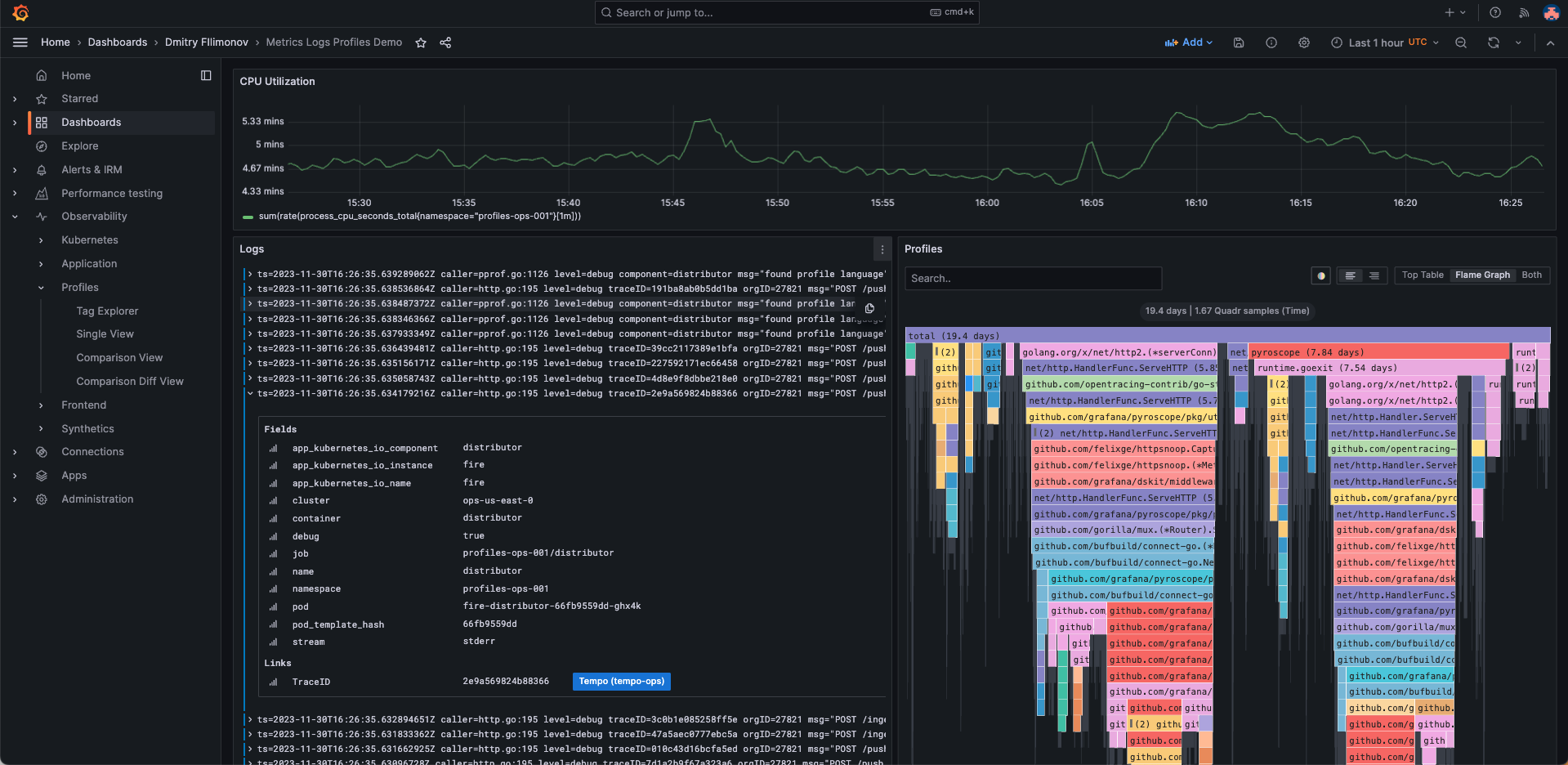
|
||||
|
||||
@@ -0,0 +1,21 @@
|
||||
---
|
||||
title: Configure traces to profiles
|
||||
menuTitle: Configure traces to profiles
|
||||
description: Learn how to configure the traces to profiles integration in Grafana and Grafana Cloud.
|
||||
weight: 300
|
||||
keywords:
|
||||
- continuous profiling
|
||||
- tracing
|
||||
---
|
||||
|
||||
# Configure traces to profiles
|
||||
|
||||
{{< admonition type="note" >}}
|
||||
|
||||
Your application must be instrumented for profiles and traces. For more information, refer to [Link traces to profiles](https://grafana.com/docs/pyroscope/<PYROSCOPE_VERSION>/configure-client/trace-span-profiles/).
|
||||
|
||||
{{< /admonition >}}
|
||||
|
||||
[//]: # 'Shared content for Trace to profiles in the Tempo data source'
|
||||
|
||||
{{< docs/shared source="grafana" lookup="datasources/tempo-traces-to-profiles.md" version="<GRAFANA VERSION>" >}}
|
||||
@@ -11,7 +11,7 @@ labels:
|
||||
- oss
|
||||
title: Query profile data
|
||||
menuTitle: Query profile data
|
||||
weight: 300
|
||||
weight: 400
|
||||
refs:
|
||||
configure-tempo-data-source:
|
||||
- pattern: /docs/grafana/
|
||||
@@ -43,11 +43,24 @@ refs:
|
||||
destination: /docs/grafana/<GRAFANA_VERSION>/administration/provisioning/#datasources
|
||||
- pattern: /docs/grafana-cloud/
|
||||
destination: /docs/grafana/<GRAFANA_VERSION>/administration/provisioning/#datasources
|
||||
flame-graph-panel:
|
||||
- pattern: /docs/grafana/
|
||||
destination: /docs/grafana/<GRAFANA_VERSION>/panels-visualizations/visualizations/flame-graph/
|
||||
- pattern: /docs/grafana-cloud/
|
||||
destination: /docs/grafana-cloud/visualizations/panels-visualizations/visualizations/flame-graph/
|
||||
---
|
||||
|
||||
https://grafana.com/docs/grafana-cloud/visualizations/panels-visualizations/visualizations/flame-graph/
|
||||
|
||||
# Query profile data
|
||||
|
||||
You can query your profile data using the built-in data source query editor or you can use the open source Grafana Explore Profiles app.
|
||||
You can query your profile data using the open source Grafana Explore Profiles app or the built-in Grafana Pyroscope data source query editor.
|
||||
|
||||
- Explore Profiles provides a queryless experience for inspecting your profiling data with opinionated workflows to assist your investigation.
|
||||
- Data source query editor provides complete control over your data exploration and is recommended for experienced users.
|
||||
|
||||
In addition, you can embed flame graph panels in Grafana dashboards.
|
||||
Refer to the [Flame graph panel](ref:flame-graph-panel) documentation for details.
|
||||
|
||||
## Explore Profiles
|
||||
|
||||
@@ -56,6 +69,8 @@ You can query your profile data using the built-in data source query editor or y
|
||||
You can use Explore Profiles in Grafana Cloud or in your own Grafana instance.
|
||||
For more information, refer to [Access or install Explore Profiles](ref:explore-profiles-install).
|
||||
|
||||

|
||||
|
||||
### Use cases
|
||||
|
||||
There are several different modes for viewing, analyzing, and comparing profiling data.
|
||||
@@ -65,7 +80,7 @@ The main use cases are the following:
|
||||
- Proactive: Cutting costs, addressing latency issues, or optimizing memory usage for applications
|
||||
- Reactive: Resolving incidents with line-level accuracy or debugging active latency/memory issues
|
||||
|
||||
Explore Profiles provides an intuitive interface to specifically support these use cases.
|
||||
Explore Profiles provides an intuitive interface to specifically support proactivee and reactive use cases.
|
||||
You get a holistic view of all of your services and how they're functioning, but also the ability to drill down for more targeted root cause analysis.
|
||||
|
||||
Explore Profiles offers a convenient platform to analyze profiles and get insights that are impossible to get from using other traditional signals like logs, metrics, or tracing.
|
||||
@@ -74,31 +89,6 @@ Explore Profiles offers a convenient platform to analyze profiles and get insigh
|
||||
|
||||
{{< docs/play title="the Grafana Play site" url="https://play.grafana.org/a/grafana-pyroscope-app/profiles-explorer" >}}
|
||||
|
||||
### Continuous profiling
|
||||
|
||||
While code profiling has been a long-standing practice, continuous profiling represents a modern and more advanced approach to performance monitoring.
|
||||
|
||||
This technique adds two critical dimensions to traditional profiles:
|
||||
|
||||
Time
|
||||
: Profiling data is collected _continuously_, providing a time-centric view that allows querying performance data from any point in the past.
|
||||
|
||||
Metadata
|
||||
: Profiles are enriched with metadata, adding contextual depth to the performance data.
|
||||
|
||||
These dimensions, coupled with the detailed nature of performance profiles, make continuous profiling a uniquely valuable tool.
|
||||
|
||||
### Flame graphs
|
||||
|
||||
<!-- vale Grafana.We = NO -->
|
||||
|
||||
Flame graphs help you visualize resource allocation and performance bottlenecks, and you even get suggested recommendations and performance fixes via AI-driven flame graph analysis, as well as line-level insights from our GitHub integration.
|
||||
|
||||
<!-- vale Grafana.We = YES -->
|
||||
|
||||
On views with a flame graph, you can use **Explain flame graph** to provide an AI flame graph analysis that explains the performance bottleneck, root cause, and recommended fix.
|
||||
For more information, refer to [Flame graph AI](https://grafana.com/docs/grafana-cloud/monitor-applications/profiles/flamegraph-ai/).
|
||||
|
||||
## Pyroscope query editor
|
||||
|
||||
The Pyroscope data source query editor gives you access to a profile type selector, a label selector, and collapsible options.
|
||||
@@ -135,7 +125,9 @@ Using **Group by**, you can group metric data by a specified label.
|
||||
Without any **Group by** label, metric data aggregates over all the labels into single time series.
|
||||
You can use multiple labels to group by. Group by only effects the metric data and doesn't change the profile data results.
|
||||
|
||||
## Profiles query results
|
||||
In conjunction with **Group by**, you can set a positive number in the **Limit** input to limit the maximum number of time series returned by the data source. The series returned are always ordered by descending value for the total aggregated data over the time period.
|
||||
|
||||
### Profiles query results
|
||||
|
||||
Profiles can be visualized in a flame graph.
|
||||
Refer to the [Flame Graph documentation](ref:flame-graph) to learn about the visualization and its features.
|
||||
@@ -146,7 +138,7 @@ Pyroscope returns profiles aggregated over a selected time range.
|
||||
The absolute values in the flame graph grow as the time range gets bigger while keeping the relative values meaningful.
|
||||
You can zoom in on the time range to get a higher granularity profile up to the point of a single scrape interval.
|
||||
|
||||
## Metrics query results
|
||||
### Metrics query results
|
||||
|
||||
Metrics results represent the aggregated sum value over time of the selected profile type.
|
||||
|
||||
|
||||
@@ -60,7 +60,7 @@ We encourage you to locate the repository of the corresponding plugin and create
|
||||
|
||||
### Links
|
||||
|
||||
- [Migrate Angular to React](https://grafana.com/developers/plugin-tools/migration-guides/angular-react/)
|
||||
- [Migrate Angular to React](https://grafana.com/developers/plugin-tools/migration-guides/migrate-angularjs-to-react)
|
||||
- [Build a panel plugin](https://grafana.com/tutorials/build-a-panel-plugin/)
|
||||
- [Build a data source plugin](https://grafana.com/tutorials/build-a-data-source-plugin/)
|
||||
- [List of current Angular plugins](angular-plugins/)
|
||||
|
||||
@@ -22,69 +22,71 @@ weight: 100
|
||||
|
||||
The annotations list shows a list of available annotations you can use to view annotated data. Various options are available to filter the list based on tags and on the current dashboard.
|
||||
|
||||
## Panel options
|
||||
{{< figure src="/media/docs/grafana/panels-visualizations/screenshot-annotations-list-viz-v12.0.png" max-width="750px" alt="The annotations list visualization" >}}
|
||||
|
||||
## Configuration options
|
||||
|
||||
{{< docs/shared lookup="visualizations/config-options-intro.md" source="grafana" version="<GRAFANA_VERSION>" >}}
|
||||
|
||||
### Panel options
|
||||
|
||||
{{< docs/shared lookup="visualizations/panel-options.md" source="grafana" version="<GRAFANA_VERSION>" >}}
|
||||
|
||||
## Annotation query
|
||||
### Annotation query options
|
||||
|
||||
The following options control the source query for the list of annotations.
|
||||
The following options control the source query for the list of annotations:
|
||||
|
||||
### Query Filter
|
||||
<!-- prettier-ignore-start -->
|
||||
|
||||
Use the query filter to create a list of annotations from all dashboards in your organization or the current dashboard in which this panel is located. It has the following options:
|
||||
| Option | Description |
|
||||
| ---------- | --------------------------------------------------------------------------------------------------------- |
|
||||
| [Query filter](#query-filter) | Specify which annotations are included in the list. |
|
||||
| [Time Range](#time-range) | Specify whether the list should be limited to the current time range. |
|
||||
| Tags | Filter the annotations by tags. You can add multiple tags to refine the list. Optionally, leave the tag list empty and filter in view mode by selecting tags that are listed as part of the results on the panel itself. |
|
||||
| Limit | Limit the number of results returned. |
|
||||
|
||||
- All dashboards - List annotations from all dashboards in the current organization.
|
||||
- This dashboard - Limit the list to the annotations on the current dashboard.
|
||||
<!-- prettier-ignore-end -->
|
||||
|
||||
### Time Range
|
||||
#### Query filter
|
||||
|
||||
Use the time range option to specify whether the list should be limited to the current time range. It has the following options:
|
||||
Use the **Query filter** option to create a list of annotations from all dashboards in your organization or the current dashboard in which this panel is located.
|
||||
Choose from:
|
||||
|
||||
- None - no time range limit for the annotations query.
|
||||
- This dashboard - Limit the list to the time range of the dashboard where the annotations list is available.
|
||||
- **All dashboards** - List annotations from all dashboards in the current organization.
|
||||
- **This dashboard** - Limit the list to the annotations on the current dashboard.
|
||||
|
||||
### Tags
|
||||
#### Time Range
|
||||
|
||||
Use the tags option to filter the annotations by tags. You can add multiple tags in order to refine the list.
|
||||
Specify whether the list should be limited to the current time range.
|
||||
Choose from:
|
||||
|
||||
{{% admonition type="note" %}}
|
||||
Optionally, leave the tag list empty and filter on the fly by selecting tags that are listed as part of the results on the panel itself.
|
||||
{{% /admonition %}}
|
||||
- **None** - No time range limit for the annotations query.
|
||||
- **This dashboard** - Limit the list to the time range of the dashboard where the annotations list is available.
|
||||
|
||||
### Limit
|
||||
### Display options
|
||||
|
||||
Use the limit option to limit the number of results returned.
|
||||
These options control additional metadata included in the annotations list display:
|
||||
|
||||
## Display
|
||||
<!-- prettier-ignore-start -->
|
||||
|
||||
These options control additional meta-data included in the annotations list display.
|
||||
| Option | Description |
|
||||
| ---------- | --------------------------------------------------------------------------------------------------------- |
|
||||
| Show user | Show or hide which user created the annotation. |
|
||||
| Show time | Show or hide the time the annotation creation time. |
|
||||
| Show tags | Show or hide the tags associated with an annotation. Note that you can use the tags to filter the annotations list. |
|
||||
|
||||
### Show user
|
||||
<!-- prettier-ignore-end -->
|
||||
|
||||
Use this option to show or hide which user created the annotation.
|
||||
### Link behavior options
|
||||
|
||||
### Show time
|
||||
Use the following options to control the behavior of annotation links in the list:
|
||||
|
||||
Use this option to show or hide the time the annotation creation time.
|
||||
<!-- prettier-ignore-start -->
|
||||
|
||||
### Show Tags
|
||||
| Option | Description |
|
||||
| ---------- | --------------------------------------------------------------------------------------------------------- |
|
||||
| Link target | Set how to view the annotated data. Choose from:<ul><li>**Panel** - The link takes you directly to a full-screen view of the panel with the corresponding annotation.</li><li>**Dashboard** - Focuses the annotation in the context of a complete dashboard.</li></ul> |
|
||||
| Time before | Set the time range before the annotation. Use duration string values like `1h` for one hour and `10m` for 10 minutes. |
|
||||
| Time after | Set the time range after the annotation. |
|
||||
|
||||
Use this option to show or hide the tags associated with an annotation. _NB_: You can use the tags to live-filter the annotations list on the visualization itself.
|
||||
|
||||
## Link behavior
|
||||
|
||||
### Link target
|
||||
|
||||
Use this option to chose how to view the annotated data. It has the following options.
|
||||
|
||||
- Panel - This option will take you directly to a full-screen view of the panel with the corresponding annotation
|
||||
- Dashboard - This option will focus the annotation in the context of a complete dashboard
|
||||
|
||||
### Time before
|
||||
|
||||
Use this option to set the time range before the annotation. Use duration string values like "1h" = 1 hour, "10m" = 10 minutes, etc.
|
||||
|
||||
### Time after
|
||||
|
||||
Use this option to set the time range after the annotation.
|
||||
<!-- prettier-ignore-end -->
|
||||
|
||||
@@ -33,7 +33,7 @@ Candlestick visualizations build upon the foundation of the [time series visuali
|
||||
|
||||
You can use a candlestick if you want to visualize, at a glance, how a price moved over time, whether it went up, down, or stayed the same, and how much it fluctuated:
|
||||
|
||||
{{< figure src="/static/img/docs/candlestick-panel/candlestick-panel-8-3.png" max-width="1065px" alt="A candlestick visualization" >}}
|
||||
{{< figure src="/media/docs/grafana/panels-visualizations/screenshot-candlestick-v11.6.png" max-width="750px" alt="A candlestick visualization" >}}
|
||||
|
||||
Each candlestick is represented as a rectangle, referred to as the _candlestick body_. The candlestick body displays the opening and closing prices during a time period. Green candlesticks represent when the price appreciated while the red candlesticks represent when the price depreciated. The lines sticking out the candlestick body are referred to as _wicks_ or _shadows_, which represent the highest and lowest prices during the time period.
|
||||
|
||||
@@ -74,43 +74,47 @@ The candlestick visualization works best with price movement data for an asset.
|
||||
|
||||
The data is converted as follows:
|
||||
|
||||
{{< figure src="/static/img/docs/candlestick-panel/candlestick.png" max-width="1065px" alt="A candlestick visualization showing the price movements of specific asset." >}}
|
||||
{{< figure src="/media/docs/grafana/panels-visualizations/screenshot-candles-volume-v11.6.png" max-width="750px" alt="A candlestick visualization showing the price movements of specific asset." >}}
|
||||
|
||||
## Panel options
|
||||
## Configuration options
|
||||
|
||||
{{< docs/shared lookup="visualizations/config-options-intro.md" source="grafana" version="<GRAFANA_VERSION>" >}}
|
||||
|
||||
### Panel options
|
||||
|
||||
{{< docs/shared lookup="visualizations/panel-options.md" source="grafana" version="<GRAFANA_VERSION>" >}}
|
||||
|
||||
## Mode
|
||||
### Candlestick options
|
||||
|
||||
The mode options allow you to toggle which dimensions are used for the visualization.
|
||||
The following options let you control which data is displayed in the visualization and how it appears:
|
||||
|
||||
- **Candles** limits the panel dimensions to the open, high, low, and close dimensions used by candlestick visualizations.
|
||||
- **Volume** limits the panel dimension to the volume dimension.
|
||||
- **Both** is the default behavior for the candlestick visualization. It includes both candlestick and volume visualizations.
|
||||
| Option | Description |
|
||||
| ------------------------------------------------------ | ----------------------------------------------------------------------------------------------------------------------------------------------------------------------------------------------------------------------------------------------------------------------------------------------------- |
|
||||
| Mode | Controls which dimensions are used for the visualization. Choose from:<ul><li>**Candles** - Uses the open, high, low, and close dimensions.</li><li>**Volume** - Uses only the volume dimension.</li><li>**Both** - The default behavior, which displays both candles and volume values.</li></ul> |
|
||||
| Candle style | Controls the appearance of the candles. Choose from:<ul><li>**Candles** - The default display style, which creates candle-style markers between the open and close dimensions.</li><li>**OHLC Bars** - Displays values for the four core dimensions, open, high, low, and close.</li></ul> |
|
||||
| [Color strategy](#color-strategy) | Controls how colors are applied to dimensions. Choose from:<ul><li>**Since Open** - This mode uses the **Up color** if the intra-period price movement is positive.</li><li>**Since Prior Close** - The color of the candle is based on the inter-period price movement or change in value.</li></ul> |
|
||||
| Up color/Down color | These options control which colors are used when the price movement is up or down. Note that the **Color strategy** selection determines if intra-period or inter-period price movement is used to select the candle or OHLC bar color. |
|
||||
| [Open, High, Low, Close, Volume](#open-high-low-close) | The candlestick visualization attempts to map fields from your data to these dimensions, as appropriate dimension. |
|
||||
| [Additional fields](#additional-fields) | The **Include** and **Ignore** options allow the candlestick visualization to display other included data such as simple moving averages, Bollinger bands and more, using the same styles and configurations available in the [time series](ref:time-series-visualization) visualization. |
|
||||
|
||||
## Candle style
|
||||
#### Color strategy
|
||||
|
||||
- **Candles** is the default display style and creates candle-style visualizations between the open and close dimensions.
|
||||
- **OHLC Bars** displays the four core dimensions open, high, low, and close values.
|
||||
The **Color strategy** option controls how colors are applied to dimensions. Choose from:
|
||||
|
||||
## Color strategy
|
||||
- **Since Open** - The default behavior. This mode uses the **Up color** if the intra-period price movement is positive. In other words, if the value on close is greater or equal to the value on open, the **Up color** is used.
|
||||
- **Since Prior Close** - An alternative display method where the color of the candle is based on the inter-period price movement or change in value. In other words, if the value on open is greater than the previous value on close, the **Up color** is used. If the value on open is lower than the previous value on close, the **Down color** is used.
|
||||
|
||||
- **Since Open** is the default behavior. This mode will utilize the _Up_ color (below) if the intra-period price movement is positive. In other words, if the value on close is greater or equal to the value on open, the _Up_ color is used.
|
||||
- **Since Prior Close** is an alternative display method based where the color of the candle is based on the inter-period price movement or change in value. In other words, if the value on open is greater than the previous value on close, the _Up_ color is used. If the value on open is lower than the previous value on close, the _Down_ color is used. _This option also triggers the hollow candlestick visualization mode_. Hollow candlesticks indicate that the intra-period movement is positive (value is higher on close than on open), filled candlesticks indicate the intra-period change is negative (value is lower on close than on open). To learn more, see the [explanation of the differences](https://thetradingbible.com/how-to-read-hollow-candlesticks).
|
||||
This option also triggers the _hollow candlestick_ visualization mode. Hollow candlesticks indicate that the intra-period movement is positive (value is higher on close than on open), while filled candlesticks indicate the intra-period change is negative (value is lower on close than on open). To learn more, refer to the [explanation of the differences](https://thetradingbible.com/how-to-read-hollow-candlesticks).
|
||||
|
||||
## Up & Down Colors
|
||||
#### Open, High, Low, Close, Volume {#open-high-low-close}
|
||||
|
||||
The **Up color** and **Down color** options select which colors are used when the price movement is up or down. Please note that the _Color strategy_ above will determine if intra-period or inter-period price movement is used to select the candle or OHLC bar color.
|
||||
The candlestick visualization attempts to map fields from your data to the appropriate dimension:
|
||||
|
||||
## Open, High, Low, Close
|
||||
|
||||
The candlestick visualization will attempt to map fields from your data to the appropriate dimension:
|
||||
|
||||
- **Open** corresponds to the starting value of the given period.
|
||||
- **High** corresponds to the highest value of the given period.
|
||||
- **Low** corresponds to the lowest value of the given period.
|
||||
- **Close** corresponds to the final (end) value of the given period.
|
||||
- **Volume** corresponds to the sample count in the given period. (for example, number of trades)
|
||||
- **Open** - Starting value of the given period.
|
||||
- **High** - Highest value of the given period.
|
||||
- **Low** - Lowest value of the given period.
|
||||
- **Close** - Final (end) value of the given period.
|
||||
- **Volume** - Sample count in the given period (for example, number of trades).
|
||||
|
||||
{{% admonition type="note" %}}
|
||||
The candlestick visualization legend doesn't display these values.
|
||||
@@ -118,36 +122,79 @@ The candlestick visualization legend doesn't display these values.
|
||||
|
||||
If your data can't be mapped to these dimensions for some reason (for example, because the column names aren't the same), you can map them manually using the **Open**, **High**, **Low**, and **Close** fields under the **Candlestick** options in the panel editor:
|
||||
|
||||

|
||||
{{< figure src="/media/docs/grafana/panels-visualizations/screenshot-olhc-options-v11.6.png" max-width="400px" alt="Open, High, Low, and Close fields in the panel editor" >}}
|
||||
|
||||
### Additional fields
|
||||
#### Additional fields
|
||||
|
||||
The candlestick visualization is based on the time series visualization. It can visualize additional data dimensions beyond open, high, low, close, and volume The **Include** and **Ignore** options allow it to visualize other included data such as simple moving averages, Bollinger bands and more, using the same styles and configurations available in the [time series](ref:time-series-visualization) visualization.
|
||||
The candlestick visualization is based on the time series visualization, and it can visualize additional data dimensions beyond open, high, low, close, and volume.
|
||||
The **Include** and **Ignore** options allow it to visualize other included data such as simple moving averages, Bollinger bands and more, using the same styles and configurations available in the [time series](ref:time-series-visualization) visualization.
|
||||
|
||||
## Standard options
|
||||
### Tooltip options
|
||||
|
||||
{{< docs/shared lookup="visualizations/standard-options.md" source="grafana" version="<GRAFANA_VERSION>" >}}
|
||||
Tooltip options control the information overlay that appears when you hover over data points in the visualization.
|
||||
|
||||
## Legend options
|
||||
| Option | Description |
|
||||
| --------------------------------------- | ------------------------------------------------------------------------------------------------------------------------------ |
|
||||
| [Tooltip mode](#tooltip-mode) | When you hover your cursor over the visualization, Grafana can display tooltips. Choose how tooltips behave. |
|
||||
| [Values sort order](#values-sort-order) | This option controls the order in which values are listed in a tooltip. |
|
||||
| [Hover proximity](#hover-proximity) | Set the hover proximity (in pixels) to control how close the cursor must be to a data point to trigger the tooltip to display. |
|
||||
| Max width | Set the maximum width of the tooltip box. |
|
||||
| Max height | Set the maximum height of the tooltip box. The default is 600 pixels. |
|
||||
|
||||
#### Tooltip mode
|
||||
|
||||
When you hover your cursor over the visualization, Grafana can display tooltips. Choose how tooltips behave.
|
||||
|
||||
- **Single -** The hover tooltip shows only a single series, the one that you are hovering over on the visualization.
|
||||
- **All -** The hover tooltip shows all series in the visualization. Grafana highlights the series that you are hovering over in bold in the series list in the tooltip.
|
||||
- **Hidden -** Do not display the tooltip when you interact with the visualization.
|
||||
|
||||
Use an override to hide individual series from the tooltip.
|
||||
|
||||
#### Values sort order
|
||||
|
||||
When you set the **Tooltip mode** to **All**, the **Values sort order** option is displayed. This option controls the order in which values are listed in a tooltip. Choose from the following:
|
||||
|
||||
- **None** - Grafana automatically sorts the values displayed in a tooltip.
|
||||
- **Ascending** - Values in the tooltip are listed from smallest to largest.
|
||||
- **Descending** - Values in the tooltip are listed from largest to smallest.
|
||||
|
||||
#### Hover proximity
|
||||
|
||||
Set the hover proximity (in pixels) to control how close the cursor must be to a data point to trigger the tooltip to display.
|
||||
|
||||

|
||||
|
||||
### Legend options
|
||||
|
||||
{{< docs/shared lookup="visualizations/legend-options-1.md" source="grafana" version="<GRAFANA_VERSION>" >}}
|
||||
|
||||
## Tooltip options
|
||||
### Graph styles options
|
||||
|
||||
{{< docs/shared lookup="visualizations/tooltip-options-2.md" source="grafana" version="<GRAFANA_VERSION>" >}}
|
||||
The options under the **Graph styles** section let you control the general appearance of [additional fields](#additional-fields) in the visualization, excluding [color](#standard-options).
|
||||
|
||||
## Data links
|
||||
{{< docs/shared lookup="visualizations/graph-styles-options.md" source="grafana" version="<GRAFANA_VERSION>" leveloffset="+1" >}}
|
||||
|
||||
### Axis options
|
||||
|
||||
{{< docs/shared lookup="visualizations/axis-options-2.md" source="grafana" version="<GRAFANA_VERSION>" leveloffset="+1" >}}
|
||||
|
||||
### Standard options
|
||||
|
||||
{{< docs/shared lookup="visualizations/standard-options.md" source="grafana" version="<GRAFANA_VERSION>" >}}
|
||||
|
||||
### Data links
|
||||
|
||||
{{< docs/shared lookup="visualizations/datalink-options.md" source="grafana" version="<GRAFANA_VERSION>" >}}
|
||||
|
||||
## Thresholds
|
||||
|
||||
{{< docs/shared lookup="visualizations/thresholds-options-1.md" source="grafana" version="<GRAFANA_VERSION>" >}}
|
||||
|
||||
## Value mappings
|
||||
### Value mappings
|
||||
|
||||
{{< docs/shared lookup="visualizations/value-mappings-options.md" source="grafana" version="<GRAFANA_VERSION>" >}}
|
||||
|
||||
## Field overrides
|
||||
### Thresholds
|
||||
|
||||
{{< docs/shared lookup="visualizations/thresholds-options-1.md" source="grafana" version="<GRAFANA_VERSION>" >}}
|
||||
|
||||
### Field overrides
|
||||
|
||||
{{< docs/shared lookup="visualizations/overrides-options.md" source="grafana" version="<GRAFANA_VERSION>" >}}
|
||||
|
||||
@@ -35,7 +35,7 @@ refs:
|
||||
|
||||
Dashboard lists allow you to display dynamic links to other dashboards. You can configure the list to use starred dashboards, recently viewed dashboards, a search query, and dashboard tags.
|
||||
|
||||
{{< figure src="/static/img/docs/v45/dashboard-list-panels.png" max-width="850px" alt="A dashboard list visualization" >}}
|
||||
{{< figure src="/media/docs/grafana/panels-visualizations/screenshot-dashboard-list-v11.6.png" max-width="750px" alt="A dashboard list visualization" >}}
|
||||
|
||||
On each dashboard load, this panel queries the dashboard list, always providing the most up-to-date results.
|
||||
|
||||
@@ -49,62 +49,53 @@ Once you’ve created a [dashboard](ref:dashboard), the following video shows yo
|
||||
|
||||
{{< docs/play title="Dashboard List Visualization" url="https://play.grafana.org/d/fdlojrg7daebka/" >}}
|
||||
|
||||
## Panel options
|
||||
## Configuration options
|
||||
|
||||
{{< docs/shared lookup="visualizations/config-options-intro.md" source="grafana" version="<GRAFANA_VERSION>" >}}
|
||||
|
||||
### Panel options
|
||||
|
||||
{{< docs/shared lookup="visualizations/panel-options.md" source="grafana" version="<GRAFANA_VERSION>" >}}
|
||||
|
||||
## Dashboard list options
|
||||
### Dashboard list options
|
||||
|
||||
Use the following options to refine your dashboard list visualization.
|
||||
|
||||
### Include current time range
|
||||
<!-- prettier-ignore-start -->
|
||||
|
||||
Select this option to propagate the time range of the current dashboard to the dashboard links. When you click a link, the linked dashboard opens with the indicated time range already set.
|
||||
| Option | Description |
|
||||
| ------ | ----------- |
|
||||
| Include current time range | Propagate the time range of the current dashboard to the dashboard list links. When you click a link, the linked dashboard opens with the indicated time range already set. |
|
||||
| Include current template variable values | Include template variables that are being used as query parameters in the dashboard list link. When you click the link, any matching templates in the linked dashboard are set to the values from the link. Learn more in [Dashboard URL variables](ref:dashboard-url-variables). |
|
||||
| Starred | Display starred dashboards in alphabetical order. |
|
||||
| Recently viewed | Display recently viewed dashboards in alphabetical order. |
|
||||
| Search | Display dashboards returned by search. You must enter at least one value in the search fields, **Query** or **Tags**. Variable interpolation is supported for both fields. For example, `$my_var` or `${my_var}`. |
|
||||
| Show headings | Headings for enabled sections are displayed. Sections are:<ul><li>**Starred**</li><li>**Recently viewed**</li><li>**Search**</li> |
|
||||
| Show folder names | Display the name of the folder where the dashboard is located. |
|
||||
| Max items | Set the maximum number of items to list per section. If you enter "10" and enable **Starred** and **Recently viewed** dashboards, the panel displays up to 20 total dashboards, 10 in each section. |
|
||||
| [Query](#query) | Search by dashboard name. This option is only applied when the **Search** switch is toggled on. |
|
||||
| [Folder](#folder) | Only dashboards from the selected folder are displayed in the dashboard list. This option is only applied when the **Search** switch is toggled on. |
|
||||
| [Tags](#tags) | Search by tags. This option is only applied when the **Search** switch is toggled on. |
|
||||
|
||||
### Include current template variable values
|
||||
<!-- prettier-ignore-end -->
|
||||
|
||||
Select this option to include template variables that are being used as query parameters in a link. When you click the link, any matching templates in the linked dashboard are set to the values from the link. Learn more in [Dashboard URL variables](ref:dashboard-url-variables).
|
||||
#### Query
|
||||
|
||||
### Starred
|
||||
Use this field to search by dashboard name. Query terms are case-insensitive and partial values are accepted.
|
||||
For example, if you have dashboards called "Indoor Temps" and "Outdoor temp", entering the word "temp" returns both results.
|
||||
This option is only applied when the **Search** switch is toggled on.
|
||||
|
||||
Display starred dashboards in alphabetical order.
|
||||
#### Folder
|
||||
|
||||
### Recently viewed
|
||||
Only dashboards from the selected folder are included in search results and displayed in the dashboard list.
|
||||
To include all dashboards in search results, select the top-level **Dashboards** folder.
|
||||
This option is only applied when the **Search** switch is toggled on.
|
||||
|
||||
Display recently viewed dashboards in alphabetical order.
|
||||
#### Tags
|
||||
|
||||
### Search
|
||||
Enter tags by which you want to search. Note that tags don't appear as you type, and they're case sensitive.
|
||||
Tag search uses an `OR` condition, so if a dashboard has one of the defined tags, it's included in the list.
|
||||
|
||||
Display dashboards by search query or tags. You must enter at least one value in **Query** or **Tags**. For the **Query** and **Tags** fields, variable interpolation is supported. For example, `$my_var` or `${my_var}`. Learn more in [Search option](#search-options).
|
||||
|
||||
### Show headings
|
||||
|
||||
The selected list section is shown as a heading:
|
||||
|
||||
- **Starred**
|
||||
- **Recently viewed**
|
||||
- **Search**
|
||||
|
||||
### Max items
|
||||
|
||||
Sets the maximum number of items to list per section. For example, if you leave this at the default value of 10 and select **Starred** and **Recently viewed** dashboards, then the panel displays up to 20 total dashboards, 10 in each section.
|
||||
|
||||
## Search options
|
||||
|
||||
These options only apply if you select the **Search** option.
|
||||
|
||||
### Query
|
||||
|
||||
Use this field to search by dashboard name. Query terms are case-insensitive and partial values are accepted. For example, if you have dashboards called "Indoor Temps" and "Outdoor temp", entering the word "temp" would return both results.
|
||||
|
||||
### Folder
|
||||
|
||||
Select the dashboard folders that you want to display.
|
||||
|
||||
### Tags
|
||||
|
||||
Enter tags by which you want to search. Note that tags don't appear as you type, and they're case sensitive. Tag search uses an `OR` condition, so if a dashboard has one of the defined tags, it's included in the list.
|
||||
|
||||
{{< admonition type="note" >}}
|
||||
When multiple tags and strings appear, the dashboard list displays those matching _all_ conditions.
|
||||
{{< /admonition >}}
|
||||
|
||||
This option is only applied when the **Search** switch is toggled on.
|
||||
|
||||
@@ -29,23 +29,20 @@ refs:
|
||||
|
||||
# Datagrid
|
||||
|
||||
{{% admonition type="note" %}}
|
||||
|
||||
The Grafana datagrid is experimental. This feature is supported by the engineering team on a best-effort basis, and breaking changes may occur without notice prior to general availability.
|
||||
|
||||
{{% /admonition %}}
|
||||
{{< docs/experimental product="The datagrid visualization" featureFlag="`enableDatagridEditing`" >}}
|
||||
|
||||
Datagrids offer you the ability to create, edit, and fine-tune data within Grafana. As such, this panel can act as a data source for other panels
|
||||
inside a dashboard.
|
||||
|
||||

|
||||
{{< figure src="/media/docs/grafana/panels-visualizations/screenshot-datagrid-visualization-v12.0.png" max-width="750px" alt="The datagrid visualization" >}}
|
||||
|
||||
Through it, you can manipulate data queried from any data source, you can start from a blank slate, or you can pull data from a dragged and dropped file. You can then use the panel as a simple tabular
|
||||
visualization, or you can modify the data—and even remove it altogether—to create a blank slate.
|
||||
Through it, you can manipulate data queried from any data source, you can start from a blank slate, or you can pull data from a dragged and dropped file.
|
||||
You can then use the panel as a simple tabular visualization, or you can modify the data—and even remove it altogether—to create a blank slate.
|
||||
|
||||
Editing the dataset changes the data source to use the inbuilt `-- Grafana --` data source, thus replacing the old data source settings and related queries, while also copying the current dataset into the dashboard model.
|
||||
|
||||
You can then use the panel as a data source for other panels, by using the inbuilt `-- Dashboard --` data source to pull the datagrid data. This allows for an interactive dashboard experience, where you can modify the data and see the changes reflected in other panels.
|
||||
You can then use the panel as a data source for other panels, by using the inbuilt `-- Dashboard --` data source to pull the datagrid data.
|
||||
This allows for an interactive dashboard experience, where you can modify the data and see the changes reflected in other panels.
|
||||
|
||||
Learn more about the inbuilt `-- Grafana --` and `-- Dashboard --` data sources in the [special data sources](ref:special-data-sources) documentation.
|
||||
|
||||
@@ -65,13 +62,9 @@ Deleting a row or column will remove the data from the datagrid, while clearing
|
||||
|
||||
You can also access a header menu by clicking the dropdown icon next to the header title. From here, you can not only delete or clear a column, but also rename it, freeze it, or convert the field type of the column.
|
||||
|
||||
{{< figure src="/media/docs/datagrid/screenshot-grafana-datagrid-header-menu-2.png" alt="Datagrid header menu" max-width="500px" >}}
|
||||
{{< figure src="/media/docs/grafana/panels-visualizations/screenshot-datagrid-header-menu-v12.0.png" alt="Datagrid header menu" max-width="400px" >}}
|
||||
|
||||
## Selecting series
|
||||
|
||||
If there are multiple series, you can set the datagrid to display the preferred dataset using the **Select series** dropdown in the panel options.
|
||||
|
||||
## Using datagrids
|
||||
## Use datagrids
|
||||
|
||||
Datagrids offer various ways of interacting with your data. You can add, edit, move, clear, and remove rows and columns; use the inbuilt search functionality to find specific data; and convert field types or freeze horizontal scroll on a specific column.
|
||||
|
||||
@@ -79,7 +72,7 @@ Datagrids offer various ways of interacting with your data. You can add, edit, m
|
||||
|
||||
You can add data to a datagrid by creating a new column or row.
|
||||
|
||||
To create a new column, take the following steps:
|
||||
To create a new column, follow these steps:
|
||||
|
||||
1. In an existing panel, click the **+** button in the table header after the last column.
|
||||
1. When prompted, add a name for the new column.
|
||||
@@ -91,7 +84,7 @@ To add a new row, click a **+** button after the last row. The button is present
|
||||
|
||||
### Edit data
|
||||
|
||||
You can edit data by taking the following steps:
|
||||
To edit data, follow these steps:
|
||||
|
||||
1. Double-click on the cell that needs to be modified. This will activate the cell and allow you to edit the data.
|
||||
1. After editing the data, click anywhere outside the cell or press the Enter key to finalize the edit.
|
||||
@@ -102,7 +95,7 @@ To easily clear a cell of data, you can click on a cell to focus it and then pre
|
||||
|
||||
You can move columns and rows as needed.
|
||||
|
||||
To move a column, take the following steps:
|
||||
To move a column, follow these steps:
|
||||
|
||||
1. Click and hold the header of the column that needs to be moved.
|
||||
1. Drag the column to the desired location.
|
||||
@@ -116,7 +109,7 @@ You can select multiple cells by clicking on a single cell and dragging the mous
|
||||
|
||||
### Delete/clear multiple rows or columns
|
||||
|
||||
To delete or clear multiple rows, take the following steps:
|
||||
To delete or clear multiple rows, follow these steps:
|
||||
|
||||
1. Hover over the number column (to the left of the first column in the grid) to display row checkbox.
|
||||
1. Select the checkboxes for the rows you want to work with.
|
||||
@@ -126,8 +119,16 @@ To delete or clear multiple rows, take the following steps:
|
||||
|
||||
The same rules apply to columns by clicking the column headers.
|
||||
|
||||
To delete all rows, use the "select all" checkbox at the top left corner of the datagrid. This selects all rows and allows you to delete them using the context menu.
|
||||
To delete all rows, use the select all checkbox at the top left corner of the datagrid. This selects all rows and allows you to delete them using the context menu.
|
||||
|
||||
## Panel options
|
||||
## Configuration options
|
||||
|
||||
{{< docs/shared lookup="visualizations/config-options-intro.md" source="grafana" version="<GRAFANA_VERSION>" >}}
|
||||
|
||||
### Panel options
|
||||
|
||||
{{< docs/shared lookup="visualizations/panel-options.md" source="grafana" version="<GRAFANA_VERSION>" >}}
|
||||
|
||||
### Datagrid options
|
||||
|
||||
If there are multiple series, you can choose the dataset the datagrid displays using the **Select series** option.
|
||||
|
||||
@@ -15,15 +15,21 @@ labels:
|
||||
description: Configure options for Grafana's flame graph visualization
|
||||
title: Flame graph
|
||||
weight: 100
|
||||
refs:
|
||||
units:
|
||||
- pattern: /docs/grafana/
|
||||
destination: /docs/grafana/<GRAFANA_VERSION>/panels-visualizations/configure-standard-options/#unit
|
||||
- pattern: /docs/grafana-cloud/
|
||||
destination: /docs/grafana-cloud/visualizations/panels-visualizations/configure-standard-options/unit
|
||||
---
|
||||
|
||||
# Flame graph
|
||||
|
||||
Flame graphs let you visualize [profiling](https://grafana.com/docs/pyroscope/latest/introduction/profiling/) data. Using this visualization, a [profile](https://grafana.com/docs/pyroscope/latest/view-and-analyze-profile-data/profiling-types/) can be represented as a [flame graph](#flame-graph-mode), [top table](#top-table-mode), or both.
|
||||
Flame graphs let you visualize [profiling](https://grafana.com/docs/pyroscope/latest/introduction/what-is-profiling/) data. Using this visualization, a [profile](https://grafana.com/docs/pyroscope/latest/view-and-analyze-profile-data/profiling-types/) can be represented as a [flame graph](#flame-graph-mode), [top table](#top-table-mode), or both.
|
||||
|
||||
For example, if you want to understand which parts of a program consume the most resources, such as CPU time, memory, or I/O operations, you can use a flame graph to visualize and analyze where potential performance issues are:
|
||||
|
||||
{{< figure src="/static/img/docs/flame-graph-panel/flame-graph-dark-mode.png" max-width="1025px" alt="A flame graph visualization for a system profile with both flame graph and top table mode." >}}
|
||||
{{< figure src="/media/docs/grafana/panels-visualizations/screenshot-flamegraph-dark-v12.0.png" max-width="750px" alt="A flame graph visualization for a system profile with both flame graph and top table mode." >}}
|
||||
|
||||
You can use a flame graph visualization if you need to:
|
||||
|
||||
@@ -69,82 +75,101 @@ The following table is an example of the type of data you need for a flame graph
|
||||
| 4 | 1.13 Bil | 1.13 K | compress/gzip.(\*Writer).Write |
|
||||
| 5 | 1.06 Bil | 1.06 K | compress/flat.(\*compressor).write |
|
||||
|
||||
## Panel options
|
||||
|
||||
{{< docs/shared lookup="visualizations/panel-options.md" source="grafana" version="<GRAFANA_VERSION>" >}}
|
||||
|
||||
## Modes
|
||||
|
||||
### Flame graph mode
|
||||
## Flame graph mode
|
||||
|
||||
A flame graph takes advantage of the hierarchical nature of profiling data. It condenses data into a format that allows you to easily see which code paths are consuming the most system resources, such as CPU time, allocated objects, or space when measuring memory. Each block in the flame graph represents a function call in a stack and its width represents its value.
|
||||
|
||||
Grayed-out sections are a set of functions that represent a relatively small value and they are collapsed together into one section for performance reasons.
|
||||
|
||||
{{< figure src="/static/img/docs/flame-graph-panel/flame-graph-mode-dark.png" max-width="650px" alt="A flame graph visualization for a system profile with flame graph mode." >}}
|
||||
{{< figure src="/static/img/docs/flame-graph-panel/flame-graph-mode-dark.png" max-width="700px" alt="A flame graph visualization for a system profile with flame graph mode." >}}
|
||||
|
||||
You can hover over a specific function to view a tooltip that shows you additional data about that function, like the function's value, percentage of total value, and the number of samples with that function.
|
||||
|
||||
{{< figure src="/media/docs/grafana/panels-visualizations/flamegraph/screenshot-flamegraph-10.1-tooltip.png" max-width="650px" alt="A flame graph visualization with a hover tooltip." >}}
|
||||
{{< figure src="/media/docs/grafana/panels-visualizations/screenshot-flamegraph-tooltip-v11.6.png" max-width="700px" alt="A flame graph visualization with a hover tooltip." >}}
|
||||
|
||||
#### Drop-down actions
|
||||
### Menu actions
|
||||
|
||||
You can click a function to show a drop-down menu with additional actions:
|
||||
|
||||
- Focus block
|
||||
- Copy function name
|
||||
- Sandwich view
|
||||
- [Focus block](#focus-block)
|
||||
- [Copy function name](#copy-function-name)
|
||||
- [Sandwich view](#sandwich-view)
|
||||
- [Grouping](#grouping)
|
||||
|
||||
{{< figure src="/media/docs/grafana/panels-visualizations/flamegraph/screenshot-flamegraph-10.1-dropdown.png" max-width="650px" alt="A flame graph visualization with drop-down actions." >}}
|
||||
{{< figure src="/media/docs/grafana/panels-visualizations/screenshot-flamegraph-menu-v12.0.png" max-width="700px" alt="A flame graph visualization with drop-down actions." >}}
|
||||
|
||||
##### Focus block
|
||||
#### Focus block
|
||||
|
||||
When you click **Focus block**, the block, or function, is set to 100% of the flame graph's width and all its child functions are shown with their widths updated relative to the width of the parent function. This makes it easier to drill down into smaller parts of the flame graph.
|
||||
|
||||
{{< figure src="/media/docs/grafana/panels-visualizations/flamegraph/screenshot-flamegraph-10.1-focus.png" max-width="650px" alt="A flame graph visualization with focus block action selected." >}}
|
||||
{{< figure src="/media/docs/grafana/panels-visualizations/screenshot-flamegraph-focus-v11.6.png" max-width="700px" alt="A flame graph visualization with focus block action selected." >}}
|
||||
|
||||
##### Copy function name
|
||||
#### Copy function name
|
||||
|
||||
When you click **Copy function name**, the full name of the function that the block represents is copied.
|
||||
|
||||
##### Sandwich view
|
||||
#### Sandwich view
|
||||
|
||||
The sandwich view allows you to show the context of the clicked function. It shows all the function's callers on the top and all the callees at the bottom. This shows the aggregated context of the function so if the function exists in multiple places in the flame graph, all the contexts are shown and aggregated in the sandwich view.
|
||||
|
||||
{{< figure src="/media/docs/grafana/panels-visualizations/flamegraph/screenshot-flamegraph-10.1-sandwich.png" max-width="650px" alt="A flame graph visualization with sandwich view selected.">}}
|
||||
{{< figure src="/media/docs/grafana/panels-visualizations/screenshot-flamegraph-sandwich-v11.6.png" max-width="700px" alt="A flame graph visualization with sandwich view selected.">}}
|
||||
|
||||
#### Status bar
|
||||
#### Grouping
|
||||
|
||||
Under the **Grouping** section of the menu, the following options let you expand and collapse groups of functions:
|
||||
|
||||
- **Expand group** - Expands the grouped function you've clicked. Displayed if you click a function that's been automatically grouped in the flame graph.
|
||||
- **Expand all groups** - Expands all grouped functions in the flame graph. Always displayed when you click the graph.
|
||||
- **Collapse group** - Collapses the expanded function you've clicked. Displayed if you click a function in the flame graph that's been manually expanded.
|
||||
- **Collapse all groups** - Collapses all expanded functions in the flame graph. Displayed if there are any expanded functions when you click the graph.
|
||||
|
||||
### Status bar
|
||||
|
||||
The status bar shows metadata about the flame graph and currently applied modifications, like what part of the graph is in focus or what function is shown in sandwich view. Click the **X** in the status bar pill to remove that modification.
|
||||
|
||||
{{< figure src="/media/docs/grafana/panels-visualizations/flamegraph/screenshot-flamegraph-10.1-status.png" max-width="1025px" alt="A flame graph visualization's status bar.">}}
|
||||
{{< figure src="/media/docs/grafana/panels-visualizations/screenshot-flamegraph-status-v11.6.png" max-width="730px" alt="A flame graph visualization's status bar.">}}
|
||||
|
||||
### Top table mode
|
||||
## Top table mode
|
||||
|
||||
The top table shows the functions from the profile in table format. The table has three columns: symbols, self, and total. The table is sorted by self time by default, but can be reordered by total time or symbol name by clicking the column headers. Each row represents aggregated values for the given function if the function appears in multiple places in the profile.
|
||||
|
||||
{{< figure src="/media/docs/grafana/panels-visualizations/flamegraph/screenshot-flamegraph-10.1-table.png" max-width="650px" alt="Table view">}}
|
||||
{{< figure src="/media/docs/grafana/panels-visualizations/screenshot-flamegraph-toptable-v12.0.png" max-width="700px" alt="Table view">}}
|
||||
|
||||
There are also action buttons on the left-most side of each row. The first button searches for the function name while second button shows the sandwich view of the function.
|
||||
|
||||
## Toolbar
|
||||
|
||||
The following table lists the features of the toolbar:
|
||||
|
||||
<!-- prettier-ignore-start -->
|
||||
|
||||
| Option | Description |
|
||||
| ------ | ----------- |
|
||||
| [Search](#search) | Use the search field to find functions with a particular name. All the functions in the flame graph that match the search will remain colored while the rest of the functions appear in gray. |
|
||||
| Reset | Reset the flame graph back to its original state from a focus block or sandwich view. The reset icon is only displayed when the flame graph is in one of those two states. |
|
||||
| [Color schema picker](#color-schema-picker) | Switch between coloring functions by their value or by their package name to visually tie functions from the same package together. |
|
||||
| Grouping | Expand or collapse all groups to show all instances of a function or show the function grouped. |
|
||||
| Text align | Align text either to the left or to the right to show more important parts of the function name when it does not fit into the block. |
|
||||
| Visualization picker | Choose to show only the flame graph, only table, or both at the same time. |
|
||||
|
||||
<!-- prettier-ignore-end -->
|
||||
|
||||
### Search
|
||||
|
||||
You can use the search field to find functions with a particular name. All the functions in the flame graph that match the search will remain colored while the rest of the functions are grayed-out.
|
||||
|
||||
{{< figure src="/static/img/docs/flame-graph-panel/flame-graph-search-dark.png" max-width="1025px" alt="Searching for a function name in a flame graph visualization.">}}
|
||||
{{< figure src="/media/docs/grafana/panels-visualizations/screenshot-flamegraph-search-v12.0.png" max-width="700px" alt="Searching for a function name in a flame graph visualization.">}}
|
||||
|
||||
### Color schema picker
|
||||
|
||||
You can switch between coloring functions by their value or by their package name to visually tie functions from the same package together.
|
||||
|
||||

|
||||
{{< figure src="/media/docs/grafana/panels-visualizations/screenshot-flamegraph-color-v11.6.png" max-width="700px" alt="Different color scheme" >}}
|
||||
|
||||
### Text align
|
||||
## Configuration options
|
||||
|
||||
Align text either to the left or to the right to show more important parts of the function name when it does not fit into the block.
|
||||
{{< docs/shared lookup="visualizations/config-options-intro.md" source="grafana" version="<GRAFANA_VERSION>" >}}
|
||||
|
||||
### Visualization picker
|
||||
### Panel options
|
||||
|
||||
You can choose to show only the flame graph, only table, or both at the same time
|
||||
{{< docs/shared lookup="visualizations/panel-options.md" source="grafana" version="<GRAFANA_VERSION>" >}}
|
||||
|
||||
@@ -46,7 +46,7 @@ You can use a histogram visualization if you need to:
|
||||
|
||||
## Configure a histogram visualization
|
||||
|
||||
Once you’ve created a [dashboard](https://grafana.com/docs/grafana/<GRAFANA_VERSION>/dashboards/build-dashboards/create-dashboard/), the following video shows you how to configure a histogram visualization:
|
||||
After you've created a [dashboard](https://grafana.com/docs/grafana/<GRAFANA_VERSION>/dashboards/build-dashboards/create-dashboard/), the following video shows you how to configure a histogram visualization:
|
||||
|
||||
{{< youtube id="QfJ480j9-KM" >}}
|
||||
|
||||
@@ -92,47 +92,42 @@ The data is converted as follows:
|
||||
|
||||
{{< figure src="/static/img/docs/histogram-panel/histogram-example-height-weight.png" max-width="1025px" alt="A histogram visualization showing the male height and weight distribution" >}}
|
||||
|
||||
## Panel options
|
||||
## Configuration options
|
||||
|
||||
{{< docs/shared lookup="visualizations/config-options-intro.md" source="grafana" version="<GRAFANA_VERSION>" >}}
|
||||
|
||||
### Panel options
|
||||
|
||||
{{< docs/shared lookup="visualizations/panel-options.md" source="grafana" version="<GRAFANA_VERSION>" >}}
|
||||
|
||||
## Histogram options
|
||||
### Histogram options
|
||||
|
||||
Use the following options to refine your histogram visualization.
|
||||
|
||||
### Bucket count
|
||||
<!-- prettier-ignore-start -->
|
||||
|
||||
Specifies the number of bins used to group your data in the histogram, affecting the granularity of the displayed distribution. Leave this empty for automatic bucket count of 30.
|
||||
| Option | Description |
|
||||
| ------ | ----------- |
|
||||
| Bucket count | Specifies the number of bins used to group your data in the histogram, affecting the granularity of the displayed distribution. Leave this empty for automatic bucket count of 30. |
|
||||
| Bucket size | The size of the buckets. Leave this empty for automatic bucket sizing (~10% of the full range). |
|
||||
| [Bucket offset](#bucket-offset) | If the first bucket should not start at zero. A non-zero offset has the effect of shifting the aggregation window. |
|
||||
| Combine series | This will merge all series and fields into a combined histogram. |
|
||||
| Stacking | Controls how multiple series are displayed in the histogram. Choose from the following:<ul><li>**Off** - Series are not stacked, but instead shown side by side.</li><li>**Normal** - Series are stacked on top of each other, showing cumulative values.</li><li>**100%** - Series are stacked to fill 100% of the chart, showing the relative proportion of each series.</li></ul> |
|
||||
| Line width | Controls line width of the bars. |
|
||||
| Fill opacity | Controls the fill opacity bars. |
|
||||
| [Gradient mode](#gradient-mode) | Set the mode of the gradient fill. Fill gradient is based on the line color. |
|
||||
|
||||
### Bucket size
|
||||
<!-- prettier-ignore-end -->
|
||||
|
||||
The size of the buckets. Leave this empty for automatic bucket sizing (~10% of the full range).
|
||||
#### Bucket offset
|
||||
|
||||
### Bucket offset
|
||||
If the first bucket should not start at zero, a non-zero offset has the effect of shifting the aggregation window.
|
||||
|
||||
If the first bucket should not start at zero. A non-zero offset has the effect of shifting the aggregation window. For example, 5-sized buckets that are 0-5, 5-10, 10-15 with a default 0 offset would become 2-7, 7-12, 12-17 with an offset of 2; offsets of 0, 5, or 10, in this case, would effectively do nothing. Typically, this option would be used with an explicitly defined bucket size rather than automatic. For this setting to affect, the offset amount should be greater than 0 and less than the bucket size; values outside this range will have the same effect as values within this range.
|
||||
For example, 5-sized buckets that are 0-5, 5-10, 10-15 with a default 0 offset would become 2-7, 7-12, 12-17 with an offset of 2; offsets of 0, 5, or 10, in this case, would effectively do nothing.
|
||||
|
||||
### Combine series
|
||||
Typically, this option would be used with an explicitly defined bucket size rather than automatic. For this setting to affect, the offset amount should be greater than 0 and less than the bucket size; values outside this range have the same effect as values within this range.
|
||||
|
||||
This will merge all series and fields into a combined histogram.
|
||||
|
||||
### Stacking
|
||||
|
||||
Controls how multiple series are displayed in the histogram. Choose from the following:
|
||||
|
||||
- **Off** - Series are not stacked, but instead shown side by side.
|
||||
- **Normal** - Series are stacked on top of each other, showing cumulative values.
|
||||
- **100%** - Series are stacked to fill 100% of the chart, showing the relative proportion of each series.
|
||||
|
||||
### Line width
|
||||
|
||||
Controls line width of the bars.
|
||||
|
||||
### Fill opacity
|
||||
|
||||
Controls the fill opacity bars.
|
||||
|
||||
### Gradient mode
|
||||
#### Gradient mode
|
||||
|
||||
Set the mode of the gradient fill. Fill gradient is based on the line color. To change the color, use the standard [color scheme](ref:color-scheme) field option.
|
||||
|
||||
@@ -145,30 +140,30 @@ Choose from the following:
|
||||
- **Hue** - Gradient color is generated based on the hue of the line color.
|
||||
- **Scheme** - The selected [color palette](https://grafana.com/docs/grafana/latest/panels-visualizations/configure-standard-options/#color-scheme) is applied to the histogram bars.
|
||||
|
||||
## Tooltip options
|
||||
### Tooltip options
|
||||
|
||||
{{< docs/shared lookup="visualizations/tooltip-options-1.md" source="grafana" version="<GRAFANA_VERSION>" >}}
|
||||
{{< docs/shared lookup="visualizations/tooltip-options-3.md" source="grafana" version="<GRAFANA_VERSION>" leveloffset="+1" >}}
|
||||
|
||||
## Legend options
|
||||
### Legend options
|
||||
|
||||
{{< docs/shared lookup="visualizations/legend-options-1.md" source="grafana" version="<GRAFANA_VERSION>" >}}
|
||||
|
||||
## Standard options
|
||||
### Standard options
|
||||
|
||||
{{< docs/shared lookup="visualizations/standard-options.md" source="grafana" version="<GRAFANA_VERSION>" >}}
|
||||
|
||||
## Data links
|
||||
### Data links
|
||||
|
||||
{{< docs/shared lookup="visualizations/datalink-options.md" source="grafana" version="<GRAFANA_VERSION>" >}}
|
||||
|
||||
## Value mappings
|
||||
### Value mappings
|
||||
|
||||
{{< docs/shared lookup="visualizations/value-mappings-options.md" source="grafana" version="<GRAFANA_VERSION>" >}}
|
||||
|
||||
## Thresholds
|
||||
### Thresholds
|
||||
|
||||
{{< docs/shared lookup="visualizations/thresholds-options-2.md" source="grafana" version="<GRAFANA_VERSION>" >}}
|
||||
|
||||
## Field overrides
|
||||
### Field overrides
|
||||
|
||||
{{< docs/shared lookup="visualizations/overrides-options.md" source="grafana" version="<GRAFANA_VERSION>" >}}
|
||||
|
||||
@@ -34,7 +34,7 @@ You can use the news visualization to provide regular news and updates to your u
|
||||
|
||||
## Configure a news visualization
|
||||
|
||||
Once you’ve created a [dashboard](https://grafana.com/docs/grafana/<GRAFANA_VERSION>/dashboards/build-dashboards/create-dashboard/), enter the URL of an RSS in the [URL](#url) field in the **News** section. This visualization type doesn't accept any other queries, and you shouldn't expect to be able to filter or query the RSS feed data in any way using this visualization.
|
||||
After you’ve created a [dashboard](https://grafana.com/docs/grafana/<GRAFANA_VERSION>/dashboards/build-dashboards/create-dashboard/), enter the URL of an RSS in the **URL** field in the **News** section. This visualization type doesn't accept any other queries, and you shouldn't expect to be able to filter or query the RSS feed data in any way using this visualization.
|
||||
|
||||
If you're having trouble loading an RSS feed, you can try rehosting the feed on a different server or using a CORS proxy. A CORS proxy is a tool that allows you to bypass CORS restrictions by making requests to the RSS feed on your behalf. You can find more information about using CORS proxies online.
|
||||
|
||||
@@ -44,18 +44,17 @@ If you're unable to display an RSS feed using the news visualization, you can tr
|
||||
|
||||
The news visualization supports RSS and Atom feeds.
|
||||
|
||||
## Panel options
|
||||
## Configuration options
|
||||
|
||||
{{< docs/shared lookup="visualizations/config-options-intro.md" source="grafana" version="<GRAFANA_VERSION>" >}}
|
||||
|
||||
### Panel options
|
||||
|
||||
{{< docs/shared lookup="visualizations/panel-options.md" source="grafana" version="<GRAFANA_VERSION>" >}}
|
||||
|
||||
## News options
|
||||
### News options
|
||||
|
||||
Use the following options to refine your news visualization.
|
||||
Use the following options to refine your news visualization:
|
||||
|
||||
### URL
|
||||
|
||||
The URL of the RSS or Atom feed.
|
||||
|
||||
### Show image
|
||||
|
||||
Controls if the news social image is displayed beside the text content.
|
||||
- **URL** - The URL of the RSS or Atom feed.
|
||||
- **Show image** - Controls if the news social image is displayed beside the text content.
|
||||
|
||||
@@ -147,7 +147,7 @@ The **Page size** option lets you paginate the state timeline visualization to l
|
||||
|
||||
### Tooltip options
|
||||
|
||||
{{< docs/shared lookup="visualizations/tooltip-options-1.md" source="grafana" version="<GRAFANA_VERSION>" leveloffset="+1" >}}
|
||||
{{< docs/shared lookup="visualizations/tooltip-options-3.md" source="grafana" version="<GRAFANA_VERSION>" leveloffset="+1" >}}
|
||||
|
||||
### Standard options
|
||||
|
||||
|
||||
@@ -32,9 +32,9 @@ refs:
|
||||
|
||||
A status history visualization displays data in a way that shows periodic states over time. In a status history, each field or series is rendered as a horizontal row, with multiple boxes showing the different statuses. This provides you with a centralized view for the status of a component or service.
|
||||
|
||||
For example, if you're monitoring the health status of different services, you can use a status history to visualize the different statuses, such as “OK,” “WARN,” or “BAD,” over time. Each status is represented by a different color:
|
||||
For example, if you're monitoring the health status of different services, you can use a status history to visualize the different statuses, such as “True” or "False," over time. Each status is represented by a different color:
|
||||
|
||||
{{< figure src="/static/img/docs/status-history-panel/status-history-example-v8-0.png" max-width="1025px" alt="A status history panel showing the health status of different services" >}}
|
||||
{{< figure src="/media/docs/grafana/panels-visualizations/screenshot-status-history-v11.6.png" max-width="800px" alt="A status history panel showing the health status of different sensors" >}}
|
||||
|
||||
{{% admonition type="note" %}}
|
||||
A status history is similar to a [state timeline](https://grafana.com/docs/grafana/<GRAFANA_VERSION>/panels-visualizations/visualizations/state-timeline/), but has different [configuration options](#status-history-options). Unlike state timelines, status histories don't merge consecutive values.
|
||||
@@ -95,60 +95,55 @@ The data is converted as follows:
|
||||
|
||||
{{< figure src="/static/img/docs/status-history-panel/status_history.png" max-width="1025px" alt="A status history panel with two time columns showing the status of two servers" >}}
|
||||
|
||||
## Panel options
|
||||
## Configuration options
|
||||
|
||||
{{< docs/shared lookup="visualizations/config-options-intro.md" source="grafana" version="<GRAFANA_VERSION>" >}}
|
||||
|
||||
### Panel options
|
||||
|
||||
{{< docs/shared lookup="visualizations/panel-options.md" source="grafana" version="<GRAFANA_VERSION>" >}}
|
||||
|
||||
## Status history options
|
||||
### Status history options
|
||||
|
||||
Use these options to refine the visualization.
|
||||
|
||||
### Show values
|
||||
<!-- prettier-ignore-start -->
|
||||
|
||||
Controls whether values are rendered inside the value boxes. Auto will render values if there is sufficient space.
|
||||
| Option | Description |
|
||||
| ------ | ----------------------------------------------------------------------------------------------- |
|
||||
| Show values | Controls whether values are rendered inside the state regions. Choose from **Auto**, **Always**, and **Never**. **Auto** renders values if there is sufficient space. |
|
||||
| Row height | Controls the height of boxes. 1 = maximum space and 0 = minimum space. |
|
||||
| Column width | Controls the width of boxes. 1 = maximum space and 0 = minimum space. |
|
||||
| Page size (enable pagination) | The **Page size** option lets you paginate the status history visualization to limit how many series are visible at once. This is useful when you have many series. |
|
||||
| Line width | Controls line width of state regions. |
|
||||
| Fill opacity | Controls value alignment inside state regions. |
|
||||
|
||||
### Row height
|
||||
<!-- prettier-ignore-end -->
|
||||
|
||||
Controls the height of boxes. 1 = maximum space and 0 = minimum space.
|
||||
### Legend options
|
||||
|
||||
### Column width
|
||||
{{< docs/shared lookup="visualizations/legend-options-2.md" source="grafana" version="<GRAFANA_VERSION>" leveloffset="+1" >}}
|
||||
|
||||
Controls the width of boxes. 1 = maximum space and 0 = minimum space.
|
||||
### Tooltip options
|
||||
|
||||
### Line width
|
||||
{{< docs/shared lookup="visualizations/tooltip-options-3.md" source="grafana" version="<GRAFANA_VERSION>" leveloffset="+1" >}}
|
||||
|
||||
Controls line width of state regions.
|
||||
|
||||
### Fill opacity
|
||||
|
||||
Controls the opacity of state regions.
|
||||
|
||||
## Legend options
|
||||
|
||||
{{< docs/shared lookup="visualizations/legend-options-2.md" source="grafana" version="<GRAFANA_VERSION>" >}}
|
||||
|
||||
## Tooltip options
|
||||
|
||||
{{< docs/shared lookup="visualizations/tooltip-options-1.md" source="grafana" version="<GRAFANA_VERSION>" >}}
|
||||
|
||||
## Standard options
|
||||
### Standard options
|
||||
|
||||
{{< docs/shared lookup="visualizations/standard-options.md" source="grafana" version="<GRAFANA_VERSION>" >}}
|
||||
|
||||
## Data links
|
||||
### Data links
|
||||
|
||||
{{< docs/shared lookup="visualizations/datalink-options.md" source="grafana" version="<GRAFANA_VERSION>" >}}
|
||||
|
||||
## Value mappings
|
||||
### Value mappings
|
||||
|
||||
{{< docs/shared lookup="visualizations/value-mappings-options.md" source="grafana" version="<GRAFANA_VERSION>" >}}
|
||||
|
||||
{{< figure src="/static/img/docs/v8/value_mappings_side_editor.png" max-width="300px" caption="Value mappings side editor" >}}
|
||||
|
||||
## Thresholds
|
||||
### Thresholds
|
||||
|
||||
{{< docs/shared lookup="visualizations/thresholds-options-2.md" source="grafana" version="<GRAFANA_VERSION>" >}}
|
||||
|
||||
## Field overrides
|
||||
### Field overrides
|
||||
|
||||
{{< docs/shared lookup="visualizations/overrides-options.md" source="grafana" version="<GRAFANA_VERSION>" >}}
|
||||
|
||||
@@ -32,11 +32,12 @@ refs:
|
||||
|
||||
# Text
|
||||
|
||||
Text visualizations enable you to directly include text or HTML in your dashboards. This can be used to add contextual information and descriptions or embed complex HTML.
|
||||
Text visualizations let you include text or HTML in your dashboards.
|
||||
This can be used to add contextual information and descriptions or embed complex HTML.
|
||||
|
||||
For example, if you want to display important links to your dashboard, you can use a text visualization to add these links:
|
||||
For example, if you want to display important links on your dashboard, you can use a text visualization to add these links:
|
||||
|
||||
{{< figure src="/static/img/docs/text-panel/text-panel.png" max-width="1025px" alt="A text panel showing important links" >}}
|
||||
{{< figure src="/media/docs/grafana/panels-visualizations/screenshot-text-visualization-v11.6.png" max-width="750px" alt="A text panel showing important links" >}}
|
||||
|
||||
{{< docs/play title="Text Panel" url="https://play.grafana.org/d/adl33bxy1ih34b/" >}}
|
||||
|
||||
@@ -46,36 +47,25 @@ Use a text visualization when you need to:
|
||||
- Provide instructions or guidance on how to interpret different panels, configure settings, or take specific actions based on the displayed data.
|
||||
- Announce any scheduled maintenance or downtime that might impact your dashboards.
|
||||
|
||||
## Panel options
|
||||
## Configuration options
|
||||
|
||||
{{< docs/shared lookup="visualizations/config-options-intro.md" source="grafana" version="<GRAFANA_VERSION>" >}}
|
||||
|
||||
### Panel options
|
||||
|
||||
{{< docs/shared lookup="visualizations/panel-options.md" source="grafana" version="<GRAFANA_VERSION>" >}}
|
||||
|
||||
## Text options
|
||||
### Text options
|
||||
|
||||
Use the following options to refine your text visualization.
|
||||
|
||||
### Mode
|
||||
<!-- prettier-ignore-start -->
|
||||
|
||||
**Mode** determines how embedded content appears.
|
||||
| Option | Description |
|
||||
| ------ | ----------- |
|
||||
| Mode | Determines how embedded content appears. Choose from:<ul><li>**Markdown** - Formats the content as [markdown](https://en.wikipedia.org/wiki/Markdown).</li><li>**HTML** - Renders the content as [sanitized](https://github.com/grafana/grafana/blob/main/packages/grafana-data/src/text/sanitize.ts) HTML. If you require more direct control over the output, you can set the [disable_sanitize_html](ref:disable_sanitize_html) flag which enables you to directly enter HTML.</li><li>**Code** - Renders content inside a read-only code editor. [Variables](ref:variables) in the content are expanded for display.</li></ul><p>To allow embedding of iframes and other websites, you need set `allow_embedding = true` in your Grafana `config.ini` or environment variables (depending on your employment).</p> |
|
||||
| Language | When you choose **Code** as your text mode, select an appropriate language to apply syntax highlighting to the embedded text. |
|
||||
| Show line numbers | Displays line numbers in the panel preview when you choose **Code** as your text mode. |
|
||||
| Show mini map | Displays a small outline of the embedded text in the panel preview when you choose **Code** as your text mode. |
|
||||
|
||||
{{< admonition type="note" >}}
|
||||
To allow embedding of iframes and other websites, you need set `allow_embedding = true` in your Grafana `config.ini` or environment variables (depending on your employment).
|
||||
{{< /admonition >}}
|
||||
|
||||
### Markdown
|
||||
|
||||
This option formats the content as [markdown](https://en.wikipedia.org/wiki/Markdown).
|
||||
|
||||
### HTML
|
||||
|
||||
This setting renders the content as [sanitized](https://github.com/grafana/grafana/blob/main/packages/grafana-data/src/text/sanitize.ts) HTML. If you require more direct control over the output, you can set the
|
||||
[disable_sanitize_html](ref:disable_sanitize_html) flag which enables you to directly enter HTML.
|
||||
|
||||
### Code
|
||||
|
||||
This setting renders content inside a read-only code editor. Select an appropriate language to apply syntax highlighting
|
||||
to the embedded text.
|
||||
|
||||
## Variables
|
||||
|
||||
[Variables](ref:variables) in the content will be expanded for display.
|
||||
<!-- prettier-ignore-end -->
|
||||
|
||||
@@ -209,168 +209,13 @@ The following example shows three series: Min, Max, and Value. The Min and Max s
|
||||
|
||||
### Axis options
|
||||
|
||||
Options under the **Axis** section control how the x- and y-axes are rendered. Some options don't take effect until you click outside of the field option box you're editing. You can also press `Enter`.
|
||||
|
||||
| Option | Description |
|
||||
| ---------------------------------- | -------------------------------------------------------------------------------------------------------------------------------------------------------------------------------------------------------------------------------------------------------------------------------------------------------------------------------------------------------------------------------- |
|
||||
| Time zone | Set the desired time zones to display along the x-axis. |
|
||||
| [Placement](#placement) | Select the placement of the y-axis. |
|
||||
| Label | Set a y-axis text label. If you have more than one y-axis, then you can assign different labels using an override. |
|
||||
| Width | Set a fixed width of the axis. By default, Grafana dynamically calculates the width of an axis. By setting the width of the axis, data with different axes types can share the same display proportions. This setting makes it easier for you to compare more than one graph’s worth of data because the axes aren't shifted or stretched within visual proximity to each other. |
|
||||
| Show grid lines | Set the axis grid line visibility.<br> |
|
||||
| Color | Set the color of the axis. |
|
||||
| Show border | Set the axis border visibility. |
|
||||
| Scale | Set the y-axis values scale.<br> |
|
||||
| Centered zero | Set the y-axis so it's centered on zero. |
|
||||
| [Soft min](#soft-min-and-soft-max) | Set a soft min to better control the y-axis limits. zero. |
|
||||
| [Soft max](#soft-min-and-soft-max) | Set a soft max to better control the y-axis limits. zero. |
|
||||
|
||||
#### Placement
|
||||
|
||||
Select the placement of the y-axis. Choose from the following:
|
||||
|
||||
- **Auto** - Automatically assigns the y-axis to the series. When there are two or more series with different units, Grafana assigns the left axis to the first unit and the right axis to the units that follow.
|
||||
- **Left** - Display all y-axes on the left side.
|
||||
- **Right** - Display all y-axes on the right side.
|
||||
- **Hidden** - Hide all axes. To selectively hide axes, [Add a field override](ref:add-a-field-override) that targets specific fields.
|
||||
|
||||
#### Soft min and soft max
|
||||
|
||||
Set a **Soft min** or **soft max** option for better control of y-axis limits. By default, Grafana sets the range for the y-axis automatically based on the dataset.
|
||||
|
||||
**Soft min** and **soft max** settings can prevent small variations in the data from being magnified when it's mostly flat. In contrast, hard min and max values help prevent obscuring useful detail in the data by clipping intermittent spikes past a specific point.
|
||||
|
||||
To define hard limits of the y-axis, set standard min/max options. For more information, refer to [Configure standard options](ref:configure-standard-options).
|
||||
|
||||

|
||||
{{< docs/shared lookup="visualizations/axis-options-1.md" source="grafana" version="<GRAFANA_VERSION>" leveloffset="+1" >}}
|
||||
|
||||
### Graph styles options
|
||||
|
||||
The options under the **Graph styles** section let you control the general appearance of the graph, excluding [color](#standard-options).
|
||||
|
||||
| Option | Description |
|
||||
| ------------------------------------------- | ------------------------------------------------------------------------------------------------------------------------------------------------------------------------------------------------------------------------------------- |
|
||||
| [Style](#style) | Choose whether to display your time-series data as lines, bars, or points. |
|
||||
| [Line interpolation](#line-interpolation) | Choose how the graph interpolates the series line. |
|
||||
| Line width | Set the thickness of the series lines or the outline for bars using the **Line width** slider. |
|
||||
| [Fill opacity](#fill-opacity) | Set the series area fill color using the **Fill opacity** slider. |
|
||||
| [Gradient mode](#gradient-mode) | Choose a gradient mode to control the gradient fill, which is based on the series color. |
|
||||
| [Line style](#line-style) | Choose a solid, dashed, or dotted line style. |
|
||||
| [Connect null values](#connect-null-values) | Choose how null values, which are gaps in the data, appear on the graph. |
|
||||
| [Disconnect values](#disconnect-values) | Choose whether to set a threshold above which values in the data should be disconnected. |
|
||||
| [Show points](#show-points) | Set whether to show data points to lines or bars. |
|
||||
| Point size | Set the size of the points, from 1 to 40 pixels in diameter. |
|
||||
| [Stack series](#stack-series) | Set whether Grafana displays series on top of each other. |
|
||||
| [Bar alignment](#bar-alignment) | Set the position of the bar relative to a data point. |
|
||||
| Bar width factor | Set the width of the bar relative to minimum space between data points. A factor of 0.5 means that the bars take up half of the available space between data points. A factor of 1.0 means that the bars take up all available space. |
|
||||
|
||||
#### Style
|
||||
|
||||
Choose whether to display your time-series data as lines, bars, or points. You can use overrides to combine multiple styles in the same graph. Choose from the following:
|
||||
|
||||

|
||||
|
||||
#### Line interpolation
|
||||
|
||||
Choose how the graph interpolates the series line:
|
||||
|
||||
- **Linear** - Points are joined by straight lines.
|
||||
- **Smooth** - Points are joined by curved lines that smooths transitions between points.
|
||||
- **Step before** - The line is displayed as steps between points. Points are rendered at the end of the step.
|
||||
- **Step after** - The line is displayed as steps between points. Points are rendered at the beginning of the step.
|
||||
|
||||
#### Line width
|
||||
|
||||
Set the thickness of the series lines or the outline for bars using the **Line width** slider.
|
||||
|
||||
#### Fill opacity
|
||||
|
||||
Set the series area fill color using the **Fill opacity** slider.
|
||||
|
||||

|
||||
|
||||
#### Gradient mode
|
||||
|
||||
Choose a gradient mode to control the gradient fill, which is based on the series color. To change the color, use the standard color scheme field option. For more information, refer to [Color scheme](ref:color-scheme).
|
||||
|
||||
- **None** - No gradient fill. This is the default setting.
|
||||
- **Opacity** - An opacity gradient where the opacity of the fill increases as y-axis values increase.
|
||||
- **Hue** - A subtle gradient that's based on the hue of the series color.
|
||||
- **Scheme** - A color gradient defined by your [Color scheme](ref:color-scheme). This setting is used for the fill area and line. For more information about scheme, refer to [Scheme gradient mode](#scheme-gradient-mode).
|
||||
|
||||
Gradient appearance is influenced by the **Fill opacity** setting. The following image shows the **Fill opacity** set to 50.
|
||||
|
||||

|
||||
|
||||
##### Scheme gradient mode
|
||||
|
||||
The **Gradient mode** option located under the **Graph styles** section has a mode called **Scheme**. When you enable **Scheme**, the line or bar receives a gradient color defined from the selected **Color scheme**.
|
||||
|
||||
###### From thresholds
|
||||
|
||||
If the **Color scheme** is set to **From thresholds (by value)** and **Gradient mode** is set to **Scheme**, then the line or bar color changes as it crosses the defined thresholds.
|
||||
|
||||
{{< figure src="/static/img/docs/time-series-panel/gradient_mode_scheme_thresholds_line.png" max-width="1200px" alt="Colors scheme: From thresholds" >}}
|
||||
|
||||
###### Gradient color schemes
|
||||
|
||||
The following image shows a line chart with the **Green-Yellow-Red (by value)** color scheme option selected.
|
||||
|
||||
{{< figure src="/static/img/docs/time-series-panel/gradient_mode_scheme_line.png" max-width="1200px" alt="Color scheme: Green-Yellow-Red" >}}
|
||||
|
||||
#### Line style
|
||||
|
||||
Choose a solid, dashed, or dotted line style:
|
||||
|
||||
- **Solid** - Display a solid line. This is the default setting.
|
||||
- **Dash** - Display a dashed line. When you choose this option, a list appears for you to select the length and gap (length, gap) for the line dashes. Dash spacing is 10, 10 by default.
|
||||
- **Dots** - Display dotted lines. When you choose this option, a list appears for you to select the gap (length = 0, gap) for the dot spacing. Dot spacing is 0, 10 by default.
|
||||
|
||||

|
||||
|
||||
{{< docs/shared lookup="visualizations/connect-null-values.md" source="grafana" version="<GRAFANA_VERSION>" leveloffset="+1" >}}
|
||||
|
||||
{{< docs/shared lookup="visualizations/disconnect-values.md" source="grafana" version="<GRAFANA_VERSION>" leveloffset="+1" >}}
|
||||
|
||||
To change the color, use the standard [color scheme](ref:color-scheme) field option.
|
||||
|
||||
#### Show points
|
||||
|
||||
Set whether to show data points as lines or bars. Choose from the following:
|
||||
|
||||
- **Auto** - Grafana determines a point's visibility based on the density of the data. If the density is low, then points appear.
|
||||
- **Always** - Show the points regardless of how dense the data set is.
|
||||
- **Never** - Don't show points.
|
||||
|
||||
#### Stack series
|
||||
|
||||
Set whether Grafana stacks or displays series on top of each other. Be cautious when using stacking because it can create misleading graphs. To read more about why stacking might not be the best approach, refer to [The issue with stacking](https://www.data-to-viz.com/caveat/stacking.html). Choose from the following:
|
||||
|
||||
- **Off** - Turns off series stacking. When **Off**, all series share the same space in the visualization.
|
||||
- **Normal** - Stacks series on top of each other.
|
||||
- **100%** - Stack by percentage where all series add up to 100%.
|
||||
|
||||
##### Stack series in groups
|
||||
|
||||
The stacking group option is only available as an override. For more information about creating an override, refer to [Configure field overrides](ref:configure-field-overrides).
|
||||
|
||||
1. Edit the panel and click **Overrides**.
|
||||
1. Create a field override for the **Stack series** option.
|
||||
1. In stacking mode, click **Normal**.
|
||||
1. Name the stacking group in which you want the series to appear.
|
||||
|
||||
The stacking group name option is only available when you create an override.
|
||||
|
||||
#### Bar alignment
|
||||
|
||||
Set the position of the bar relative to a data point. In the examples below, **Show points** is set to **Always** which makes it easier to see the difference this setting makes. The points don't change, but the bars change in relationship to the points. Choose from the following:
|
||||
|
||||
- **Before** 
|
||||
The bar is drawn before the point. The point is placed on the trailing corner of the bar.
|
||||
- **Center** 
|
||||
The bar is drawn around the point. The point is placed in the center of the bar. This is the default.
|
||||
- **After** 
|
||||
The bar is drawn after the point. The point is placed on the leading corner of the bar.
|
||||
{{< docs/shared lookup="visualizations/graph-styles-options.md" source="grafana" version="<GRAFANA_VERSION>" >}}
|
||||
|
||||
### Standard options
|
||||
|
||||
|
||||
@@ -51,7 +51,7 @@ refs:
|
||||
# Traces
|
||||
|
||||
Traces visualizations let you follow a request as it traverses the services in your infrastructure.
|
||||
The traces visualization displays traces data in a diagram that allows you to easily interpret it.
|
||||
The traces visualization displays traces data in a diagram that allows you to easily interpret it. Traces visualizations currently render one trace traversal based on the traceID used in TraceQL or using a variable.
|
||||
|
||||
For more information about traces and how to use them, refer to the following documentation:
|
||||
|
||||
|
||||
@@ -25,53 +25,65 @@ refs:
|
||||
|
||||
# Trend
|
||||
|
||||
Trend visualizations should be used for datasets that have a sequential, numeric X that is not time. Some examples are function graphs, rpm/torque curves, supply/demand relationships, and elevation or heart rate plots along a race course (with x as distance or duration from start).
|
||||
Trend visualizations should be used for datasets that have a sequential, numeric x-field that is not time. Some examples are function graphs, rpm/torque curves, supply/demand relationships, and elevation or heart rate plots along a race course (with x as distance or duration from start).
|
||||
|
||||
For example, you could represent engine power and torque versus speed where speed is plotted on the x-axis and power and torque are plotted on the y-axes:
|
||||
|
||||
{{< figure src="/media/docs/grafana/screenshot-trend-visualization-v12.0.png" max-width="750px" alt="Trend engine power and torque curves" >}}
|
||||
|
||||
Trend visualizations support all visual styles and options available in the [time series visualization](ref:time-series-visualization) with these exceptions:
|
||||
|
||||
- No annotations or time regions
|
||||
- No shared cursor/crosshair
|
||||
- No multi-timezone x axis
|
||||
- No ability to change the dashboard time range via drag-selection
|
||||
- No multi-timezone x-axis
|
||||
- No ability to change the dashboard time range using drag-selection
|
||||
|
||||
## X Field selection
|
||||
## Configuration options
|
||||
|
||||
Use this option to select a field that contains increasing numeric values.
|
||||
{{< docs/shared lookup="visualizations/config-options-intro.md" source="grafana" version="<GRAFANA_VERSION>" >}}
|
||||
|
||||
{{< figure src="/media/docs/grafana/screenshot-grafana-10-0-trend-speed-xvalue.png" max-width="750px" caption="Trend x value selection" >}}
|
||||
|
||||
For example, you could represent engine power and torque versus speed where speed is plotted on the x axis and power and torque are plotted on the y axes.
|
||||
|
||||
{{< figure src="/media/docs/grafana/screenshot-grafana-10-0-trend-panel-new-colors.png" max-width="750px" caption="Trend engine power and torque curves" >}}
|
||||
|
||||
## Panel options
|
||||
### Panel options
|
||||
|
||||
{{< docs/shared lookup="visualizations/panel-options.md" source="grafana" version="<GRAFANA_VERSION>" >}}
|
||||
|
||||
## Standard options
|
||||
### X axis options
|
||||
|
||||
{{< docs/shared lookup="visualizations/standard-options.md" source="grafana" version="<GRAFANA_VERSION>" >}}
|
||||
In the **X field** option, select a field that contains increasing numeric values.
|
||||
|
||||
## Legend options
|
||||
### Tooltip options
|
||||
|
||||
{{< docs/shared lookup="visualizations/tooltip-options-2.md" source="grafana" version="<GRAFANA_VERSION>" leveloffset="+1" >}}
|
||||
|
||||
### Legend options
|
||||
|
||||
{{< docs/shared lookup="visualizations/legend-options-1.md" source="grafana" version="<GRAFANA_VERSION>" >}}
|
||||
|
||||
## Tooltip options
|
||||
### Graph styles options
|
||||
|
||||
{{< docs/shared lookup="visualizations/tooltip-options-2.md" source="grafana" version="<GRAFANA_VERSION>" >}}
|
||||
The options under the **Graph styles** section let you control the general appearance of the graph, excluding [color](#standard-options).
|
||||
|
||||
## Data links
|
||||
{{< docs/shared lookup="visualizations/graph-styles-options.md" source="grafana" version="<GRAFANA_VERSION>" >}}
|
||||
|
||||
### Axis options
|
||||
|
||||
{{< docs/shared lookup="visualizations/axis-options-2.md" source="grafana" version="<GRAFANA_VERSION>" leveloffset="+1" >}}
|
||||
|
||||
### Standard options
|
||||
|
||||
{{< docs/shared lookup="visualizations/standard-options.md" source="grafana" version="<GRAFANA_VERSION>" >}}
|
||||
|
||||
### Data links
|
||||
|
||||
{{< docs/shared lookup="visualizations/datalink-options.md" source="grafana" version="<GRAFANA_VERSION>" >}}
|
||||
|
||||
## Thresholds
|
||||
|
||||
{{< docs/shared lookup="visualizations/thresholds-options-1.md" source="grafana" version="<GRAFANA_VERSION>" >}}
|
||||
|
||||
## Value mappings
|
||||
### Value mappings
|
||||
|
||||
{{< docs/shared lookup="visualizations/value-mappings-options.md" source="grafana" version="<GRAFANA_VERSION>" >}}
|
||||
|
||||
## Field overrides
|
||||
### Thresholds
|
||||
|
||||
{{< docs/shared lookup="visualizations/thresholds-options-1.md" source="grafana" version="<GRAFANA_VERSION>" >}}
|
||||
|
||||
### Field overrides
|
||||
|
||||
{{< docs/shared lookup="visualizations/overrides-options.md" source="grafana" version="<GRAFANA_VERSION>" >}}
|
||||
|
||||
@@ -61,44 +61,91 @@ refs:
|
||||
|
||||
XY charts provide a way to visualize arbitrary x and y values in a graph so that you can easily show the relationship between two variables. XY charts are typically used to create scatter plots. You can also use them to create bubble charts where field values determine the size of each bubble:
|
||||
|
||||

|
||||
{{< figure src="/media/docs/grafana/panels-visualizations/screenshot-xy-charts-v11.6.png" max-width="750px" alt="An xy chart showing height weight distribution" >}}
|
||||
|
||||
## Supported data formats
|
||||
|
||||
You can use any type of tabular data with at least two numeric fields in an xy chart. This type of visualization doesn't require time data.
|
||||
|
||||
## Panel options
|
||||
## Configuration options
|
||||
|
||||
{{< docs/shared lookup="visualizations/config-options-intro.md" source="grafana" version="<GRAFANA_VERSION>" >}}
|
||||
|
||||
### Panel options
|
||||
|
||||
{{< docs/shared lookup="visualizations/panel-options.md" source="grafana" version="<GRAFANA_VERSION>" >}}
|
||||
|
||||
## XY chart options
|
||||
### XY Chart options
|
||||
|
||||
### Series mapping
|
||||
The following options let you control how data is displayed in an xy chart:
|
||||
|
||||
Set how series data is mapped in the chart.
|
||||
<!-- prettier-ignore-start -->
|
||||
|
||||
- [Auto](#auto-series-mapping-options) - Automatically generates series from all available data frames (or datasets). You can filter to select only one frame.
|
||||
- [Manual](#manual-series-mapping-options) - Explicitly define the series by selecting from available data frames.
|
||||
| Option | Description |
|
||||
| ------ | ----------- |
|
||||
| [Series mapping](#series-mapping) | Set how series data is mapped in the chart. Choose from: **Auto** and **Manual**. Depending on your series mapping selection, the **Frame**, **X-field**, and **Y-field** options differ. For information on setting these specific fields, refer to the [Series mapping section](#series-mapping). |
|
||||
| Size field | Set which field's values control the size of the points in the chart. This value is relative to the min and max of all the values in the data frame. When you select this option, you can then set the **Min point size** and **Max point size** options. Required in **Manual** mode. |
|
||||
| Color field | Set which field's values control the color of the points in the chart. To use the color value options under the **Standard** options, you must set this field. Typically, this field is used when you only have one series displayed in the chart. Required in **Manual** mode. |
|
||||
| [Show](#show) | Set how values are represented in the visualization. Choose from: **Points**, **Lines**, or **Both**. |
|
||||
| Point size | Set the size of all points in the chart, from one to one hundred pixels in diameter. The default size is five pixels. You can set an [override](ref:configure-field-overrides) to set the pixel size by series (y-field). |
|
||||
| Min/Max point size | Use these options to control the minimum or maximum point size when you've set the **Size field** option. You can [override](ref:configure-field-overrides) these options for specific series. |
|
||||
| Point shape | Set the shape of the points in the chart. Choose from:<ul><li>**Circle** - The default setting</li><li>**Square** </li></ul> |
|
||||
| Point stroke width | The width of the point stroke in pixels. The default is one pixel. |
|
||||
| Fill opacity | The opacity of the point fill. The default is 50. |
|
||||
| [Line style](#line-style) | Set the style of the lines that connect points. Choose from: **Solid**, **Dash**, or **Dots**. |
|
||||
| Line width | The width of the lines that connect points, in pixels. |
|
||||
|
||||
Depending on your series mapping selection, the **Frame**, **X-field**, and **Y-field** options differ. The [Auto](#auto-series-mapping-options) and [Manual](#manual-series-mapping-options) series mapping sections describe these different options.
|
||||
<!-- prettier-ignore-end -->
|
||||
|
||||
#### Auto series mapping options
|
||||
#### Series mapping
|
||||
|
||||
Set how series data is mapped in the chart. Choose from:
|
||||
|
||||
- **Auto** - Automatically generates series from all available data frames (or datasets). You can filter to select only one frame.
|
||||
- **Manual** - Explicitly define the series by selecting from available data frames.
|
||||
|
||||
Depending on your series mapping selection, the **Frame**, **X-field**, and **Y-field** options differ.
|
||||
These options are described in the tabs that follow:
|
||||
|
||||
{{< tabs >}}
|
||||
{{< tab-content name="Auto series mapping options" >}}
|
||||
|
||||
When you select **Auto** as your series mapping mode, the following options are preconfigured, but you can also define them yourself:
|
||||
|
||||
- [Frame](#frame)
|
||||
- [X-field](#x-field)
|
||||
- [Y-field](#y-field)
|
||||
- [Size field](#size-field)
|
||||
- [Color field](#color-field)
|
||||
<!-- prettier-ignore-start -->
|
||||
|
||||
##### Frame
|
||||
| Option | Description |
|
||||
| ------ | ----------- |
|
||||
| Frame | By default, an xy chart displays all data frames. You can filter to select only one frame. |
|
||||
| [X field](#x-field) | Select which field or fields x represents. By default, this is the first number field in each data frame. For an example of this in **Auto** mode, refer to the [X field section](#x-field). |
|
||||
| [Y field](#y-field) | After the x-field is set, by default, all the remaining number fields in the data frame are designated as the y-fields. You can use this option to explicitly choose which fields to use for y. For more information on how to use this in **Auto** mode, refer to the [Y field section](#y-field). |
|
||||
|
||||
By default, an xy chart displays all data frames. You can filter to select only one frame.
|
||||
<!-- prettier-ignore-end -->
|
||||
|
||||
##### X-field
|
||||
{{< /tab-content >}}
|
||||
{{< tab-content name="Manual series mapping options" >}}
|
||||
|
||||
Select which field or fields x represents. By default, this is the first number field in each data frame. For example, you enter the following CSV content:
|
||||
When you select **Manual** as your series mode, you can add, edit, and delete series.
|
||||
To manage a series, click the **Series** field; to rename the series, click the series name.
|
||||
|
||||
In **Manual** mode, these fields are required:
|
||||
|
||||
<!-- prettier-ignore-start -->
|
||||
|
||||
| Option | Description |
|
||||
| ------ | ----------- |
|
||||
| Frame | Select your data frame or dataset. You can add as many frames as you want. |
|
||||
| X field | Select which field x represents. |
|
||||
| Y field | Select which field y represents. |
|
||||
|
||||
<!-- prettier-ignore-end -->
|
||||
|
||||
{{< /tab-content >}}
|
||||
{{< /tabs >}}
|
||||
|
||||
#### X field
|
||||
|
||||
In **Auto** series mapping mode, select which field or fields x represents. By default, this is the first number field in each data frame. For example, you enter the following CSV content:
|
||||
|
||||
| a | b | c |
|
||||
| --- | --- | --- |
|
||||
@@ -108,210 +155,85 @@ Select which field or fields x represents. By default, this is the first number
|
||||
|
||||
In the resulting chart, the x-field is generated from the values in column "a" unless you define it differently.
|
||||
|
||||
##### Y-field
|
||||
#### Y field
|
||||
|
||||
After the x-field is set, by default, all the remaining number fields in the data frame are designated as the y-fields. You can use this option to explicitly choose which fields to use for y.
|
||||
In **Auto** series mapping mode, after the x-field is set, by default, all the remaining number fields in the data frame are designated as the y-fields.
|
||||
You can use this option to explicitly choose which fields to use for y.
|
||||
|
||||
The series of the chart are generated from the y-fields. To make changes to a series in an xy chart, make [overrides](ref:configure-field-overrides) to the y-field.
|
||||
The series of the chart are generated from the y-fields.
|
||||
To make changes to a series in an xy chart, make [overrides](ref:configure-field-overrides) to the y-field.
|
||||
|
||||
{{< admonition type=note >}}
|
||||
Any field you use in the [Size field](#size-field) or [Color field](#color-field) doesn't generate a series.
|
||||
Any field you use in the **Size field** or **Color field** doesn't generate a series.
|
||||
{{< /admonition >}}
|
||||
|
||||
You can also use [overrides](ref:configure-field-overrides) to exclude y-fields individually. To do so, add an override with the following properties for each y-field you want removed:
|
||||
You can also use [overrides](ref:configure-field-overrides) to exclude y-fields individually.
|
||||
To do so, add an override with the following properties for each y-field you want removed:
|
||||
|
||||
- Override type: **Fields with name**
|
||||
- Override property: **Series > Hide in area**
|
||||
- Area: **Viz**
|
||||
|
||||
##### Size field
|
||||
#### Show
|
||||
|
||||
Set which field's values control the size of the points in the chart. This value is relative to the min and max of all the values in the data frame.
|
||||
Set how values are represented in the visualization. Choose from:
|
||||
|
||||
When you select this option, you can then set the [Min point size](#minmax-point-size) and [Max point size](#minmax-point-size) options.
|
||||
|
||||
##### Color field
|
||||
|
||||
Set which field's values control the color of the points in the chart. To use the color value options under the Standard options, you must set this field.
|
||||
|
||||
Typically, this field is used when you only have one series displayed in the chart.
|
||||
|
||||
#### Manual series mapping options
|
||||
|
||||
When you select **Manual** as your series mode, you can add, edit, and delete series. To manage a series, click the **Series** field; to rename the series, click the series name.
|
||||
|
||||
In **Manual** mode, you must set the following options:
|
||||
|
||||
- **Frame** - Select your data frame or dataset. You can add as many frames as you want.
|
||||
- **X-field** - Select which field x represents.
|
||||
- **Y-field** - Select which field y represents.
|
||||
- **Size field** - Select which field controls the size of the points in the chart.
|
||||
- **Color field** - Select which field controls the color of the points in the chart.
|
||||
|
||||
### Show
|
||||
|
||||
Set how values are represented in the visualization.
|
||||
|
||||
- **Points** - Display values as points. When you select this option, the [Point size](#point-size) option is also displayed.
|
||||
- **Lines** - Add a line between values. When you select this option, the [Line style](#line-style) and [Line width](#line-width) options are also displayed.
|
||||
- **Points** - Display values as points. When you select this option, the **Point size** option is also displayed.
|
||||
- **Lines** - Add a line between values. When you select this option, the [Line style](#line-style) and **Line width** options are also displayed.
|
||||
- **Both** - Display both points and lines.
|
||||
|
||||
### Point size
|
||||
|
||||
Set the size of all points in the chart, from one to one hundred pixels in diameter. The default size is five pixels. You can set an [override](ref:configure-field-overrides) to set the pixel size by series (y-field).
|
||||
|
||||
### Min/Max point size
|
||||
|
||||
Use these options to control the minimum or maximum point size when you've set the **Size field** option. You can [override](ref:configure-field-overrides) these options for specific series.
|
||||
|
||||
### Point shape
|
||||
|
||||
Set the shape of the points in the chart.
|
||||
|
||||
- **Circle** - Display points as circles. This is the default setting.
|
||||
- **Square** - Display points as squares.
|
||||
|
||||
### Point stroke width
|
||||
|
||||
Set the width of the point stroke in pixels. The default is one pixel.
|
||||
|
||||
### Fill opacity
|
||||
|
||||
Set the opacity of the point fill. The default is 50.
|
||||
|
||||
### Line style
|
||||
#### Line style
|
||||
|
||||
Set the style of the lines that connect points. To change the color, use the standard [Color scheme](ref:color-scheme) field option.
|
||||
|
||||

|
||||
{{< figure src="/media/docs/grafana/panels-visualizations/screenshot-line-style-options-v11.6.png" max-width="400px" alt="Line style options" >}}
|
||||
|
||||
- **Solid:** Display a solid line. This is the default setting.
|
||||
- **Dash:** Display a dashed line. When you choose this option, a drop-down list is displayed where you can select the length and gap setting for the line dashes. By default, the length and gap are set to `10, 10`.
|
||||
- **Dots:** Display dotted lines. When you choose this option, a drop-down list is displayed where you can select dot spacing. By default, the dot spacing is set to `0, 10` (the first number represents dot length, which is always zero).
|
||||
- **Solid** - Display a solid line. This is the default setting.
|
||||
- **Dash** - Display a dashed line. When you choose this option, a drop-down list is displayed where you can select the length and gap setting for the line dashes. By default, the length and gap are set to `10, 10`.
|
||||
- **Dots** - Display dotted lines. When you choose this option, a drop-down list is displayed where you can select dot spacing. By default, the dot spacing is set to `0, 10` (the first number represents dot length, which is always zero).
|
||||
|
||||
### Line width
|
||||
|
||||
Set the width of the lines that connect points, in pixels.
|
||||
|
||||
## Tooltip options
|
||||
### Tooltip options
|
||||
|
||||
Tooltip options control the information overlay that appears when you hover over data points in the visualization.
|
||||
|
||||
### Tooltip mode
|
||||
<!-- prettier-ignore-start -->
|
||||
|
||||
When you hover your cursor over the visualization, Grafana can display tooltips. Choose how tooltips behave.
|
||||
| Option | Description |
|
||||
| ------------ | ----------- |
|
||||
| Tooltip mode | When you hover your cursor over the visualization, Grafana can display tooltips. Choose how they behave:<ul><li>**Single** - The hover tooltip shows only a single series, the one that you are hovering over on the visualization.</li><li>**Hidden** - Do not display the tooltip when you interact with the visualization.</li></ul> |
|
||||
| Max width | Set the maximum width of the tooltip box. |
|
||||
|
||||
- **Single -** The hover tooltip shows only a single series, the one that you are hovering over on the visualization.
|
||||
- **Hidden -** Do not display the tooltip when you interact with the visualization.
|
||||
<!-- prettier-ignore-end -->
|
||||
|
||||
Use an override to hide individual series from the tooltip.
|
||||
|
||||
### Max width
|
||||
|
||||
Set the maximum width of the tooltip box.
|
||||
|
||||
### Max height
|
||||
|
||||
Set the maximum height of the tooltip box. The default is 600 pixels.
|
||||
|
||||
## Legend options
|
||||
### Legend options
|
||||
|
||||
{{< docs/shared lookup="visualizations/legend-options-1.md" source="grafana" version="<GRAFANA_VERSION>" >}}
|
||||
|
||||
## Axis options
|
||||
### Axis options
|
||||
|
||||
Options under the axis category change how the x- and y-axes are rendered. Some options don't take effect until you click outside of the field option box you are editing. You can also or press `Enter`.
|
||||
{{< docs/shared lookup="visualizations/axis-options-2.md" source="grafana" version="<GRAFANA_VERSION>" >}}
|
||||
|
||||
### Placement (y-axis)
|
||||
|
||||
Select the placement of the y-axis.
|
||||
|
||||
- **Auto:** Automatically assigns the y-axis to the series. When there are two or more series with different units, Grafana assigns the left axis to the first unit and the right axis to the units that follow.
|
||||
- **Left:** Display all y-axes on the left side.
|
||||
- **Right:** Display all y-axes on the right side.
|
||||
- **Hidden:** Hide all axes.
|
||||
|
||||
To selectively hide axes, [Add a field override](ref:add-a-field-override) that targets specific fields.
|
||||
|
||||
### Label
|
||||
|
||||
Set a y-axis text label. If you have more than one y-axis, then you can assign different labels using an override.
|
||||
|
||||
### Width
|
||||
|
||||
Set a fixed width of the axis. By default, Grafana dynamically calculates the width of an axis.
|
||||
|
||||
By setting the width of the axis, data with different axes types can share the same display proportions. This setting makes it easier for you to compare more than one graph’s worth of data because the axes are not shifted or stretched within visual proximity to each other.
|
||||
|
||||
### Show grid lines
|
||||
|
||||
Set the axis grid line visibility.
|
||||
|
||||
- **Auto:** Automatically show grid lines based on the density of the data.
|
||||
- **On:** Always show grid lines.
|
||||
- **Off:** Never show grid lines.
|
||||
|
||||
### Color
|
||||
|
||||
Set the color of the axis.
|
||||
|
||||
- **Text:** Set the color based on theme text color.
|
||||
- **Series:** Set the color based on the series color.
|
||||
|
||||
### Show border
|
||||
|
||||
Set the axis border visibility.
|
||||
|
||||
### Scale
|
||||
|
||||
Set the y-axis values scale.
|
||||
|
||||
- **Linear:** Divides the scale into equal parts.
|
||||
- **Logarithmic:** Use a logarithmic scale. When you select this option, a list appears for you to choose a binary (base 2) or common (base 10) logarithmic scale.
|
||||
- **Symlog:** Use a symmetrical logarithmic scale. When you select this option, a list appears for you to choose a binary (base 2) or common (base 10) logarithmic scale. The linear threshold option allows you to set the threshold at which the scale changes from linear to logarithmic.
|
||||
|
||||
### Centered zero
|
||||
|
||||
Set the y-axis to be centered on zero.
|
||||
|
||||
### Soft min and soft max
|
||||
|
||||
Set a **Soft min** or **soft max** option for better control of all axes limits. By default, Grafana sets the range automatically based on the dataset.
|
||||
|
||||
**Soft min** and **soft max** settings can prevent small variations in the data from being magnified when it's mostly flat. In contrast, hard min and max values help prevent obscuring useful detail in the data by clipping intermittent spikes past a specific point.
|
||||
|
||||
To define hard limits of the axes, set standard min/max options. For more information, refer to [Configure standard options](ref:configure-standard-options).
|
||||
|
||||

|
||||
|
||||
### Transform
|
||||
|
||||
Use this option to transform the series values without affecting the values shown in the tooltip, context menu, or legend.
|
||||
|
||||
- **Negative Y transform:** Flip the results to negative values on the Y axis.
|
||||
- **Constant:** Show the first value as a constant line.
|
||||
|
||||
{{% admonition type="note" %}}
|
||||
The transform option is only available as an override.
|
||||
{{% /admonition %}}
|
||||
|
||||
{{< docs/shared lookup="visualizations/multiple-y-axes.md" source="grafana" version="<GRAFANA_VERSION>" leveloffset="+2" >}}
|
||||
|
||||
## Standard options
|
||||
### Standard options
|
||||
|
||||
**Standard options** in the panel editor pane let you change how field data is displayed in your visualizations. When you set a standard option, the change is applied to all fields or series. For more granular control over the display of fields, refer to [Configure field overrides](ref:configure-field-overrides).
|
||||
|
||||
You can customize the following standard options:
|
||||
|
||||
- **Field min/max** - Enable **Field min/max** to have Grafana calculate the min or max of each field individually, based on the minimum or maximum value of the field.
|
||||
- **Color scheme** - Set single or multiple colors for your entire visualization.
|
||||
- **Color scheme** - Set single or multiple colors for your entire visualization. To learn more about color schemes, refer to [Configure standard options](ref:configure-standard-options).
|
||||
|
||||
To learn more, refer to [Configure standard options](ref:configure-standard-options).
|
||||
|
||||
## Data links
|
||||
### Data links
|
||||
|
||||
{{< docs/shared lookup="visualizations/datalink-options.md" source="grafana" version="<GRAFANA_VERSION>" >}}
|
||||
|
||||
## Field overrides
|
||||
### Value mappings
|
||||
|
||||
{{< docs/shared lookup="visualizations/value-mappings-options.md" source="grafana" version="<GRAFANA_VERSION>" >}}
|
||||
|
||||
### Thresholds
|
||||
|
||||
{{< docs/shared lookup="visualizations/thresholds-options-2.md" source="grafana" version="<GRAFANA_VERSION>" >}}
|
||||
|
||||
### Field overrides
|
||||
|
||||
{{< docs/shared lookup="visualizations/overrides-options.md" source="grafana" version="<GRAFANA_VERSION>" >}}
|
||||
|
||||
@@ -1788,7 +1788,7 @@ Configures the batch size for the annotation clean-up job. This setting is used
|
||||
|
||||
### tags_length
|
||||
|
||||
Enforces the maximum allowed length of the tags for any newly introduced annotations. It can be between 500 and 4096 (inclusive). Default value is 500. Setting it to a higher value would impact performance therefore is not recommended.
|
||||
Enforces the maximum allowed amount of tags for any newly introduced annotations. This value can be between 500 and 4096 (inclusive). The default value is 500. Setting it to a higher value would impact performance and is therefore not recommended.
|
||||
|
||||
## [annotations.dashboard]
|
||||
|
||||
|
||||
@@ -77,7 +77,6 @@ Most [generally available](https://grafana.com/docs/release-life-cycle/#general-
|
||||
| `pinNavItems` | Enables pinning of nav items | Yes |
|
||||
| `openSearchBackendFlowEnabled` | Enables the backend query flow for Open Search datasource plugin | Yes |
|
||||
| `cloudWatchRoundUpEndTime` | Round up end time for metric queries to the next minute to avoid missing data | Yes |
|
||||
| `azureMonitorEnableUserAuth` | Enables user auth for Azure Monitor datasource only | Yes |
|
||||
|
||||
## Public preview feature toggles
|
||||
|
||||
|
||||
@@ -49,7 +49,7 @@ are not installed in your system:
|
||||
|
||||
```bash
|
||||
cd <grafana-image-render plugin directory>
|
||||
ldd chrome-headless-shell/linux-132.0.6781.0/chrome-headless-shell-linux64/chrome-headless-shell
|
||||
ldd chrome-linux/chrome
|
||||
linux-vdso.so.1 (0x00007fff1bf65000)
|
||||
libdl.so.2 => /lib/x86_64-linux-gnu/libdl.so.2 (0x00007f2047945000)
|
||||
libpthread.so.0 => /lib/x86_64-linux-gnu/libpthread.so.0 (0x00007f2047924000)
|
||||
|
||||
@@ -46,7 +46,7 @@ Installation of Grafana on other operating systems is possible, but is not recom
|
||||
Grafana requires the minimum system resources:
|
||||
|
||||
- Minimum recommended memory: 512 MB
|
||||
- Minimum recommended CPU: 1
|
||||
- Minimum recommended CPU: 1 core
|
||||
|
||||
Some features might require more memory or CPUs, including:
|
||||
|
||||
|
||||
@@ -187,7 +187,7 @@ This section describes the steps you must complete to access Grafana via web bro
|
||||
|
||||
## Customize Grafana default configuration
|
||||
|
||||
Helm is a popular package manager for Kubernetes. It bundles Kubernetes resource manifests to be re-used across different environments. These manifests are written in a templating language, allowing you to provide configuration values via `values.yaml` file, or in-line using Helm, to replace the placeholders in the manifest where these configurations should reside.
|
||||
Helm is a popular package manager for Kubernetes. It bundles Kubernetes resource manifests to be reused across different environments. These manifests are written in a templating language, allowing you to provide configuration values via `values.yaml` file, or in-line using Helm, to replace the placeholders in the manifest where these configurations should reside.
|
||||
|
||||
The `values.yaml` file allows you to customize the chart's configuration by specifying values for various parameters such as image versions, resource limits, service configurations, etc.
|
||||
|
||||
|
||||
@@ -0,0 +1,26 @@
|
||||
---
|
||||
labels:
|
||||
products:
|
||||
- cloud
|
||||
- enterprise
|
||||
- oss
|
||||
title: 'Add an alertmanager data source'
|
||||
---
|
||||
|
||||
1. Click **Connections** in the left-side menu.
|
||||
1. Under Your connections, click **Data sources**.
|
||||
1. Enter `Alertmanager` in the search bar.
|
||||
1. Click **Alertmanager**.
|
||||
|
||||
The **Settings** tab of the data source is displayed.
|
||||
|
||||
1. Set the data source's basic configuration options:
|
||||
|
||||
| Name | Description |
|
||||
| ------------------------------- | ------------------------------------------------------------------------------------------------------------------------------------------------------------------------------------------- |
|
||||
| **Name** | Sets the name you use to refer to the data source |
|
||||
| **Default** | Sets whether the data source is pre-selected for new panels and queries |
|
||||
| **Alertmanager Implementation** | Alertmanager implementation. **Mimir**, **Cortex,** and **Prometheus** are supported |
|
||||
| **Receive Grafana Alerts** | When enabled, the Alertmanager can receive Grafana-managed alerts. **Important:** This works only if receiving alerts is enabled for the Alertmanager in the Grafana Alerting Settings page |
|
||||
| **HTTP URL** | Sets the HTTP protocol, IP, and port of your Alertmanager instance, such as `https://alertmanager.example.org:9093` |
|
||||
| **Access** | Only **Server** access mode is functional |
|
||||
@@ -384,7 +384,7 @@ To reset the notification policy tree to the default and unlock it for editing i
|
||||
|
||||
## Data source-managed resources
|
||||
|
||||
The Alerting Provisioning HTTP API can only be used to manage Grafana-managed alert resources. To manage resources related to [data source-managed alerts](https://grafana.com/docs/grafana/<GRAFANA_VERSION>/alerting/alerting-rules/create-mimir-loki-managed-rule/), consider the following tools:
|
||||
The Alerting Provisioning HTTP API can only be used to manage Grafana-managed alert resources. To manage resources related to [data source-managed alerts](https://grafana.com/docs/grafana/<GRAFANA_VERSION>/alerting/alerting-rules/create-data-source-managed-rule/), consider the following tools:
|
||||
|
||||
- [mimirtool](https://grafana.com/docs/mimir/<GRAFANA_VERSION>/manage/tools/mimirtool/): to interact with the Mimir alertmanager and ruler configuration.
|
||||
- [cortex-tools](https://github.com/grafana/cortex-tools#cortextool): to interact with the Cortex alertmanager and ruler configuration.
|
||||
|
||||
@@ -0,0 +1,13 @@
|
||||
---
|
||||
labels:
|
||||
products:
|
||||
- oss
|
||||
title: 'Set alert rule name'
|
||||
---
|
||||
|
||||
## Set alert rule name
|
||||
|
||||
1. Click **Alerts & IRM** -> **Alert rules** -> **+ New alert rule**.
|
||||
1. Enter a name to identify your alert rule.
|
||||
|
||||
This name is displayed in the alert rule list. It is also the `alertname` label for every alert instance that is created from this rule.
|
||||
@@ -0,0 +1,36 @@
|
||||
---
|
||||
labels:
|
||||
products:
|
||||
- oss
|
||||
title: 'Configure notification message'
|
||||
---
|
||||
|
||||
## Configure notification message
|
||||
|
||||
Use [annotations](ref:shared-annotations) to add information to alert messages that can help respond to the alert.
|
||||
|
||||
Annotations are included by default in notification messages, and can use text or [templates](ref:shared-alert-rule-template) to display dynamic data from queries.
|
||||
|
||||
Grafana provides several optional annotations.
|
||||
|
||||
1. Optional: Add a summary.
|
||||
|
||||
Short summary of what happened and why.
|
||||
|
||||
1. Optional: Add a description.
|
||||
|
||||
Description of what the alert rule does.
|
||||
|
||||
1. Optional: Add a Runbook URL.
|
||||
|
||||
Webpage where you keep your runbook for the alert
|
||||
|
||||
1. Optional: Add a custom annotation.
|
||||
|
||||
Add any additional information that could help address the alert.
|
||||
|
||||
1. Optional: **Link dashboard and panel**.
|
||||
|
||||
[Link the alert rule to a panel](ref:shared-link-alert-rules-to-panels) to facilitate alert investigation.
|
||||
|
||||
1. Click **Save rule**.
|
||||
@@ -0,0 +1,12 @@
|
||||
---
|
||||
labels:
|
||||
products:
|
||||
- oss
|
||||
title: 'Provisioning'
|
||||
---
|
||||
|
||||
### Provisioning
|
||||
|
||||
Note that if you delete an alert resource created in the UI, you can no longer retrieve it.
|
||||
|
||||
To backup and manage alert rules, you can [provision alerting resources](ref:shared-provision-alerting-resources) using options such as configuration files, Terraform, or the Alerting API.
|
||||
@@ -8,7 +8,7 @@ title: 'How label matching works'
|
||||
|
||||
{{< collapse title="How label matching works" >}}
|
||||
|
||||
Use [labels](ref:alert-labels) and label matchers to link alert rules to [notification policies](ref:notification-policies) and [silences](ref:silences). This allows for a flexible way to manage your alert instances, specify which policy should handle them, and which alerts to silence.
|
||||
Use [labels](ref:shared-alert-labels) and label matchers to link alert rules to [notification policies](ref:shared-notification-policies) and [silences](ref:shared-silences). This allows for a flexible way to manage your alert instances, specify which policy should handle them, and which alerts to silence.
|
||||
|
||||
A label matchers consists of 3 distinct parts, the **label**, the **value** and the **operator**.
|
||||
|
||||
|
||||
@@ -0,0 +1,17 @@
|
||||
---
|
||||
labels:
|
||||
products:
|
||||
- oss
|
||||
title: 'Mute timings vs silences'
|
||||
---
|
||||
|
||||
## Mute timings vs silences
|
||||
|
||||
[Mute timings](ref:shared-mute-timings) and [silences](ref:shared-silences) are distinct methods to suppress notifications. They do not prevent alert rules from being evaluated or stop alert instances from appearing in the user interface; they only prevent notifications from being created.
|
||||
|
||||
The following table highlights the key differences between mute timings and silences.
|
||||
|
||||
| | Mute timing | Silence |
|
||||
| ---------- | ----------------------------------------------------------- | ---------------------------------------------------------------- |
|
||||
| **Setup** | Created and then added to notification policies | Matches alerts using labels to determine whether to silence them |
|
||||
| **Period** | Uses time interval definitions that can repeat periodically | Has a fixed start and end time |
|
||||
@@ -0,0 +1,10 @@
|
||||
---
|
||||
labels:
|
||||
products:
|
||||
- oss
|
||||
title: 'Note Prometheus data source-managed rules'
|
||||
---
|
||||
|
||||
> Rules from a Prometheus data source appear in the **Data source-managed** section of the **Alert rules** page when [Manage alerts via Alerting UI](ref:shared-configure-prometheus-data-source-alerting) is enabled.
|
||||
>
|
||||
> However, Grafana can only create and edit data source-managed rules for Mimir and Loki, not for a Prometheus instance.
|
||||
@@ -0,0 +1,14 @@
|
||||
---
|
||||
labels:
|
||||
products:
|
||||
- oss
|
||||
title: 'Table configure no data and error'
|
||||
---
|
||||
|
||||
| Configure | Set alert state | Description |
|
||||
| ---------------- | --------------- | -------------------------------------------------------------------------------------------------------------------------------------------------------------------------------------------------------------------------------------------------------------------- |
|
||||
| No Data | No Data | The default option for **No Data** events.<br/>Sets alert instance state to `No Data`. <br/> The alert rule also creates a new alert instance `DatasourceNoData` with the name and UID of the alert rule, and UID of the datasource that returned no data as labels. |
|
||||
| Error | Error | The default option for **Error** events.<br/>Sets alert instance state to `Error`. <br/> The alert rule also creates a new alert instance `DatasourceError` with the name and UID of the alert rule, and UID of the datasource that returned no data as labels. |
|
||||
| No Data or Error | Alerting | Sets the alert instance state to `Pending` and then transitions to `Alerting` once the pending period ends. If you sent the pending period to 0, the alert instance state is immediately set to `Alerting`. |
|
||||
| No Data or Error | Normal | Sets alert instance state to `Normal`. |
|
||||
| No Data or Error | Keep Last State | Maintains the alert instance in its last state. Useful for mitigating temporary issues. |
|
||||
Some files were not shown because too many files have changed in this diff Show More
Reference in New Issue
Block a user